View page in desktop
|
Report error
  •   Apple app store icon
  • Google play store icon
Terms of Service
|
Privacy Policy
|
PDPA
|
Site Map
©2004-2026 Sgcarmart, Singapore. All rights reserved.
  • Home
  • Car Articles
  • features
  • features Listings
  • Features
  • Story behind the new Lexus IS

    08 Jul 2013

    |

    7,786 views

    We get up close with the Chief Engineer of the new Lexus IS, Junichi Furuyama, to understand what makes the car define its segment.


    At the helm of the new IS range's development is Mr. Junichi Furuyama (JF), Chief Engineer at Lexus International, Toyota Motor Corporation. Having joined the company since 1979, Mr. Furuyama has acquired a depth of experience in developing various models, ranging from pickup trucks and SUVs to minivans and compact cars.

    Mr. Furuyama thinks that hybrid drivetrains have more potential for development than diesels
    In the development of the new IS, one of the key elements is driving dynamics. Mr. Furuyama's motivation for making the IS 'fun to drive' stems from his passion for sports cars. We get up close with the Chief Engineer to find out what goes into the new IS.

    SGCM: What was the greatest change, in terms of engineering, in the new IS?

    JF: The IS was conceived to be a sporty compact sedan. This concept has not changed since its inception. The new IS is still the most sporty model in Lexus' lineup, and is designed to possess a young appeal.

    The latest generation showcases what Lexus aims to be as a carmaker, and highlights one of its priority, which is an emotional appeal. The new styling is now more aggressive, coupled with the 'fun to drive' element, and is aimed to be combined with Lexus' renowned refinement and luxury traits to outdo the competition.

    SGCM: What was the main reason behind adding a hybrid variant to the IS range?

    JF: Hybrid has been the leading technology for the firm, and we aim to incorporate it into the entire lineup. The previous IS model had a diesel variant, but suffered due to the strong competition in Europe. We foresee that CO2 emission regulations will become more stringent, and since we believe that hybrid technology has more potential than diesel, we decided to compete on the front of hybrid.
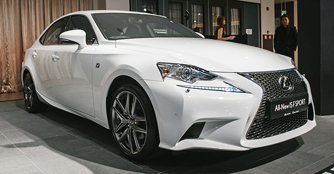
    Mr Furuyama's team had to create a complete package - aggressive styling with emotional appeal, complete with driving enjoyment

    SGCM: On that point, Lexus stressed that one of the new IS' priorities is to boast better driving fun. How did Lexus strive a compromise between this aspect and the weight issue of a hybrid drivetrain, which will hamper the driving dynamics?

    JF: During the initial planning and engineering process of the new IS, we considered a number of different types of hybrids. CO2 emission was one of the key factor in the decision, as it needs to better that of a diesel.

    That puts us in a dilemma, as in order to achieve lower emissions and better fuel consumption, the engine revs need to be kept at an optimum 2,000rpm range. This will definitely dull the driving experience, as drivers will link how rev-happy the engine is to driving fun.

    As a result, we decided to stop putting our focus solely on fuel economy. We have also derived new systems in the IS, such as the Active Sound Control (ASC), which amplifies the engine sound for a more exhilarative driving experience.

    For us, it is not all about how powerful the car is, but how the speed is achieved. Hence, we emphasised on the process of acceleration, as well as maintaining the refinement and luxury - which a diesel will not be able to match up to.

    SGCM: Does the new IS hybrid inherit any components from the GS, RX or LS hybrid models?

    JF: The latest IS hybrid has a new engine and transmission, and is different from the GS, RX or LS models.

    SGCM: On that point, what is the biggest challenge in the engineering of the new IS?

    JF: One of the biggest challenge was to achieve CO2 emission of less than 100g/km. At the same time, we need to construct a car that is fun to drive, hence the extensive testing on tracks around the world. That said, we cannot forgo the practicality of the sedan. Utility is also one key aspect we needed to focus on. For instance, the IS hybrid's battery pack is designed to fit under the boot floor for maximum boot space.

    Nicholas Low
    Text by Nicholas Low
    Writing may be my thing, but cars, well, that's just pure passion that I simply cannot get rid off.
    Photos by Low Fai Ming
    24.4k

    Tags

    interview chief engineer lexus is sedan sedan compact sports is250 hybrid borneo motors singapore

    AllReviewsNewsAdviceFeaturesVideos
    • Home
    • Car Articles
    • features
    • features Listings
    • Features

    Story behind the new Lexus IS

    08 Jul 2013

    |

    7,786 views

    We get up close with the Chief Engineer of the new Lexus IS, Junichi Furuyama, to understand what makes the car define its segment.


    At the helm of the new IS range's development is Mr. Junichi Furuyama (JF), Chief Engineer at Lexus International, Toyota Motor Corporation. Having joined the company since 1979, Mr. Furuyama has acquired a depth of experience in developing various models, ranging from pickup trucks and SUVs to minivans and compact cars.

    Mr. Furuyama thinks that hybrid drivetrains have more potential for development than diesels
    In the development of the new IS, one of the key elements is driving dynamics. Mr. Furuyama's motivation for making the IS 'fun to drive' stems from his passion for sports cars. We get up close with the Chief Engineer to find out what goes into the new IS.

    SGCM: What was the greatest change, in terms of engineering, in the new IS?

    JF: The IS was conceived to be a sporty compact sedan. This concept has not changed since its inception. The new IS is still the most sporty model in Lexus' lineup, and is designed to possess a young appeal.

    The latest generation showcases what Lexus aims to be as a carmaker, and highlights one of its priority, which is an emotional appeal. The new styling is now more aggressive, coupled with the 'fun to drive' element, and is aimed to be combined with Lexus' renowned refinement and luxury traits to outdo the competition.

    SGCM: What was the main reason behind adding a hybrid variant to the IS range?

    JF: Hybrid has been the leading technology for the firm, and we aim to incorporate it into the entire lineup. The previous IS model had a diesel variant, but suffered due to the strong competition in Europe. We foresee that CO2 emission regulations will become more stringent, and since we believe that hybrid technology has more potential than diesel, we decided to compete on the front of hybrid.

    Mr Furuyama's team had to create a complete package - aggressive styling with emotional appeal, complete with driving enjoyment

    SGCM: On that point, Lexus stressed that one of the new IS' priorities is to boast better driving fun. How did Lexus strive a compromise between this aspect and the weight issue of a hybrid drivetrain, which will hamper the driving dynamics?

    JF: During the initial planning and engineering process of the new IS, we considered a number of different types of hybrids. CO2 emission was one of the key factor in the decision, as it needs to better that of a diesel.

    That puts us in a dilemma, as in order to achieve lower emissions and better fuel consumption, the engine revs need to be kept at an optimum 2,000rpm range. This will definitely dull the driving experience, as drivers will link how rev-happy the engine is to driving fun.

    As a result, we decided to stop putting our focus solely on fuel economy. We have also derived new systems in the IS, such as the Active Sound Control (ASC), which amplifies the engine sound for a more exhilarative driving experience.

    For us, it is not all about how powerful the car is, but how the speed is achieved. Hence, we emphasised on the process of acceleration, as well as maintaining the refinement and luxury - which a diesel will not be able to match up to.

    SGCM: Does the new IS hybrid inherit any components from the GS, RX or LS hybrid models?

    JF: The latest IS hybrid has a new engine and transmission, and is different from the GS, RX or LS models.

    SGCM: On that point, what is the biggest challenge in the engineering of the new IS?

    JF: One of the biggest challenge was to achieve CO2 emission of less than 100g/km. At the same time, we need to construct a car that is fun to drive, hence the extensive testing on tracks around the world. That said, we cannot forgo the practicality of the sedan. Utility is also one key aspect we needed to focus on. For instance, the IS hybrid's battery pack is designed to fit under the boot floor for maximum boot space.

    Nicholas Low
    Text by Nicholas Low
    Writing may be my thing, but cars, well, that's just pure passion that I simply cannot get rid off.
    Photos by Low Fai Ming
    24.4k

    Tags

    interview chief engineer lexus is sedan sedan compact sports is250 hybrid borneo motors singapore

    Newsletter

    Be Notified On The Latest News

    Newsletter

    Be Notified On The Latest News

    Related Articles

    BMW iX3 Review

    BMW iX3 Review

    Us against the world: Which is the best off-roader?

    Us against the world: Which is the best off-roader?

    New cars are safer: Opt for one when you can

    New cars are safer: Opt for one when you can

    Toyota RAV4 Hybrid vs Subaru Forester e-Boxer

    Toyota RAV4 Hybrid vs Subaru Forester e-Boxer

    Is parallel import hesitancy growing among car buyers?

    Is parallel import hesitancy growing among car buyers?

    BYD Seal 6 Premium Review

    BYD Seal 6 Premium Review

    Should I buy a car in July / August / September 2026?

    Should I buy a car in July / August / September 2026?

    Sgcarmart Explores: Bras Basah!

    Sgcarmart Explores: Bras Basah!

    Related Articles

    BMW iX3 Review

    BMW iX3 Review

    Us against the world: Which is the best off-roader?

    Us against the world: Which is the best off-roader?

    New cars are safer: Opt for one when you can

    New cars are safer: Opt for one when you can

    Toyota RAV4 Hybrid vs Subaru Forester e-Boxer

    Toyota RAV4 Hybrid vs Subaru Forester e-Boxer

    Is parallel import hesitancy growing among car buyers?

    Is parallel import hesitancy growing among car buyers?

    BYD Seal 6 Premium Review

    BYD Seal 6 Premium Review

    Should I buy a car in July / August / September 2026?

    Should I buy a car in July / August / September 2026?

    Sgcarmart Explores: Bras Basah!

    Sgcarmart Explores: Bras Basah!

    You May Also Like

    We try out roadside parking with the new OBU!

    We try out roadside parking with the new OBU!

    New cars are safer: Opt for one when you can

    New cars are safer: Opt for one when you can

    EV NEXT: Peace of mind with battery SOH certification

    EV NEXT: Peace of mind with battery SOH certification

    Mazda 6e Fastback GT Electric review

    Mazda 6e Fastback GT Electric review

    Is parallel import hesitancy growing among car buyers?

    Is parallel import hesitancy growing among car buyers?

    Sgcarmart Explores: Bras Basah!

    Sgcarmart Explores: Bras Basah!

    Opinion: Is it time for a change to our road traffic laws?

    Opinion: Is it time for a change to our road traffic laws?

    Big Test: Which brand makes the best hybrid?

    Big Test: Which brand makes the best hybrid?

    Toyota RAV4 Hybrid vs Subaru Forester e-Boxer

    Toyota RAV4 Hybrid vs Subaru Forester e-Boxer

    Hongqi Singapore opens its showroom doors

    Hongqi Singapore opens its showroom doors

    The BYD Sealion 8 seven-seater SUV arrives in Singapore

    The BYD Sealion 8 seven-seater SUV arrives in Singapore

    A first look at Chery's iCaur V23 and Jaecoo J8 in Singapore

    A first look at Chery's iCaur V23 and Jaecoo J8 in Singapore

    Tesla launches Model Y L in Singapore, first six-seater here

    Tesla launches Model Y L in Singapore, first six-seater here

    Motoring Icons: JDM legends - Honda NSX

    Motoring Icons: JDM legends - Honda NSX

    7 things we learnt about the Zeekr 7GT

    7 things we learnt about the Zeekr 7GT

    Mercedes-Benz GLC debuts alongside Studio opening

    Mercedes-Benz GLC debuts alongside Studio opening

    You May Also Like

    We try out roadside parking with the new OBU!

    We try out roadside parking with the new OBU!

    New cars are safer: Opt for one when you can

    New cars are safer: Opt for one when you can

    EV NEXT: Peace of mind with battery SOH certification

    EV NEXT: Peace of mind with battery SOH certification

    Mazda 6e Fastback GT Electric review

    Mazda 6e Fastback GT Electric review

    Is parallel import hesitancy growing among car buyers?

    Is parallel import hesitancy growing among car buyers?

    Sgcarmart Explores: Bras Basah!

    Sgcarmart Explores: Bras Basah!

    Opinion: Is it time for a change to our road traffic laws?

    Opinion: Is it time for a change to our road traffic laws?

    Big Test: Which brand makes the best hybrid?

    Big Test: Which brand makes the best hybrid?

    Toyota RAV4 Hybrid vs Subaru Forester e-Boxer

    Toyota RAV4 Hybrid vs Subaru Forester e-Boxer

    Hongqi Singapore opens its showroom doors

    Hongqi Singapore opens its showroom doors

    The BYD Sealion 8 seven-seater SUV arrives in Singapore

    The BYD Sealion 8 seven-seater SUV arrives in Singapore

    A first look at Chery's iCaur V23 and Jaecoo J8 in Singapore

    A first look at Chery's iCaur V23 and Jaecoo J8 in Singapore

    Tesla launches Model Y L in Singapore, first six-seater here

    Tesla launches Model Y L in Singapore, first six-seater here

    Motoring Icons: JDM legends - Honda NSX

    Motoring Icons: JDM legends - Honda NSX

    7 things we learnt about the Zeekr 7GT

    7 things we learnt about the Zeekr 7GT

    Mercedes-Benz GLC debuts alongside Studio opening

    Mercedes-Benz GLC debuts alongside Studio opening