Singapore's car COE system could be in for a shake-up.
The Land Transport Authority (LTA) has launched a public consultation on a proposal that would merge Category A and Category B COE into a single passenger car category. To continue distinguishing between mainstream and higher-value cars, it is also studying a rebate-and-surcharge system tied to a vehicle's Open Market Value (OMV).
For years, most motorists have understood Cat A and Cat B as a rough dividing line between mainstream and higher-end cars. Cat A was generally associated with smaller and more affordable models, while Cat B was where larger, more powerful and often more expensive cars tended to land. But that distinction has become harder to draw in recent years.
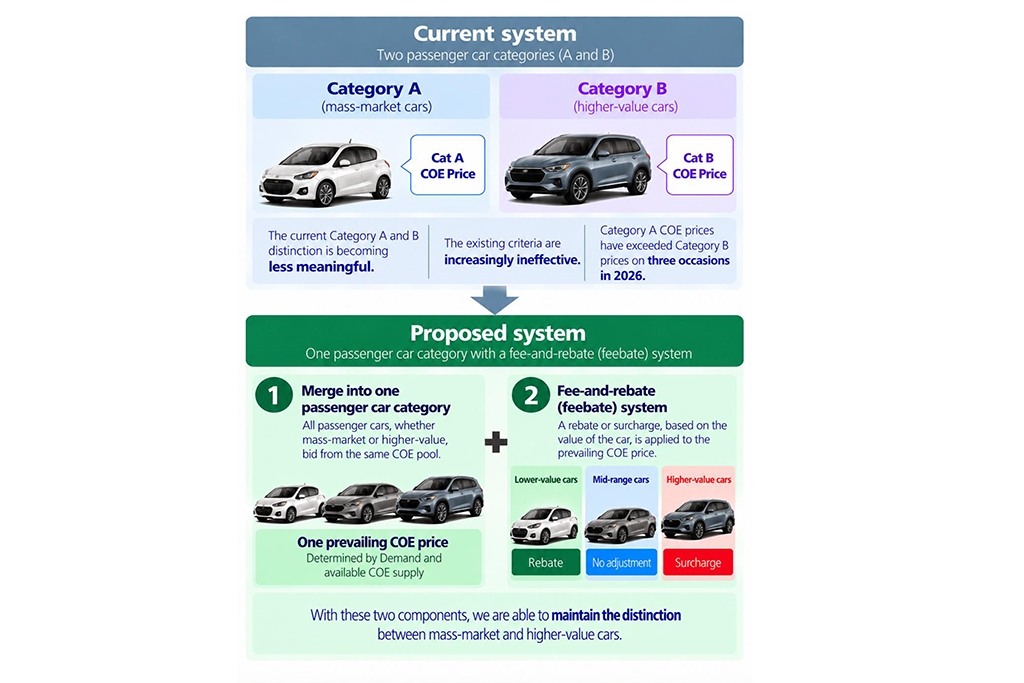
According to LTA, advances in vehicle technology, particularly the rise of electric vehicles, have made the existing criteria less effective. Cars with very different price tags and market positioning can now end up competing in the same category, blurring the line between what is considered a mainstream car and what is not.
The shift is reflected in COE bidding results as well. Between February and June 2026, Category A premiums ended up higher than Category B premiums on three occasions, something that would once have seemed unusual.
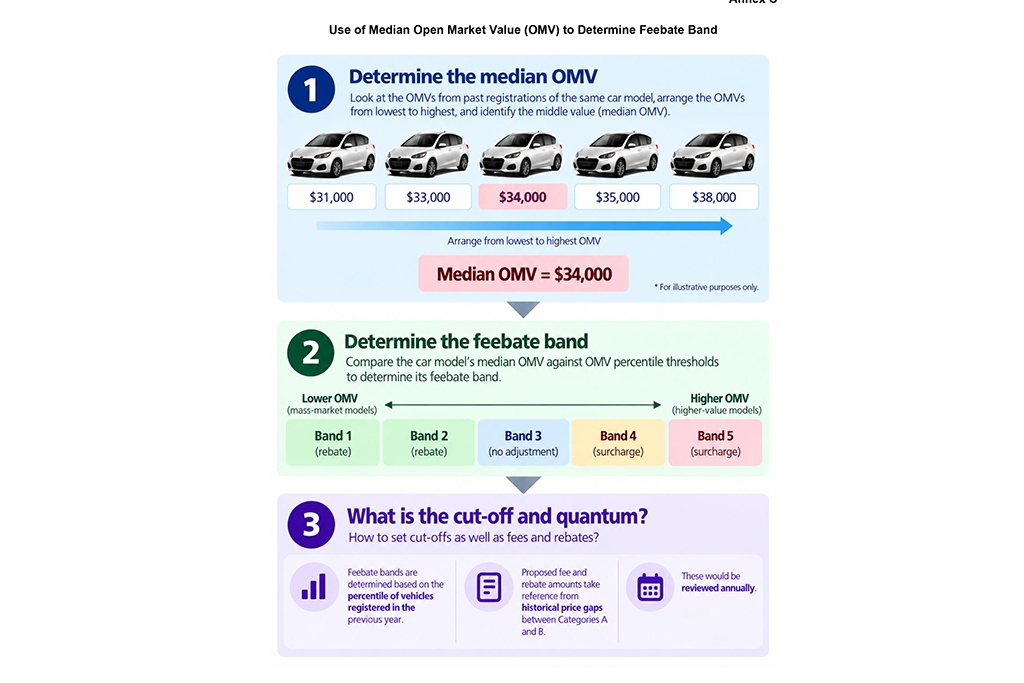
Under the proposal, all passenger cars would bid from the same COE pool. A separate "feebate" system would then apply rebates or surcharges based on OMV, with adjustments of up to $15,000 being studied under different banding structures. The consultation also looks at related issues, including whether the feebate system should apply to COE renewals and what happens to Category E if Categories A and B are eventually combined.
More than anything, the review raises an interesting question: If engine capacity and power output are no longer the best way to separate mainstream cars from higher-end models, what should take their place?
Motorists who have a view on the matter can submit their feedback through LTA's consultation portal via this link. The consultation runs until Nov 2, with LTA expected to share its findings and recommendations in the first half of 2027.