This technology, which manages the inlet valve timing in a gasoline engine in a very innovative way, is used by Audi for its direct-injection 2.8 and 3.2-liter V6-FSI engines in the A4, A5, A6 and A8.
Intelligence is all in the head, one might say - the cylinder head in the case of a car's engine. The aim is to open and close the valves in such a way that the correct charge of air is always drawn into the cylinders. The first breakthrough came years ago with the rotation of the camshaft by means of adjusters - permitting the valve opening and closing times to be varied. The Audi valvelift system now achieves the next step - variable control of the valve lift, thus influencing the cross-section of the intake duct.
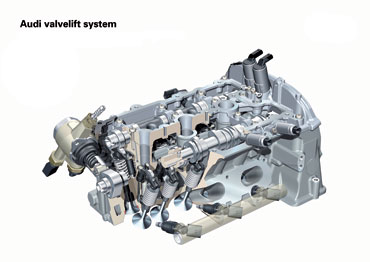
How it works: The two inlet camshafts are equipped with teeth. On each of them sit three cam elements - cylindrical sleeves, on the outside of which there are spiral grooves. There are six metal pins integrated into the ladder frames of each of the two cylinder heads, which extend by four millimeters, powered by lightning-fast electromagnetic actuators. Two of them are responsible for each cam element.
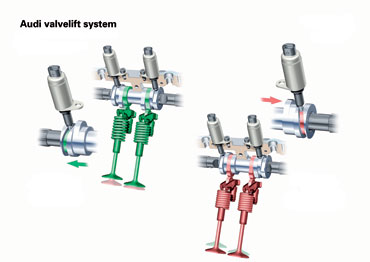
The top illustration on page 2 of this newsletter shows the right-hand pin in action. It engages in the groove of the rotating cam element and so pushes it by seven millimeters to the right on the shaft. It is locked in the end position by means of a spring-loaded pin. The metal pin, now idle, is pushed back mechanically.
Each cam element carries two adjacent profiles for small and large valve lifts. When pushed to the right the cam element is in the full load position, where the voluminous full-load profiles (shown in red in the drawing) operate the especially narrow roller cam followers. They open the two inlet valves with a lift of 11.0 mm - ideal for high charge volumes and flow speeds in the combustion chamber.
Under partial load the cam element is pushed to the left by the left-hand pin; now the small cam profiles (green) come into play. They open the valves with a small and variable lift, either only 2.0 mm or 5.7 mm. This asymmetric opening leads the to the charge air rotating both spirally and cylindrically as it flows into the combustion chamber. This "drumble", which is assisted by edges and bumps in the combustion chamber and a specially shaped piston, renders superfluous the charge motion flaps which are otherwise necessary in the intake duct of FSI engines.
The changeover between the valve lift settings takes place in the range between 700 and 4,000 rpm; it is completed within two revolutions of the crankshaft. A collection of short-term interventions - a switch to retarded ignition, the adjustment of all four camshafts and the closing of the throttle - prevent torque surges. What the driver will notice are the engine's smooth power build-up and spontaneous throttle response.
The most important effect, however, is that fuel consumption drops by up to seven percent. AVS technology achieves its greatest potential fuel savings at a constant speed in the mid-load range. In sixth gear, the engine of the Audi A6 2.8 FSI propels the car at up to 150 km/h (93.21 mph) using the small valve lift setting.
The Audi valvelift system enables the volume of air drawn in to be controlled to a large extent by the opening of the inlet valves. The throttle butterfly can remain fully open even under partial load and the undesirable choke losses are considerably reduced. A technical pipe dream becomes reality - in a new, intelligent way. Current solutions operate with additional elements such as levers or cups between the camshafts and the valves. This has various disadvantages: the increased mass of the moving parts, greater friction and reduced valve gear rigidity.
None of these problems are associated with the two-stage Audi valvelift system. Its uncomplicated design means that it can cope with engine speeds of up to 7,000 rpm, so it can deliver high peak performance. Its compact proportions also simplify the packaging of the engines in the vehicle and permit efficient production using the modular system. The components are made in the engines plant at Györ in Hungary, where a large proportion of the V6 engines also come off the production line. In AVS technology, which is the result of six years of development work, Audi sees a solution with great potential for the future. In theory it will be possible to implement further development stages, up to and including the complete shutdown of individual cylinders.
The FSI engines with AVS sport a few other special features. A new type of sensor technology feeds data to their management systems. It gets its information from the position of the adjustable inlet camshafts and no longer from the pressure in the inlet manifold as before, which is in fact constant when operating with the throttle wide open. In the case of the 2.8-liter V6, a variable intake manifold enhances the effect of the AVS system. It increases torque at low revs and power output at high revs.
Audi Technology ABC
• Choke losses
are unavoidable on a conventional four-stroke gasoline engine, because the engine load is regulated by means of the intake air volume. The engine encounters resistance from the throttle butterfly in the intake choke when drawing in air, since the throttle is only slightly open under partial load, and this choke effect reduces efficiency. The throttle butterfly is still retained with the Audi valvelift system but it now plays only a minor role. The engine actually runs with the throttle wide open in various part-load ranges.
• The Audi valvelift system
is currently employed at Audi on two V6 engines - the 3.2 FSI and the 2.8 FSI. With the 2.8-liter V6, delivering 154 kW (210 hp), the luxury saloon Audi A8 consumes just 8.3 liters of fuel per 100 km (28.34 USmpg). The associated carbon dioxide emissions amount to just 199 grams per kilometer (320.26 g/mile) - the lowest figure in the entire luxury saloon segment.
Intelligence is all in the head, one might say - the cylinder head in the case of a car's engine. The aim is to open and close the valves in such a way that the correct charge of air is always drawn into the cylinders. The first breakthrough came years ago with the rotation of the camshaft by means of adjusters - permitting the valve opening and closing times to be varied. The Audi valvelift system now achieves the next step - variable control of the valve lift, thus influencing the cross-section of the intake duct.
How it works: The two inlet camshafts are equipped with teeth. On each of them sit three cam elements - cylindrical sleeves, on the outside of which there are spiral grooves. There are six metal pins integrated into the ladder frames of each of the two cylinder heads, which extend by four millimeters, powered by lightning-fast electromagnetic actuators. Two of them are responsible for each cam element.
The top illustration on page 2 of this newsletter shows the right-hand pin in action. It engages in the groove of the rotating cam element and so pushes it by seven millimeters to the right on the shaft. It is locked in the end position by means of a spring-loaded pin. The metal pin, now idle, is pushed back mechanically.
Each cam element carries two adjacent profiles for small and large valve lifts. When pushed to the right the cam element is in the full load position, where the voluminous full-load profiles (shown in red in the drawing) operate the especially narrow roller cam followers. They open the two inlet valves with a lift of 11.0 mm - ideal for high charge volumes and flow speeds in the combustion chamber.
Under partial load the cam element is pushed to the left by the left-hand pin; now the small cam profiles (green) come into play. They open the valves with a small and variable lift, either only 2.0 mm or 5.7 mm. This asymmetric opening leads the to the charge air rotating both spirally and cylindrically as it flows into the combustion chamber. This "drumble", which is assisted by edges and bumps in the combustion chamber and a specially shaped piston, renders superfluous the charge motion flaps which are otherwise necessary in the intake duct of FSI engines.
The changeover between the valve lift settings takes place in the range between 700 and 4,000 rpm; it is completed within two revolutions of the crankshaft. A collection of short-term interventions - a switch to retarded ignition, the adjustment of all four camshafts and the closing of the throttle - prevent torque surges. What the driver will notice are the engine's smooth power build-up and spontaneous throttle response.
The most important effect, however, is that fuel consumption drops by up to seven percent. AVS technology achieves its greatest potential fuel savings at a constant speed in the mid-load range. In sixth gear, the engine of the Audi A6 2.8 FSI propels the car at up to 150 km/h (93.21 mph) using the small valve lift setting.
The Audi valvelift system enables the volume of air drawn in to be controlled to a large extent by the opening of the inlet valves. The throttle butterfly can remain fully open even under partial load and the undesirable choke losses are considerably reduced. A technical pipe dream becomes reality - in a new, intelligent way. Current solutions operate with additional elements such as levers or cups between the camshafts and the valves. This has various disadvantages: the increased mass of the moving parts, greater friction and reduced valve gear rigidity.
None of these problems are associated with the two-stage Audi valvelift system. Its uncomplicated design means that it can cope with engine speeds of up to 7,000 rpm, so it can deliver high peak performance. Its compact proportions also simplify the packaging of the engines in the vehicle and permit efficient production using the modular system. The components are made in the engines plant at Györ in Hungary, where a large proportion of the V6 engines also come off the production line. In AVS technology, which is the result of six years of development work, Audi sees a solution with great potential for the future. In theory it will be possible to implement further development stages, up to and including the complete shutdown of individual cylinders.
The FSI engines with AVS sport a few other special features. A new type of sensor technology feeds data to their management systems. It gets its information from the position of the adjustable inlet camshafts and no longer from the pressure in the inlet manifold as before, which is in fact constant when operating with the throttle wide open. In the case of the 2.8-liter V6, a variable intake manifold enhances the effect of the AVS system. It increases torque at low revs and power output at high revs.
 |  |
Audi Technology ABC
• Choke losses
are unavoidable on a conventional four-stroke gasoline engine, because the engine load is regulated by means of the intake air volume. The engine encounters resistance from the throttle butterfly in the intake choke when drawing in air, since the throttle is only slightly open under partial load, and this choke effect reduces efficiency. The throttle butterfly is still retained with the Audi valvelift system but it now plays only a minor role. The engine actually runs with the throttle wide open in various part-load ranges.
• The Audi valvelift system
is currently employed at Audi on two V6 engines - the 3.2 FSI and the 2.8 FSI. With the 2.8-liter V6, delivering 154 kW (210 hp), the luxury saloon Audi A8 consumes just 8.3 liters of fuel per 100 km (28.34 USmpg). The associated carbon dioxide emissions amount to just 199 grams per kilometer (320.26 g/mile) - the lowest figure in the entire luxury saloon segment.