The new Skoda Fabia has been able to make use of a range of ingenious technology to ensure its testing programme remains on track - in some cases, quite literally. Thanks to a seemingly ordinary-looking trailer called a 'towing dyno', engineers are able to recreate a driving experience as intense as ascending the Grossglockner peak in the Alps without ever leaving the flat terrain of the test facility.
With a built-in dynamometer producing up to 198bhp of power, the trailer can change the resistance felt by the car in line with settings entered by technicians. By braking its wheels, the trailer can generate up to 9kN of force. "In this way we can simulate various driving conditions, including the profiles of real hills or driving with trailers of various weights," explains Pavel Kolajta, who oversees functional testing of the new Fabia.
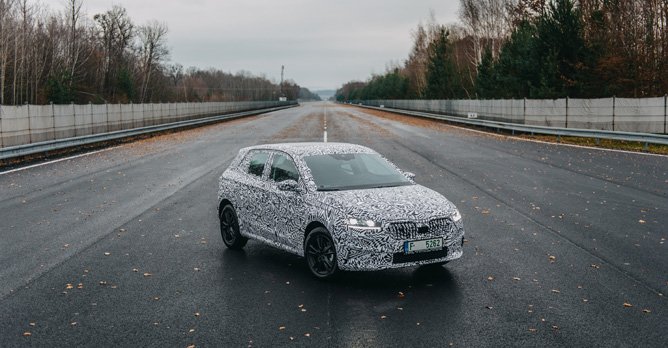

While such tests have remained largely the same for decades, there have been major shifts in the evaluation of other areas of the car's design, particularly those which have become more complex in recent years. Assistance systems, safety devices and the car's electronic equipment must all be rigorously examined to ensure they function as intended.
'Stress testing' of the car's safety is one of the most stringently tested criteria. The car and its various parts are subjected to a series of impact and crash tests. Right from the start, computer simulations are used to design the surface panels of the body, like the bumper cover and bonnet, which are then tested using dummies or 'impactors'. The goal is to ensure the car is pliant in a collision.
Like safety, aerodynamics is an area that has experienced a leap forward in recent years. The new Fabia is the most aerodynamically efficient car in its segment thanks to the hard work during development and testing. Such excellent aerodynamics help cut fuel consumption and reduce CO2 emissions.
Painstaking optimisation of the car body is just one of a series of new technical solutions. Another example is found in the 'cooling shutters 'which prevent air from entering the engine bay, thereby improving airflow around the car. 'Air curtains', meanwhile, are used extensively on the chassis. These are vents in the front bumper which improve airflow around the front wheels.