View page in desktop
|
Report error
  •   Apple app store icon
  • Google play store icon
Terms of Service
|
Privacy Policy
|
PDPA
|
Site Map
©2004-2026 Sgcarmart, Singapore. All rights reserved.
  • Home
  • Car Articles
  • news
  • news Listings
  • BMW News
  • BMW's Munich plant builds on use of AI and data

    02 Mar 2020

    |

    1,094 views

    The BMW Group Plant in Munich is making increasing use of applications with artificial intelligence for more efficient vehicle production.


    BMW's Munich plant is making increasing use of applications with Artificial Intelligence (AI), opening up new opportunities for more efficient vehicle production.
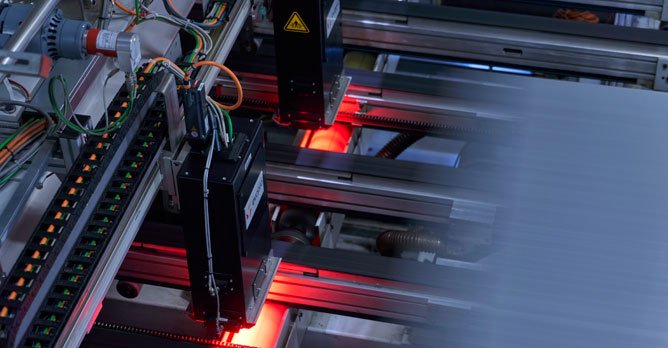
    An iQ Press system records material parameters of each blank at the press shop, eliminating the need for each body part to be checked in detail
    The options for using AI and smart data analytics are currently being tested in various areas of the BMW Group Plant in Munich. In some areas, the technologies are already in use in serial production, such as the press shop and function validation.

    The press shop at the BMW Group's home plant in Munich turns more than 30,000 blanks a day into vehicle body parts. Since 2019 each blank has been given a laser code at the start of production so the body part can be clearly identified throughout.

    This code is picked up by an iQ Press system, which records material and process parameters such as the thickness of the metal and oil layer, the temperature and speed of the presses. The parameters are then related to the quality of the parts produced.

    Uploaded to the cloud in real time, the data is immediately available in its entirety for the production team to gain a clearer picture of the manufacturing process. iQ Press data is an important tool as it eliminates the need for each body part to be checked in minute detail, such as in quality control, and picks out only irregularities that require action.
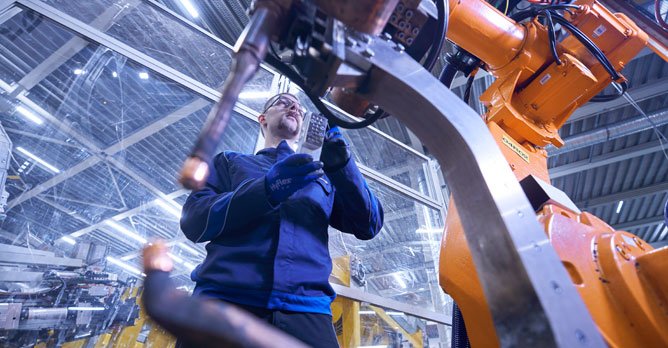
    Evaluation of data from sensors attached to welding tongs allows for better planning of replacements at the body shop, reducing maintenance costs and time
    Meanwhile, at the body shop, maintenance specialists at the Munich plant have been fitting sensors to all the welding tongs to measure friction levels three times per shift and report any abnormalities.

    Until now, the condition of tongs to be monitored by eye by a member of the production team.

    With body shop robots carrying a combined total of over 600 welding tongs, unexpected replacement of the tongs would cost significant time and money.

    The data produced by the new sensors however, is now constantly evaluated by software, allowing potential machine failures to be predicted. Martin Hilt, Innovation and Digitalisation Officer at Plant Munich, explains, "Because we have the sensors and collect their data in a cloud, we can now monitor round-the-clock whether any maintenance work is needed. So, we can plan any replacements better and potentially schedule them for a production break."

    Elsewhere, a special robot has been developed to validate the integration of Comfort Access on BMW’s vehicles.
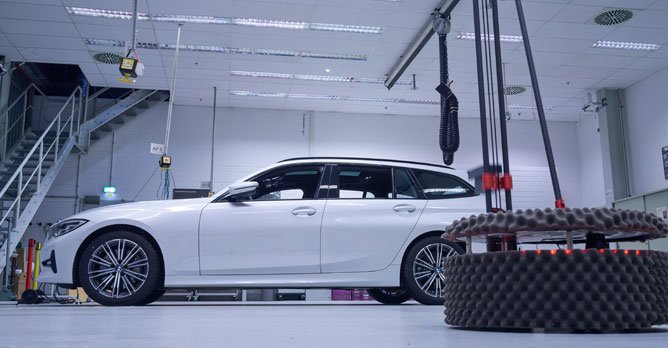
    A special robot has been developed to test BMW's Comfort Access feature, saving development time
    Vehicles with Comfort Access use three exterior antennas to generate a three-dimensional electromagnetic field around the car. When the driver enters the field, the system recognises the car key. At about 3m from the car, it switches the welcome light of the car on to illuminate the area outside the driver's door. At about 1.5m, the doors unlock - and relock automatically if the driver walks away.

    Until now, this special feature has been validated manually, with parameterisation in development alone taking two days per vehicle.

    The Comfort Access zones and the influence of production processes on them had to be checked manually in the plant, before production begins, taking into account the various country-specific requirements and equipment features. It was a lengthy process that was not always entirely accurate, given the multitude of different factors.

    To solve the problem, the BMW Group and the University of Applied Sciences in Dresden have developed a measurement robot that autonomously circles the vehicle several times in a pre-defined pattern to determine the strength of the magnetic field at various required points. Attached to the robot is a box containing the car key.
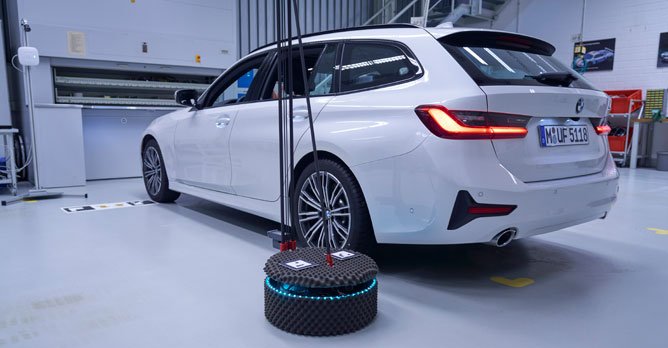
    The robot can detect the locking or unlocking of the car's doors, and measures its distance from the vehicle where it is portrayed as a graphic
    The box can be set at different heights to reflect the different ways a driver might carry it. As soon as the robot detects the vehicle electronics locking or unlocking the doors, its inbuilt scanner measures the distance between the key and the vehicle, and surveys the vehicle's surroundings.

    The data that is generates goes straight to a central computer, where it is portrayed as a graphic.

    The advantages of the system are obvious, "This robot is not only much faster, it's also more precise. The results we obtain are highly detailed and, most importantly, objective. So we can even start validating the function before the car has its first test-drive," explains Martin Hilt.

    24.4k

    Tags

    bmw munich vehicle production artificial intelligence ai data bmw group

    AllReviewsNewsAdviceFeaturesVideos
    • Home
    • Car Articles
    • news
    • news Listings
    • BMW News

    BMW's Munich plant builds on use of AI and data

    02 Mar 2020

    |

    1,094 views

    The BMW Group Plant in Munich is making increasing use of applications with artificial intelligence for more efficient vehicle production.


    BMW's Munich plant is making increasing use of applications with Artificial Intelligence (AI), opening up new opportunities for more efficient vehicle production.

    An iQ Press system records material parameters of each blank at the press shop, eliminating the need for each body part to be checked in detail
    The options for using AI and smart data analytics are currently being tested in various areas of the BMW Group Plant in Munich. In some areas, the technologies are already in use in serial production, such as the press shop and function validation.

    The press shop at the BMW Group's home plant in Munich turns more than 30,000 blanks a day into vehicle body parts. Since 2019 each blank has been given a laser code at the start of production so the body part can be clearly identified throughout.

    This code is picked up by an iQ Press system, which records material and process parameters such as the thickness of the metal and oil layer, the temperature and speed of the presses. The parameters are then related to the quality of the parts produced.

    Uploaded to the cloud in real time, the data is immediately available in its entirety for the production team to gain a clearer picture of the manufacturing process. iQ Press data is an important tool as it eliminates the need for each body part to be checked in minute detail, such as in quality control, and picks out only irregularities that require action.

    Evaluation of data from sensors attached to welding tongs allows for better planning of replacements at the body shop, reducing maintenance costs and time
    Meanwhile, at the body shop, maintenance specialists at the Munich plant have been fitting sensors to all the welding tongs to measure friction levels three times per shift and report any abnormalities.

    Until now, the condition of tongs to be monitored by eye by a member of the production team.

    With body shop robots carrying a combined total of over 600 welding tongs, unexpected replacement of the tongs would cost significant time and money.

    The data produced by the new sensors however, is now constantly evaluated by software, allowing potential machine failures to be predicted. Martin Hilt, Innovation and Digitalisation Officer at Plant Munich, explains, "Because we have the sensors and collect their data in a cloud, we can now monitor round-the-clock whether any maintenance work is needed. So, we can plan any replacements better and potentially schedule them for a production break."

    Elsewhere, a special robot has been developed to validate the integration of Comfort Access on BMW’s vehicles.

    A special robot has been developed to test BMW's Comfort Access feature, saving development time
    Vehicles with Comfort Access use three exterior antennas to generate a three-dimensional electromagnetic field around the car. When the driver enters the field, the system recognises the car key. At about 3m from the car, it switches the welcome light of the car on to illuminate the area outside the driver's door. At about 1.5m, the doors unlock - and relock automatically if the driver walks away.

    Until now, this special feature has been validated manually, with parameterisation in development alone taking two days per vehicle.

    The Comfort Access zones and the influence of production processes on them had to be checked manually in the plant, before production begins, taking into account the various country-specific requirements and equipment features. It was a lengthy process that was not always entirely accurate, given the multitude of different factors.

    To solve the problem, the BMW Group and the University of Applied Sciences in Dresden have developed a measurement robot that autonomously circles the vehicle several times in a pre-defined pattern to determine the strength of the magnetic field at various required points. Attached to the robot is a box containing the car key.

    The robot can detect the locking or unlocking of the car's doors, and measures its distance from the vehicle where it is portrayed as a graphic
    The box can be set at different heights to reflect the different ways a driver might carry it. As soon as the robot detects the vehicle electronics locking or unlocking the doors, its inbuilt scanner measures the distance between the key and the vehicle, and surveys the vehicle's surroundings.

    The data that is generates goes straight to a central computer, where it is portrayed as a graphic.

    The advantages of the system are obvious, "This robot is not only much faster, it's also more precise. The results we obtain are highly detailed and, most importantly, objective. So we can even start validating the function before the car has its first test-drive," explains Martin Hilt.
    24.4k

    Tags

    bmw munich vehicle production artificial intelligence ai data bmw group

    Newsletter

    Be Notified On The Latest News

    Newsletter

    Be Notified On The Latest News

    Latest COE Prices

    September 2026 | 1st BIDDING
    NEXT TENDER: 23 Sep 2026
    CAT A
    $133,009
    CAT B
    $135,001
    CAT C
    $93,101
    CAT E
    $137,890
    View Full Results

    Latest COE Prices

    September 2026 | 1st BIDDING
    NEXT TENDER: 23 Sep 2026
    CAT A
    $133,009
    CAT B
    $135,001
    CAT C
    $93,101
    CAT E
    $137,890
    View Full Results

    Related Articles

    Sgcarmart Explores: Bras Basah!

    Sgcarmart Explores: Bras Basah!

    Toyota RAV4 Hybrid vs Subaru Forester e-Boxer

    Toyota RAV4 Hybrid vs Subaru Forester e-Boxer

    New cars are safer: Opt for one when you can

    New cars are safer: Opt for one when you can

    Maxus MIFA 7 Elite: Going big for the little moments

    Maxus MIFA 7 Elite: Going big for the little moments

    Tesla launches Model Y L in Singapore, first six-seater here

    Tesla launches Model Y L in Singapore, first six-seater here

    The BYD Sealion 8 seven-seater SUV arrives in Singapore

    The BYD Sealion 8 seven-seater SUV arrives in Singapore

    Tesla Model Y L Premium AWD 88kWh Review

    Tesla Model Y L Premium AWD 88kWh Review

    Proton e.MAS 7 Premium 100kW Review

    Proton e.MAS 7 Premium 100kW Review

    Related Articles

    Sgcarmart Explores: Bras Basah!

    Sgcarmart Explores: Bras Basah!

    Toyota RAV4 Hybrid vs Subaru Forester e-Boxer

    Toyota RAV4 Hybrid vs Subaru Forester e-Boxer

    New cars are safer: Opt for one when you can

    New cars are safer: Opt for one when you can

    Maxus MIFA 7 Elite: Going big for the little moments

    Maxus MIFA 7 Elite: Going big for the little moments

    Tesla launches Model Y L in Singapore, first six-seater here

    Tesla launches Model Y L in Singapore, first six-seater here

    The BYD Sealion 8 seven-seater SUV arrives in Singapore

    The BYD Sealion 8 seven-seater SUV arrives in Singapore

    Tesla Model Y L Premium AWD 88kWh Review

    Tesla Model Y L Premium AWD 88kWh Review

    Proton e.MAS 7 Premium 100kW Review

    Proton e.MAS 7 Premium 100kW Review

    You May Also Like

    We try out roadside parking with the new OBU!

    We try out roadside parking with the new OBU!

    New cars are safer: Opt for one when you can

    New cars are safer: Opt for one when you can

    EV NEXT: Peace of mind with battery SOH certification

    EV NEXT: Peace of mind with battery SOH certification

    Mazda 6e Fastback GT Electric review

    Mazda 6e Fastback GT Electric review

    Is parallel import hesitancy growing among car buyers?

    Is parallel import hesitancy growing among car buyers?

    Sgcarmart Explores: Bras Basah!

    Sgcarmart Explores: Bras Basah!

    Opinion: Is it time for a change to our road traffic laws?

    Opinion: Is it time for a change to our road traffic laws?

    Hongqi Singapore opens its showroom doors

    Hongqi Singapore opens its showroom doors

    Toyota RAV4 Hybrid vs Subaru Forester e-Boxer

    Toyota RAV4 Hybrid vs Subaru Forester e-Boxer

    The BYD Sealion 8 seven-seater SUV arrives in Singapore

    The BYD Sealion 8 seven-seater SUV arrives in Singapore

    A first look at Chery's iCaur V23 and Jaecoo J8 in Singapore

    A first look at Chery's iCaur V23 and Jaecoo J8 in Singapore

    Big Test: Which brand makes the best hybrid?

    Big Test: Which brand makes the best hybrid?

    Tesla launches Model Y L in Singapore, first six-seater here

    Tesla launches Model Y L in Singapore, first six-seater here

    Motoring Icons: JDM legends - Honda NSX

    Motoring Icons: JDM legends - Honda NSX

    7 things we learnt about the Zeekr 7GT

    7 things we learnt about the Zeekr 7GT

    Mercedes-Benz GLC debuts alongside Studio opening

    Mercedes-Benz GLC debuts alongside Studio opening

    You May Also Like

    We try out roadside parking with the new OBU!

    We try out roadside parking with the new OBU!

    New cars are safer: Opt for one when you can

    New cars are safer: Opt for one when you can

    EV NEXT: Peace of mind with battery SOH certification

    EV NEXT: Peace of mind with battery SOH certification

    Mazda 6e Fastback GT Electric review

    Mazda 6e Fastback GT Electric review

    Is parallel import hesitancy growing among car buyers?

    Is parallel import hesitancy growing among car buyers?

    Sgcarmart Explores: Bras Basah!

    Sgcarmart Explores: Bras Basah!

    Opinion: Is it time for a change to our road traffic laws?

    Opinion: Is it time for a change to our road traffic laws?

    Hongqi Singapore opens its showroom doors

    Hongqi Singapore opens its showroom doors

    Toyota RAV4 Hybrid vs Subaru Forester e-Boxer

    Toyota RAV4 Hybrid vs Subaru Forester e-Boxer

    The BYD Sealion 8 seven-seater SUV arrives in Singapore

    The BYD Sealion 8 seven-seater SUV arrives in Singapore

    A first look at Chery's iCaur V23 and Jaecoo J8 in Singapore

    A first look at Chery's iCaur V23 and Jaecoo J8 in Singapore

    Big Test: Which brand makes the best hybrid?

    Big Test: Which brand makes the best hybrid?

    Tesla launches Model Y L in Singapore, first six-seater here

    Tesla launches Model Y L in Singapore, first six-seater here

    Motoring Icons: JDM legends - Honda NSX

    Motoring Icons: JDM legends - Honda NSX

    7 things we learnt about the Zeekr 7GT

    7 things we learnt about the Zeekr 7GT

    Mercedes-Benz GLC debuts alongside Studio opening

    Mercedes-Benz GLC debuts alongside Studio opening