Automobili Lamborghini celebrates the 30th Anniversary of the Diablo this year, one of the most iconic models in the history of super sports cars, and originally on the market from January 1990.
The Diablo story began in 1985. It was codenamed Project 132, with the aim of replacing the Countach at the top of the Lamborghini range. The clean and aggressive lines are the result of a project by Marcello Gandini that was partially revised by Chrysler's design centre, which in the meantime became the majority shareholder of Automobili Lamborghini.
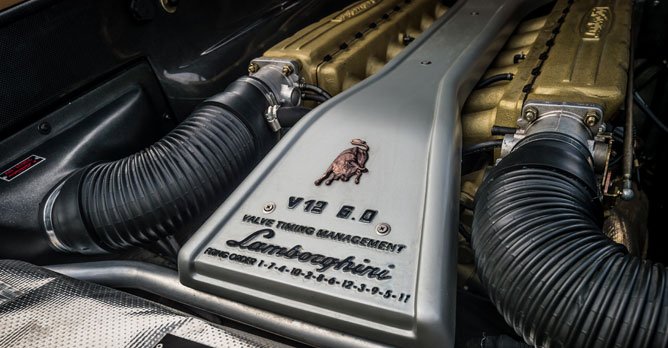

The Diablo sports the classic Lamborghini 12-cylinder set-up, with a 5.7-litre engine, four overhead camshafts and four valves per cylinder, equipped with multi-point electronic injection capable of developing 478bhp and 580Nm of torque, in a rear longitudinal position.
Despite being luxuriously finished, with leather interior, air conditioning, electric windows and electrically adjustable seats, the Diablo is still a hard and pure car with traction on the rear wheels only, no electronic driving aids or power steering were available until 1993.
In 1993, Automobili Lamborghini launched the Diablo VT, the first Lamborghini Granturismo to be equipped with four-wheel drive, which also brought a series of mechanical improvements and stylistic changes also to be soon adopted on the two-wheel drive version.
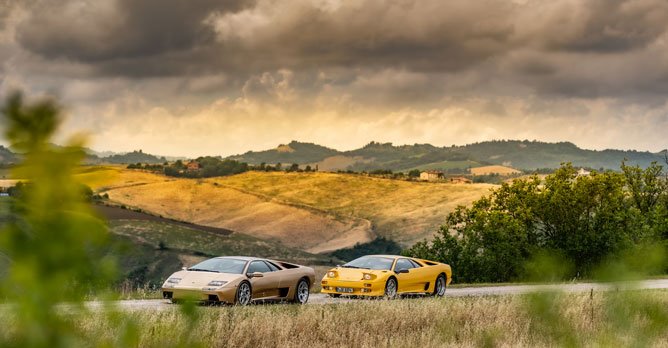
In December of the same year, the Diablo VT Roadster came to market, Lamborghini's first 12-cylinder, open-roofed, mass-produced Lamborghini, with slightly revised lines and offered with four-wheel drive only.
In 1999, following the purchase of Automobili Lamborghini by the Audi Group, there was the unveiling of the Diablo SV 'restyling' designed by Luc Donckerwolke, Lamborghini's first in-house designer. It followed the VT and VT Roadster, all three models evoked clear signs of modernisation through its revised lines and interior.
From a mechanical point of view the engine, now with 521bhp and 605Nm of torque, was equipped with the variable valve lift system and, for the first time on a Lamborghini, the braking system came with ABS.
The Diablo, also launched in special series or for competition with 6.0-litre engines, was Lamborghini's most produced car to date with 2,903 units in total. It remained available until 2001, when it was succeeded by the Murcielago model.