View page in desktop
|
Report error
  •   Apple app store icon
  • Google play store icon
Terms of Service
|
Privacy Policy
|
PDPA
|
Site Map
©2004-2026 Sgcarmart, Singapore. All rights reserved.
  • Home
  • Car Articles
  • news
  • news Listings
  • Other News
  • Gordon Murray Automotive reveals the track-only T.50s Niki Lauda

    12 Apr 2021

    |

    1,336 views

    Developed in parallel with the T.50 supercar, the T.50s Niki Lauda has been designed and engineered to offer an on-track experience like no other car to date.


    Gordon Murray Automotive has unveiled its T.50s Niki Lauda. Developed in parallel with the T.50, the T.50s Niki Lauda has been conceived, designed and engineered to offer the ultimate on-track driving experience, and the car bears the name of Niki Lauda, the legendary three-time Formula One World Champion.

    Like the T.50, the T.50s Niki Lauda has been designed and engineered without compromise, but with an even more extreme specification. It weighs just 852kg and will be powered by a substantially redesigned version of the T.50's Cosworth-engineered 3.9-litre V12, producing 715bhp, revving to 12,100rpm and going through a six-speed gearbox.
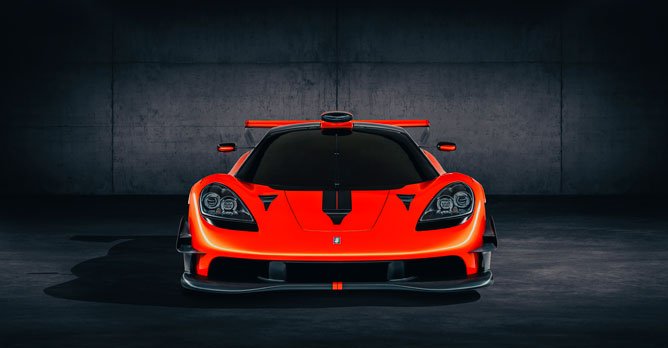
    The front splitter on the T.50s Niki Lauda helps to balance out the downforce created by the rear spoiler
    Advanced aerodynamics, aided by a 400mm rear-mounted fan, will produce up to 1,500kg of downforce for optimum track performance. Just 25 T.50s Niki Laudas will be made. Production will start in January 2023 at Gordon Murray Automotive's manufacturing centre in Dunsfold, U.K., after the run of 100 T.50 supercars is completed. 
    Gordon Murray Automotive engineered the T.50s body design to achieve their aerodynamic performance targets, whilst retaining the T.50's balanced and classic proportions. A striking central fin designed to enhance stability features a Niki Lauda logo. At the rear, the distinctive 400mm fan from the T.50 is retained, accompanied by an even larger rear diffuser and a new delta wing.

    The aerodynamic elements continue at the front of the car. Barge boards are sculpted to improve airflow to the side ducts, which house the oil cooling systems for the engine and transmission. A splitter and dive planes are also prominent and further reflect the car's aero-influenced design. Owners will be able to individualise their T.50s Niki Lauda through their choice of colours and liveries, so that no two cars will be alike.
    The Cosworth-designed 3.9-litre V12 engine is a dramatically different version of the engine that powers the T.50. It is even more powerful and faster-revving too, delivering 715bhp at 11,500rpm, on its way to a 12,100rpm rev-limit. The torque figure is 485Nm at 9,000rpm.
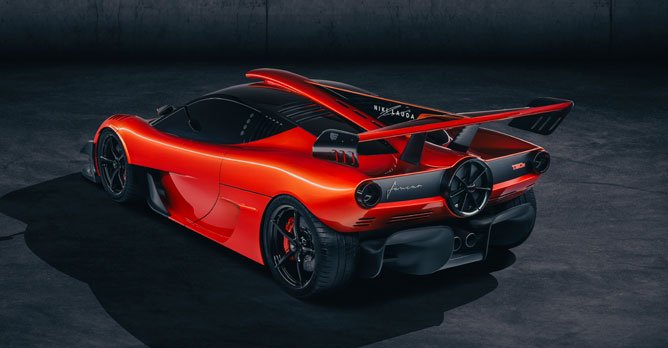
    At 1,758mm wide, the rear spoiler is part of the new aerodynamic package on the T.50s Niki Lauda that creates 1,500kg of downforce
    The T.50s Niki Lauda's engine is fed by a roof-mounted, high-performance RAM induction airbox. A newly-developed, bespoke, straight-through exhaust system also takes the engine sound to a new level. The V12 pushes the boundaries of engine design even further, with many new components. Changes include completely revised cylinder heads and camshafts, plus a higher compression ratio of 15:1.

    Through meticulous attention to detail, this new iteration of the Cosworth GMA V12 weighs just 162kg, 16kg less than what was already the lightest road-going V12 engine ever. The weight-saving measures extend to the intake, exhaust and control systems, as well as the engine itself. All the valves are made from titanium, while there is no variable valve timing due to the additional weight of the geartrain and electronic control system.

    A simpler induction system features 12 throttle bodies on top of the engine, fed directly by the racing-style air box. The exhaust system does without catalytic converters, has thinner Inconel walls and, with only track noise limits to meet, benefits from smaller silencers.

    A Xtrac Instantaneous Gearshift six-speed gearbox is fitted, designed to fit the exacting packaging and weight demands of the T.50s Niki Lauda. As part of Xtrac's efforts to minimise weight wherever possible, even the gears are lighter, contributing to a 5kg total weight reduction. Both the gearbox and the clutch are electronically actuated.
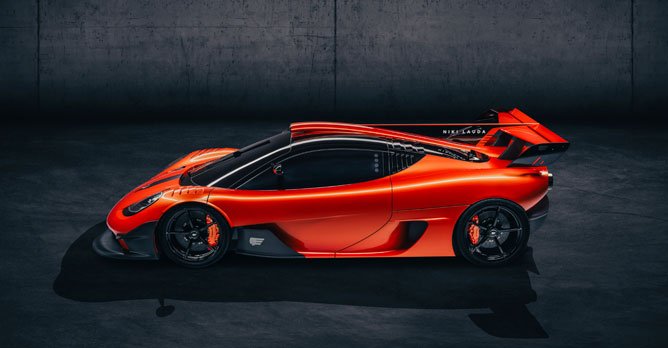
    The T.50s Niki Lauda has carbon fibre body panels and a carbon fibre monocoque, which protects passengers with a Formula One-style safety cell
    Ratios have been chosen to optimise on-track performance and driver enjoyment and engagement, up to a top speed of 338km/h. A set of closer ratios optimised for shorter circuits will also be offered, allowing owners to make the most of all six gears via the steering column-mounted paddles. In this configuration, the T.50s Niki Lauda will reach a top speed of 274km/h.

    The T.50s Niki Lauda is built around a specially developed, lightweight carbon fibre monocoque. Optimised for weight reduction and structural rigidity, it is constructed using advanced part-binding technology, with carbon fibre wrapped around a honeycomb aluminium core. This stiffness and strength also contributes to the T.50s' exceptional occupant safety, with precisely engineered deformable areas.

    Exterior body panels are also made from carbon fibre. The T.50s Niki Lauda utilises the same forged aluminium front and rear double wishbone suspension system as the T.50. However, the springs, dampers and anti-roll bar have been respecified to optimise track performance, while the ride height has been lowered to 87mm at the front and 116mm at the rear.

    As part of the Trackspeed package, the T.50s Niki Lauda's chassis can be adjusted to find the ideal setup for its owner. Both the chassis settings and the aerodynamics are fully adjustable. The T.50s Niki Lauda retains the T.50's rack and pinion steering, but with a revised steering ratio.
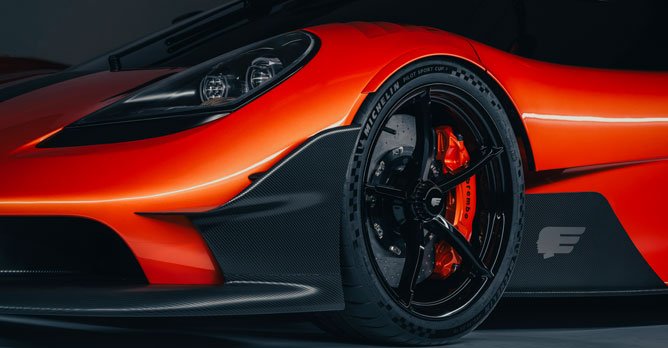
    The wheels are made of forged magnesium and are extremely lightweight, weighing less than 6kg each for an 18-inch wheel
    The Brembo carbon ceramic discs of the T.50 are carried over to the T.50s Niki Lauda, with six-piston callipers and 370mm discs up front, and four-piston callipers clamping on 340mm discs in the rear. The brakes and aerodynamics together produce 3.5g of deceleration. To ensure the brakes maintain their phenomenal performance throughout a track session, new ducting around each wheel is designed to improve brake cooling.

    The T.50s sits on extremely light magnesium forged 18-inch wheels, weighing less than 6kg each, with centre locking hubs. Michelin slick tyres wrap around the rims, with 250mm wide tyres in front and 300m wide tyres in the rear. A wet option tyre is also provided.

    The T.50s Niki Lauda has new aero creating 1,500kg of downforce, including a 1,758mm-wide, rear-mounted delta wing. The front splitter with a central aerofoil section generates huge load figures to balance out the rear wing. The splitter's central channel reduces the car's sensitivity to pitch while allowing airflow under the car to continue to drive the central diffuser section, keeping the efficiency of the entire aero package high.

    Dive planes include horizontal elements paired with a vertical duct to manage wheel arch pressures and tyre wake, reducing drag and improving efficiency. A pair of NACA ducts have been perfectly positioned on the front clam shell in a region of high pressure and where the thin boundary layer is ideal for cooling the large front brakes.
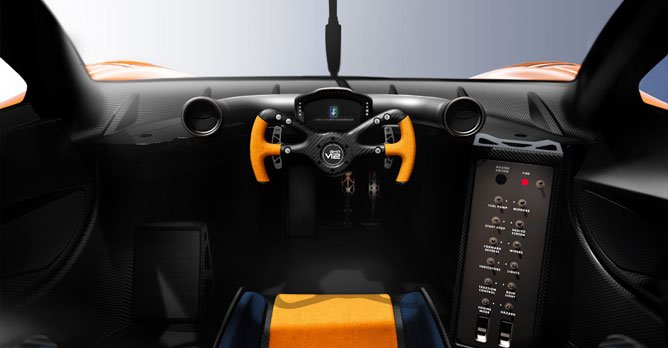
    The cockpit of the T.50s Niki Lauda is simple, with the display gauge, steering wheel and all necessary buttons and switches in easy reach
    A central fin stretching from the top of the roof to the rear lip of the car has also been added for increased yaw stability. The large vertical face is presented to the airflow during high-speed cornering and helps counteract the momentum of the car towards the outside of the corner.

    To further improve airflow and accommodate the central fin, the oil cooling systems for the engine and transmission are now located in side ducts. With the powertrain coolers located directly downstream of the front wheels, barge boards have been added to manage the turbulent wake emanating from the front wheel arches, ensuring a clean flow of air to the side ducts.

    The T.50s Niki Lauda retains the same 400mm ground-effect fan as the T.50, but here it runs in a single High Downforce mode, spinning at 7000rpm. The T.50s also has much simpler ducting, with a permanently open duct running down to the redesigned rear diffuser.

    The dihedral doors lift to reveal a race-car oriented cabin. The T.50s Niki Lauda retains the driver-focused central seating position of the T.50, giving the driver an unhindered view of the track ahead and allowing perfect placement. The driver sits on a full racing carbon fibre seat with fore and aft adjustment and is secured with a six-point harness.
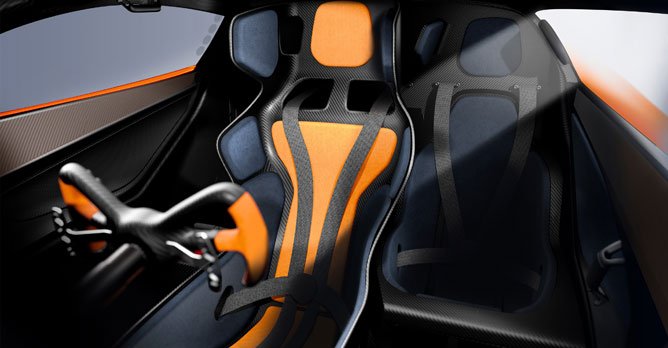
    Unlike the road-going T.50, there are only two seats in the T.50s as the space for the right seat is used for the fire extinguisher system and switchgear panel
    The T.50s is a two-seater with a fixed passenger seat to the left of the driver, complete with a four-point harness. In place of the seat on the right is a fire extinguisher system. Should an owner wish, the car can be ordered without a passenger seat to save further weight and create an even more focused feel.

    The rectangular carbon fibre steering wheel features only the key controls that the driver needs. This includes buttons for the traction and launch control, as well as the car-to-pit/driver-to-passenger radio and to select neutral. The slim, uncluttered design is influenced by Gordon Murray's racing experience.

    To avoid unnecessary distractions, the T.50s features a single digital screen. This displays essential vehicle and engine data, as well as aero info, the gearchange indicator, telemetry, lap time, tyre pressures/temperatures, g-forces and a camera video feed. The T.50s also maintains the same spaciousness, visibility and comfort as the road car, making the T.50s Niki Lauda a uniquely usable track car, despite its incredible performance.

    24.4k

    Tags

    video news gordon murray automotive t.50s niki lauda niki lauda t.50s track only track special naturally aspirated limited production

    AllReviewsNewsAdviceFeaturesVideos
    • Home
    • Car Articles
    • news
    • news Listings
    • Other News

    Gordon Murray Automotive reveals the track-only T.50s Niki Lauda

    12 Apr 2021

    |

    1,336 views

    Developed in parallel with the T.50 supercar, the T.50s Niki Lauda has been designed and engineered to offer an on-track experience like no other car to date.


    Gordon Murray Automotive has unveiled its T.50s Niki Lauda. Developed in parallel with the T.50, the T.50s Niki Lauda has been conceived, designed and engineered to offer the ultimate on-track driving experience, and the car bears the name of Niki Lauda, the legendary three-time Formula One World Champion.

    Like the T.50, the T.50s Niki Lauda has been designed and engineered without compromise, but with an even more extreme specification. It weighs just 852kg and will be powered by a substantially redesigned version of the T.50's Cosworth-engineered 3.9-litre V12, producing 715bhp, revving to 12,100rpm and going through a six-speed gearbox.

    The front splitter on the T.50s Niki Lauda helps to balance out the downforce created by the rear spoiler
    Advanced aerodynamics, aided by a 400mm rear-mounted fan, will produce up to 1,500kg of downforce for optimum track performance. Just 25 T.50s Niki Laudas will be made. Production will start in January 2023 at Gordon Murray Automotive's manufacturing centre in Dunsfold, U.K., after the run of 100 T.50 supercars is completed. 
    Gordon Murray Automotive engineered the T.50s body design to achieve their aerodynamic performance targets, whilst retaining the T.50's balanced and classic proportions. A striking central fin designed to enhance stability features a Niki Lauda logo. At the rear, the distinctive 400mm fan from the T.50 is retained, accompanied by an even larger rear diffuser and a new delta wing.

    The aerodynamic elements continue at the front of the car. Barge boards are sculpted to improve airflow to the side ducts, which house the oil cooling systems for the engine and transmission. A splitter and dive planes are also prominent and further reflect the car's aero-influenced design. Owners will be able to individualise their T.50s Niki Lauda through their choice of colours and liveries, so that no two cars will be alike.
    The Cosworth-designed 3.9-litre V12 engine is a dramatically different version of the engine that powers the T.50. It is even more powerful and faster-revving too, delivering 715bhp at 11,500rpm, on its way to a 12,100rpm rev-limit. The torque figure is 485Nm at 9,000rpm.

    At 1,758mm wide, the rear spoiler is part of the new aerodynamic package on the T.50s Niki Lauda that creates 1,500kg of downforce
    The T.50s Niki Lauda's engine is fed by a roof-mounted, high-performance RAM induction airbox. A newly-developed, bespoke, straight-through exhaust system also takes the engine sound to a new level. The V12 pushes the boundaries of engine design even further, with many new components. Changes include completely revised cylinder heads and camshafts, plus a higher compression ratio of 15:1.

    Through meticulous attention to detail, this new iteration of the Cosworth GMA V12 weighs just 162kg, 16kg less than what was already the lightest road-going V12 engine ever. The weight-saving measures extend to the intake, exhaust and control systems, as well as the engine itself. All the valves are made from titanium, while there is no variable valve timing due to the additional weight of the geartrain and electronic control system.

    A simpler induction system features 12 throttle bodies on top of the engine, fed directly by the racing-style air box. The exhaust system does without catalytic converters, has thinner Inconel walls and, with only track noise limits to meet, benefits from smaller silencers.

    A Xtrac Instantaneous Gearshift six-speed gearbox is fitted, designed to fit the exacting packaging and weight demands of the T.50s Niki Lauda. As part of Xtrac's efforts to minimise weight wherever possible, even the gears are lighter, contributing to a 5kg total weight reduction. Both the gearbox and the clutch are electronically actuated.

    The T.50s Niki Lauda has carbon fibre body panels and a carbon fibre monocoque, which protects passengers with a Formula One-style safety cell
    Ratios have been chosen to optimise on-track performance and driver enjoyment and engagement, up to a top speed of 338km/h. A set of closer ratios optimised for shorter circuits will also be offered, allowing owners to make the most of all six gears via the steering column-mounted paddles. In this configuration, the T.50s Niki Lauda will reach a top speed of 274km/h.

    The T.50s Niki Lauda is built around a specially developed, lightweight carbon fibre monocoque. Optimised for weight reduction and structural rigidity, it is constructed using advanced part-binding technology, with carbon fibre wrapped around a honeycomb aluminium core. This stiffness and strength also contributes to the T.50s' exceptional occupant safety, with precisely engineered deformable areas.

    Exterior body panels are also made from carbon fibre. The T.50s Niki Lauda utilises the same forged aluminium front and rear double wishbone suspension system as the T.50. However, the springs, dampers and anti-roll bar have been respecified to optimise track performance, while the ride height has been lowered to 87mm at the front and 116mm at the rear.

    As part of the Trackspeed package, the T.50s Niki Lauda's chassis can be adjusted to find the ideal setup for its owner. Both the chassis settings and the aerodynamics are fully adjustable. The T.50s Niki Lauda retains the T.50's rack and pinion steering, but with a revised steering ratio.

    The wheels are made of forged magnesium and are extremely lightweight, weighing less than 6kg each for an 18-inch wheel
    The Brembo carbon ceramic discs of the T.50 are carried over to the T.50s Niki Lauda, with six-piston callipers and 370mm discs up front, and four-piston callipers clamping on 340mm discs in the rear. The brakes and aerodynamics together produce 3.5g of deceleration. To ensure the brakes maintain their phenomenal performance throughout a track session, new ducting around each wheel is designed to improve brake cooling.

    The T.50s sits on extremely light magnesium forged 18-inch wheels, weighing less than 6kg each, with centre locking hubs. Michelin slick tyres wrap around the rims, with 250mm wide tyres in front and 300m wide tyres in the rear. A wet option tyre is also provided.

    The T.50s Niki Lauda has new aero creating 1,500kg of downforce, including a 1,758mm-wide, rear-mounted delta wing. The front splitter with a central aerofoil section generates huge load figures to balance out the rear wing. The splitter's central channel reduces the car's sensitivity to pitch while allowing airflow under the car to continue to drive the central diffuser section, keeping the efficiency of the entire aero package high.

    Dive planes include horizontal elements paired with a vertical duct to manage wheel arch pressures and tyre wake, reducing drag and improving efficiency. A pair of NACA ducts have been perfectly positioned on the front clam shell in a region of high pressure and where the thin boundary layer is ideal for cooling the large front brakes.

    The cockpit of the T.50s Niki Lauda is simple, with the display gauge, steering wheel and all necessary buttons and switches in easy reach
    A central fin stretching from the top of the roof to the rear lip of the car has also been added for increased yaw stability. The large vertical face is presented to the airflow during high-speed cornering and helps counteract the momentum of the car towards the outside of the corner.

    To further improve airflow and accommodate the central fin, the oil cooling systems for the engine and transmission are now located in side ducts. With the powertrain coolers located directly downstream of the front wheels, barge boards have been added to manage the turbulent wake emanating from the front wheel arches, ensuring a clean flow of air to the side ducts.

    The T.50s Niki Lauda retains the same 400mm ground-effect fan as the T.50, but here it runs in a single High Downforce mode, spinning at 7000rpm. The T.50s also has much simpler ducting, with a permanently open duct running down to the redesigned rear diffuser.

    The dihedral doors lift to reveal a race-car oriented cabin. The T.50s Niki Lauda retains the driver-focused central seating position of the T.50, giving the driver an unhindered view of the track ahead and allowing perfect placement. The driver sits on a full racing carbon fibre seat with fore and aft adjustment and is secured with a six-point harness.

    Unlike the road-going T.50, there are only two seats in the T.50s as the space for the right seat is used for the fire extinguisher system and switchgear panel
    The T.50s is a two-seater with a fixed passenger seat to the left of the driver, complete with a four-point harness. In place of the seat on the right is a fire extinguisher system. Should an owner wish, the car can be ordered without a passenger seat to save further weight and create an even more focused feel.

    The rectangular carbon fibre steering wheel features only the key controls that the driver needs. This includes buttons for the traction and launch control, as well as the car-to-pit/driver-to-passenger radio and to select neutral. The slim, uncluttered design is influenced by Gordon Murray's racing experience.

    To avoid unnecessary distractions, the T.50s features a single digital screen. This displays essential vehicle and engine data, as well as aero info, the gearchange indicator, telemetry, lap time, tyre pressures/temperatures, g-forces and a camera video feed. The T.50s also maintains the same spaciousness, visibility and comfort as the road car, making the T.50s Niki Lauda a uniquely usable track car, despite its incredible performance.
    24.4k

    Tags

    video news gordon murray automotive t.50s niki lauda niki lauda t.50s track only track special naturally aspirated limited production

    Newsletter

    Be Notified On The Latest News

    Newsletter

    Be Notified On The Latest News

    Latest COE Prices

    August 2026 | 2nd BIDDING
    NEXT TENDER: 09 Sep 2026
    CAT A
    $128,501
    CAT B
    $131,001
    CAT C
    $90,002
    CAT E
    $135,000
    View Full Results

    Latest COE Prices

    August 2026 | 2nd BIDDING
    NEXT TENDER: 09 Sep 2026
    CAT A
    $128,501
    CAT B
    $131,001
    CAT C
    $90,002
    CAT E
    $135,000
    View Full Results

    Related Articles

    New cars are safer: Opt for one when you can

    New cars are safer: Opt for one when you can

    Toyota launches the bZ4X BEV in Singapore

    Toyota launches the bZ4X BEV in Singapore

    Is parallel import hesitancy growing among car buyers?

    Is parallel import hesitancy growing among car buyers?

    BYD Seal 6 Plug-in Hybrid Review

    BYD Seal 6 Plug-in Hybrid Review

    Potential fixes to our COE system

    Potential fixes to our COE system

    A first look at Chery's iCaur V23 and Jaecoo J8 in Singapore

    A first look at Chery's iCaur V23 and Jaecoo J8 in Singapore

    DENZA B5 Review

    DENZA B5 Review

    Mazda 6e Fastback GT Electric review

    Mazda 6e Fastback GT Electric review

    Related Articles

    New cars are safer: Opt for one when you can

    New cars are safer: Opt for one when you can

    Toyota launches the bZ4X BEV in Singapore

    Toyota launches the bZ4X BEV in Singapore

    Is parallel import hesitancy growing among car buyers?

    Is parallel import hesitancy growing among car buyers?

    BYD Seal 6 Plug-in Hybrid Review

    BYD Seal 6 Plug-in Hybrid Review

    Potential fixes to our COE system

    Potential fixes to our COE system

    A first look at Chery's iCaur V23 and Jaecoo J8 in Singapore

    A first look at Chery's iCaur V23 and Jaecoo J8 in Singapore

    DENZA B5 Review

    DENZA B5 Review

    Mazda 6e Fastback GT Electric review

    Mazda 6e Fastback GT Electric review

    You May Also Like

    Sgcarmart Explores: Bras Basah!

    Sgcarmart Explores: Bras Basah!

    New cars are safer: Opt for one when you can

    New cars are safer: Opt for one when you can

    Maxus MIFA 7 Elite: Going big for the little moments

    Maxus MIFA 7 Elite: Going big for the little moments

    Sgcarmart Explores: East Coast Park!

    Sgcarmart Explores: East Coast Park!

    We try out roadside parking with the new OBU!

    We try out roadside parking with the new OBU!

    Opinion: Why do we even need green number plates?

    Opinion: Why do we even need green number plates?

    The BYD Sealion 8 seven-seater SUV arrives in Singapore

    The BYD Sealion 8 seven-seater SUV arrives in Singapore

    Mazda 6e Fastback GT Electric review

    Mazda 6e Fastback GT Electric review

    Hongqi Singapore opens its showroom doors

    Hongqi Singapore opens its showroom doors

    Opinion: Is it time for a change to our road traffic laws?

    Opinion: Is it time for a change to our road traffic laws?

    Mercedes-Benz GLB250+ Review

    Mercedes-Benz GLB250+ Review

    A first look at Chery's iCaur V23 and Jaecoo J8 in Singapore

    A first look at Chery's iCaur V23 and Jaecoo J8 in Singapore

    Is parallel import hesitancy growing among car buyers?

    Is parallel import hesitancy growing among car buyers?

    New to driving? Here's how to become a better driver

    New to driving? Here's how to become a better driver

    Tesla launches Model Y L in Singapore, first six-seater here

    Tesla launches Model Y L in Singapore, first six-seater here

    Toyota RAV4 Hybrid vs Subaru Forester e-Boxer

    Toyota RAV4 Hybrid vs Subaru Forester e-Boxer

    You May Also Like

    Sgcarmart Explores: Bras Basah!

    Sgcarmart Explores: Bras Basah!

    New cars are safer: Opt for one when you can

    New cars are safer: Opt for one when you can

    Maxus MIFA 7 Elite: Going big for the little moments

    Maxus MIFA 7 Elite: Going big for the little moments

    Sgcarmart Explores: East Coast Park!

    Sgcarmart Explores: East Coast Park!

    We try out roadside parking with the new OBU!

    We try out roadside parking with the new OBU!

    Opinion: Why do we even need green number plates?

    Opinion: Why do we even need green number plates?

    The BYD Sealion 8 seven-seater SUV arrives in Singapore

    The BYD Sealion 8 seven-seater SUV arrives in Singapore

    Mazda 6e Fastback GT Electric review

    Mazda 6e Fastback GT Electric review

    Hongqi Singapore opens its showroom doors

    Hongqi Singapore opens its showroom doors

    Opinion: Is it time for a change to our road traffic laws?

    Opinion: Is it time for a change to our road traffic laws?

    Mercedes-Benz GLB250+ Review

    Mercedes-Benz GLB250+ Review

    A first look at Chery's iCaur V23 and Jaecoo J8 in Singapore

    A first look at Chery's iCaur V23 and Jaecoo J8 in Singapore

    Is parallel import hesitancy growing among car buyers?

    Is parallel import hesitancy growing among car buyers?

    New to driving? Here's how to become a better driver

    New to driving? Here's how to become a better driver

    Tesla launches Model Y L in Singapore, first six-seater here

    Tesla launches Model Y L in Singapore, first six-seater here

    Toyota RAV4 Hybrid vs Subaru Forester e-Boxer

    Toyota RAV4 Hybrid vs Subaru Forester e-Boxer