In just half a decade, compact sports utility vehicles (SUVs) - or as some may call them crossover utility vehicles (CUVs) - have become a popular choice among car buyers. Born in 1994, the Toyota RAV4 was the first of such a vehicle.
The name RAV4 stands for Recreational Active Vehicle with four-wheel drive, although the RAV4s of the past only had full time four-wheel drive as an option.
The early success of the RAV4 in the 1990s popularised the breed of CUVs, paving the way for competitors like the BMW X3, Honda CR-V, Kia Sportage and many others.
Unveiled at the 2012 Los Angeles Motor Show, the fourth generation RAV4 has been completely redesigned with fresh styling, more features, and the promise of better fuel economy.
With that, the latest RAV4 looks set to reclaim its standing as a top choice for CUVs with its trendsetter moniker.
Exterior
If someone said that the new RAV4 bore no resemblance to its predecessors, we would be inclined to agree.
The new RAV4 is dressed to impress with a new front fascia, a lower roofline, and a sporty rear spoiler.
The name RAV4 stands for Recreational Active Vehicle with four-wheel drive, although the RAV4s of the past only had full time four-wheel drive as an option.
The early success of the RAV4 in the 1990s popularised the breed of CUVs, paving the way for competitors like the BMW X3, Honda CR-V, Kia Sportage and many others.
Unveiled at the 2012 Los Angeles Motor Show, the fourth generation RAV4 has been completely redesigned with fresh styling, more features, and the promise of better fuel economy.
With that, the latest RAV4 looks set to reclaim its standing as a top choice for CUVs with its trendsetter moniker.
Exterior
If someone said that the new RAV4 bore no resemblance to its predecessors, we would be inclined to agree.
The new RAV4 is dressed to impress with a new front fascia, a lower roofline, and a sporty rear spoiler.
Also with a look unseen on any other Toyotas, the new RAV4 features a piercing front end with sharp headlights, LED daytime running lights and an under-biting front bumper with a chrome plating (available on the Premium variant only) - making the car look cooler than ever.
One of the bigger and more noticeable changes is the absence of the spare tyre mounted on the RAV4's tailgate, thereby eliminating the old design that swung out to the right and hindered kerbside loading.
This design also improves aerodynamics, and adds to a cleaner look of the rump.
Together with pronounced wheel arches complemented with 17-inch rubbers, the car displays a stable and planted stance, perfectly suitable for a compact SUV.
One of the bigger and more noticeable changes is the absence of the spare tyre mounted on the RAV4's tailgate, thereby eliminating the old design that swung out to the right and hindered kerbside loading.
This design also improves aerodynamics, and adds to a cleaner look of the rump.
Together with pronounced wheel arches complemented with 17-inch rubbers, the car displays a stable and planted stance, perfectly suitable for a compact SUV.
Interior
Climb aboard and current RAV4 owners may be taken aback by the all new interior of the latest model. There's a lot more sophistication in both looks and materials - providing an upscale look wherever you glance.
As premium looking as the variant is named, our test car came fitted with a Terra Cotta interior colour that is only available on that trim.
Together with soft leather seats and materials that feel good to the touch, there is an added air of style in the cabin.
Resembling the faces of sports watches, the sleek new dash clusters are illuminated with a blue coloured background with red needle gauges that display clear vehicle information.
Climb aboard and current RAV4 owners may be taken aback by the all new interior of the latest model. There's a lot more sophistication in both looks and materials - providing an upscale look wherever you glance.
As premium looking as the variant is named, our test car came fitted with a Terra Cotta interior colour that is only available on that trim.
Together with soft leather seats and materials that feel good to the touch, there is an added air of style in the cabin.
Resembling the faces of sports watches, the sleek new dash clusters are illuminated with a blue coloured background with red needle gauges that display clear vehicle information.
Located in the centre console is a standard six-inch integrated touch screen display system which also includes a reverse camera that helps to make even the basic variant - Elegance - look premium.
Under the centre console is a leather shelf which houses additional controls such as USB slots, seat warmers and ECO/Sport mode switches.
However, we reckon that visibility of these controls is slightly hindered while on the move.
At the back, there's adequate leg and headroom to spare for three adults with well bolstered seats that provide optimum comfort.
Under the centre console is a leather shelf which houses additional controls such as USB slots, seat warmers and ECO/Sport mode switches.
However, we reckon that visibility of these controls is slightly hindered while on the move.
At the back, there's adequate leg and headroom to spare for three adults with well bolstered seats that provide optimum comfort.
The Drive
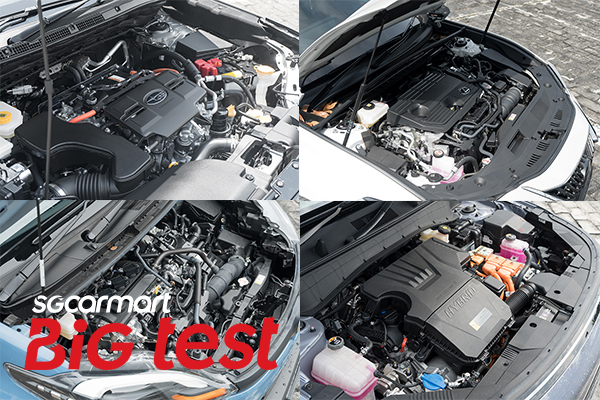
Following the trend of having downsized engines, Toyota has ditched the 2.4-litre lump on the RAV4's predecessor for a new 2.0-litre Valvematic Dual-VVTi engine that is good for 151bhp and 195Nm of torque, which will do the job just fine for those looking for an easygoing family workhorse.
While we didn't actually measure acceleration, the powerplant has enough power and is snappier than before due to the additional gears in its new seven-speed CVT automatic transmission.
A Sport mode button for better throttle response and slightly heavier steering weight is also available for those who are looking for a more engaging drive.
Impressively, even with a bit of hard driving in Sport mode, fuel efficiency of the RAV4 is remarkable as we managed to achieve a figure of 10.1km/L, as compared to the manufacturer's figure of 13.3km/L.
The RAV4's handling is well balanced thanks to enhanced aerodynamics and the elimination of the spare tyre on its back.
Following the trend of having downsized engines, Toyota has ditched the 2.4-litre lump on the RAV4's predecessor for a new 2.0-litre Valvematic Dual-VVTi engine that is good for 151bhp and 195Nm of torque, which will do the job just fine for those looking for an easygoing family workhorse.
While we didn't actually measure acceleration, the powerplant has enough power and is snappier than before due to the additional gears in its new seven-speed CVT automatic transmission.
A Sport mode button for better throttle response and slightly heavier steering weight is also available for those who are looking for a more engaging drive.
Impressively, even with a bit of hard driving in Sport mode, fuel efficiency of the RAV4 is remarkable as we managed to achieve a figure of 10.1km/L, as compared to the manufacturer's figure of 13.3km/L.
The RAV4's handling is well balanced thanks to enhanced aerodynamics and the elimination of the spare tyre on its back.
Credit also goes to the revised Dynamic Torque Control all-wheel drive system that controls the amount of torque delivered to the wheels based on road speed, steering angle and throttle input.
More notably, the RAV4 is as nifty as a sedan through corners with little body roll.
Of course, one cannot defy the law of physics. Overdo the throttle round the bend and you'll undoubtedly find yourself in a nervous situation with a car that measures over 1.6 metres tall.
Conclusion
The new RAV4 features more space, better driving dynamics and an attractive style.
Combine that with some new technology, a vastly improved interior and the quality we've come to expect from the Japanese auto giant over the years, the CUV becomes capable of standing apart from the rest in a highly competitive segment.
More notably, the RAV4 is as nifty as a sedan through corners with little body roll.
Of course, one cannot defy the law of physics. Overdo the throttle round the bend and you'll undoubtedly find yourself in a nervous situation with a car that measures over 1.6 metres tall.
Conclusion
The new RAV4 features more space, better driving dynamics and an attractive style.
Combine that with some new technology, a vastly improved interior and the quality we've come to expect from the Japanese auto giant over the years, the CUV becomes capable of standing apart from the rest in a highly competitive segment.