How to select the right size
Low profile and wide tyres definately enhances the looks of a car and this is the main reason why drivers like to go for them. However, switching to different sized tyres can have serious dynamic implications which need to be understood.
Lower profile tyres improve the steering response and overall handling but dramatically reduce ride comfort. For our Singapore road conditions with frequent humps and speed limiting strips, low profile tyres are not advisable and it's best to stick to the original size, or something close.
What you could do if you are looking for better performance is to go in for a tyre with a higher speed rating. As a general rule, tyres with a higher speed rating also perform better.
If you do want to go in for a low-profile tyre you need to ensure that the overall circumference of the tyre doesn't change dramatically as this could affect the ground clearance, speedometer readings and gearing of the car. This might mean changing over to a larger rim size to compensate for the shorter sidewall height of the low-profile tyre.
This is where the 'Plus One/Plus Two' concept comes in. The whole objective of the 'Plus' concept is to arrive at the right wheel/tyre size combination that maintains the vehicle's original tyre diameter. If the diameter is too small, the ground clearance could become too low and the car could ground. If the diameter is too big, the gearing could become taller and affect the car's performance and there is a danger of the tyre rubbing against the inside of the wheel arch.
There is a myth is that fitting fatter tyres gives a better road contact. Car manufacturers do keep in mind that with replacement tyres owners may go in for an 'upsize' and therefore most manufacturers advise upgrading of a size or two (up to 20mm).
Fitting wider than what is recommended not only leads to instability and poor performance but may also prove to be dangerous. It has often been seen that too wide a tyre not only leads to aquaplaning but also cannot produce the required traction needed for the car. This is because the wider tyre results in a different camber and in effect reduces the actual contact patch or footprint of the tyre.
Size calculations
Low profile and wide tyres definately enhances the looks of a car and this is the main reason why drivers like to go for them. However, switching to different sized tyres can have serious dynamic implications which need to be understood.
Lower profile tyres improve the steering response and overall handling but dramatically reduce ride comfort. For our Singapore road conditions with frequent humps and speed limiting strips, low profile tyres are not advisable and it's best to stick to the original size, or something close.
What you could do if you are looking for better performance is to go in for a tyre with a higher speed rating. As a general rule, tyres with a higher speed rating also perform better.
If you do want to go in for a low-profile tyre you need to ensure that the overall circumference of the tyre doesn't change dramatically as this could affect the ground clearance, speedometer readings and gearing of the car. This might mean changing over to a larger rim size to compensate for the shorter sidewall height of the low-profile tyre.
This is where the 'Plus One/Plus Two' concept comes in. The whole objective of the 'Plus' concept is to arrive at the right wheel/tyre size combination that maintains the vehicle's original tyre diameter. If the diameter is too small, the ground clearance could become too low and the car could ground. If the diameter is too big, the gearing could become taller and affect the car's performance and there is a danger of the tyre rubbing against the inside of the wheel arch.
There is a myth is that fitting fatter tyres gives a better road contact. Car manufacturers do keep in mind that with replacement tyres owners may go in for an 'upsize' and therefore most manufacturers advise upgrading of a size or two (up to 20mm).
Fitting wider than what is recommended not only leads to instability and poor performance but may also prove to be dangerous. It has often been seen that too wide a tyre not only leads to aquaplaning but also cannot produce the required traction needed for the car. This is because the wider tyre results in a different camber and in effect reduces the actual contact patch or footprint of the tyre.
Size calculations
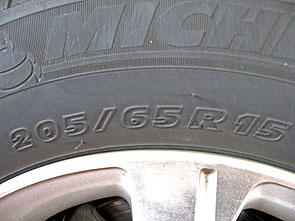
| Always bear in mind to allow only a variance of +/-2% should you choose to increase or decrease the size of your tyre from stock. So how do I calculate my stock tyre size from the markings on it? Take for example your stock tyre and rim is 205/65-15. Tyre Width = 205 mm Aspect Ratio = 0.65 Rim Diameter = 15 inchs = 381 mm Section Height = Width x Aspect Ratio = 205 x 0.65 = 133.25 mm Combined Section Height = Section Height x 2 = 133.25 x 2 = 266.5 mm Overall Diameter = Combined Section Height + Rim Diameter = 266.5 + 381 = 647.5 mm |
|