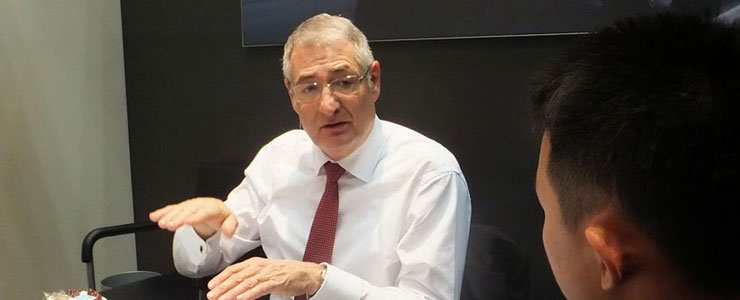
As the Head of Powertrain Development at the Volkswagen Group, Dr. Heinz-Jakob Neusser is more than qualified to hold his own. He has a doctorate in mechanical engineering and began his career as an engine developer in 1986. 10 years later, he joined Porsche's engine development unit as a project manager, before taking charge of engine construction in 1998 and drivetrain development in 2001.
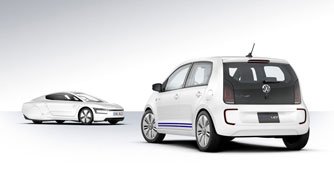

SGCM: We have seen the Twin up! concept and it looks every bit production ready. Are you guys considering it for production yet?
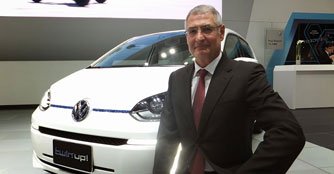
Dr. Neusser: We have done this concept to show that it's possible to have a fully equipped family vehicle, which only has 1L/100km fuel consumption. That's the most important thing because we have already done the XL1. But that is a two-seater and it's a technology leader that's made fully from carbon fibre so it's on another price range compared to our plug-in hybrid Twin up!.
The two-cylinder diesel powertrain is from the 1.6-litre four-cylinder diesel engine. We just took two cylinders out. We also have a 35kW e-motor inside. Transmission is a seven-speed dual-clutch DSG, which has a mass production of 1.5 million units a year. We want to keep all the synergies of mass production cars inside this car.
At the moment, things are looking rather positive but we'll have to wait and see if things pick up. Once they do, we'll decide whether or not the Twin up! should get a green light for production.
SGCM: Future technologies that people expect are already present in cars, such as adaptive cruise control and radar systems. Thus, how will these technologies in EVs be employed in the market to improve safety, fuel efficiency and driving behaviours?
Dr. Neusser: We think that all these new technologies like connectivity and infotainment system will come as modular strategies. The main intention of the MQB system is to create a module that will be suitable for all the different cars and to keep this module as a core so that we will be able to fit it in all cars. This way, we have the advantage of making the basic development work just once. The only thing we have to make individually is the final application.
SGCM: Volkswagen lags behind many other automakers when it comes to electric cars, considering the Nissan Leaf arrived in the States almost three years ago, so has the Chevrolet Volt. Plus, BMW has already launched the highly anticipated BMW i3. As such, how well do you think VW will fare in this electric competition?
Dr. Neusser: At the moment, no car manufacturer can say how steep the increase will be for the electric car market in the future. Thus, we have decided to be flexible. We can provide the model to the market like we do here at the Tokyo Motor Show. But we can't guide the people to buy them because it's according to demands and whether or not they are suitable for a plug-in hybrid or an electric car or even just a conventional one.
But it's dependent on trends and if we can get a trend, we can have a proper plan. We have to define these modular platforms before we can make decisions on what other different power-sourced cars we can go into. Otherwise, the risks are very high.
SGCM: Battery technology will continue advancing, making current electric cars 'outdated'. Does Volkswagen have a solution for this?
Dr. Neusser: Just like our e-motors, we decided to build the batteries by ourselves. There's a clear strategy behind this because you only get a full understanding about the component when you do it yourself. We need to see that the core technology is done on our own before we can supply. The only thing that we aren't doing on our own with the batteries is the chemistry of the cells.
SGCM: Does the up! car run on its own platform?
Dr. Neusser: The platform of the up! is an individual one. It's based on the New Small Family platform (NSF). It's difficult for the car to be based on the MQB because of its small dimensions. But the up! takes modules from the MQB such as the infotainment.