View page in desktop
|
Report error
  •   Apple app store icon
  • Google play store icon
Terms of Service
|
Privacy Policy
|
PDPA
|
Site Map
©2004-2026 Sgcarmart, Singapore. All rights reserved.
  • Home
  • Car Articles
  • news
  • news Listings
  • Fiat News
  • Fiat's new camshaft technology promises more power for less fuel

    09 Mar 2009

    |

    5,209 views

    A new camshaft design which can adjust valve timings might pave the way for even better power with less fuel consumed.

    The Fiat Group has just launched a new petrol engine design technology called MultiAir, which Fiat claims is a fundamental breakthrough and will dramatically cut fuel consumption, as well as significantly boost power and torque. Emissions will also be lowered by between 10 and 25 percent, and up to 60 percent in other engine pollutants.

    The new technology claims that maximum power will be increased by up to 10 percent, while low rpm torque goes up by up to 15 percent. Apart from also being able to achieve greater fuel economy and reduce harmful gas emissions, the MultiAir design is applicable to all internal combustion engines, regardless of the type of fuel used.

    In short, an engine equipped with Fiat MultiAir technology is more powerful, more responsive across the entire engine speed range, uses considerably less fuel, and reduces all types of exhaust emissions by a substantial amount. It will also assist in enabling Fiat to maintain its lead in low emissions and low fuel consumption technology, which has seen Fiat crowned for the past two years as the number one car maker for the lowest range-wide CO2 emissions.

    The first new engine to be equipped with MultiAir will be the 16-valve 1.4 litre family of naturally aspirated and turbocharged engines, and the first car to go on sale with MultiAir installed will be the Alfa MiTo at the end of 2009. Its second application will be as an integral part of a new two cylinder engine family.

    MultiAir Technology: How it works


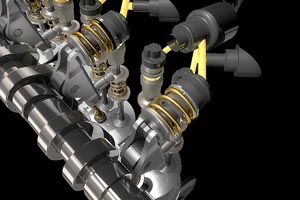
    The operating principle of the system, applied to intake valves, is the following: a piston, moved by a mechanical intake camshaft, is connected to the intake valve through a hydraulic chamber, which is controlled by a normally open on/off solenoid valve.

    When the solenoid valve is closed, the oil in the hydraulic chamber behaves like a solid body and transmits to the intake valves the lift schedule imposed by the mechanical intake camshaft.

    When the solenoid valve is open, the hydraulic chamber and the intake valves are de-coupled; the intake valves do not follow the intake camshaft anymore and close under the valve spring action.

    The final part of the valve closing stroke is controlled by a dedicated hydraulic brake, to ensure a soft and regular landing phase in any engine operating conditions.

    Through solenoid valve opening and closing time control, a wide range of optimum intake valve opening schedules can be easily obtained.

    For maximum power, the solenoid valve is always closed and full valve opening is achieved following completely the mechanical camshaft, which is specifically designed to maximise power at high engine speed (long opening time).

    For low-rpm torque, the solenoid valve is opened near the end of the camshaft profile, leading to early intake valve closing. This eliminates unwanted backflow into the manifold and maximises the air mass trapped in the cylinders.

    In engine part-load, the solenoid valve is opened earlier, causing partial valve openings to control the trapped air mass as a function of the required torque.

    Alternatively the intake valves can be partially opened by closing the solenoid valve once the mechanical camshaft action has already started. In this case the air stream into the cylinder is faster and results in higher in-cylinder turbulence.

    The last two actuation modes can be combined in the same intake stroke, generating a so-called Multilift mode that enhances turbulence and combustion rate at very low loads.

    24.4k

    Tags

    fiat fiat group fiat multiair multiair fiat multilift multilift fiat technology italian cars carbon emissions

    AllReviewsNewsAdviceFeaturesVideos
    • Home
    • Car Articles
    • news
    • news Listings
    • Fiat News

    Fiat's new camshaft technology promises more power for less fuel

    09 Mar 2009

    |

    5,209 views

    A new camshaft design which can adjust valve timings might pave the way for even better power with less fuel consumed.

    The Fiat Group has just launched a new petrol engine design technology called MultiAir, which Fiat claims is a fundamental breakthrough and will dramatically cut fuel consumption, as well as significantly boost power and torque. Emissions will also be lowered by between 10 and 25 percent, and up to 60 percent in other engine pollutants.

    The new technology claims that maximum power will be increased by up to 10 percent, while low rpm torque goes up by up to 15 percent. Apart from also being able to achieve greater fuel economy and reduce harmful gas emissions, the MultiAir design is applicable to all internal combustion engines, regardless of the type of fuel used.

    In short, an engine equipped with Fiat MultiAir technology is more powerful, more responsive across the entire engine speed range, uses considerably less fuel, and reduces all types of exhaust emissions by a substantial amount. It will also assist in enabling Fiat to maintain its lead in low emissions and low fuel consumption technology, which has seen Fiat crowned for the past two years as the number one car maker for the lowest range-wide CO2 emissions.

    The first new engine to be equipped with MultiAir will be the 16-valve 1.4 litre family of naturally aspirated and turbocharged engines, and the first car to go on sale with MultiAir installed will be the Alfa MiTo at the end of 2009. Its second application will be as an integral part of a new two cylinder engine family.

    MultiAir Technology: How it works


    The operating principle of the system, applied to intake valves, is the following: a piston, moved by a mechanical intake camshaft, is connected to the intake valve through a hydraulic chamber, which is controlled by a normally open on/off solenoid valve.

    When the solenoid valve is closed, the oil in the hydraulic chamber behaves like a solid body and transmits to the intake valves the lift schedule imposed by the mechanical intake camshaft.

    When the solenoid valve is open, the hydraulic chamber and the intake valves are de-coupled; the intake valves do not follow the intake camshaft anymore and close under the valve spring action.

    The final part of the valve closing stroke is controlled by a dedicated hydraulic brake, to ensure a soft and regular landing phase in any engine operating conditions.

    Through solenoid valve opening and closing time control, a wide range of optimum intake valve opening schedules can be easily obtained.

    For maximum power, the solenoid valve is always closed and full valve opening is achieved following completely the mechanical camshaft, which is specifically designed to maximise power at high engine speed (long opening time).

    For low-rpm torque, the solenoid valve is opened near the end of the camshaft profile, leading to early intake valve closing. This eliminates unwanted backflow into the manifold and maximises the air mass trapped in the cylinders.

    In engine part-load, the solenoid valve is opened earlier, causing partial valve openings to control the trapped air mass as a function of the required torque.

    Alternatively the intake valves can be partially opened by closing the solenoid valve once the mechanical camshaft action has already started. In this case the air stream into the cylinder is faster and results in higher in-cylinder turbulence.

    The last two actuation modes can be combined in the same intake stroke, generating a so-called Multilift mode that enhances turbulence and combustion rate at very low loads.
    24.4k

    Tags

    fiat fiat group fiat multiair multiair fiat multilift multilift fiat technology italian cars carbon emissions

    Newsletter

    Be Notified On The Latest News

    Newsletter

    Be Notified On The Latest News

    Latest COE Prices

    August 2026 | 2nd BIDDING
    NEXT TENDER: 09 Sep 2026
    CAT A
    $128,501
    CAT B
    $131,001
    CAT C
    $90,002
    CAT E
    $135,000
    View Full Results

    Latest COE Prices

    August 2026 | 2nd BIDDING
    NEXT TENDER: 09 Sep 2026
    CAT A
    $128,501
    CAT B
    $131,001
    CAT C
    $90,002
    CAT E
    $135,000
    View Full Results

    You May Also Like

    Sgcarmart Explores: Bras Basah!

    Sgcarmart Explores: Bras Basah!

    New cars are safer: Opt for one when you can

    New cars are safer: Opt for one when you can

    Maxus MIFA 7 Elite: Going big for the little moments

    Maxus MIFA 7 Elite: Going big for the little moments

    We try out roadside parking with the new OBU!

    We try out roadside parking with the new OBU!

    Sgcarmart Explores: East Coast Park!

    Sgcarmart Explores: East Coast Park!

    Opinion: Why do we even need green number plates?

    Opinion: Why do we even need green number plates?

    Mazda 6e Fastback GT Electric review

    Mazda 6e Fastback GT Electric review

    Opinion: Is it time for a change to our road traffic laws?

    Opinion: Is it time for a change to our road traffic laws?

    The BYD Sealion 8 seven-seater SUV arrives in Singapore

    The BYD Sealion 8 seven-seater SUV arrives in Singapore

    Hongqi Singapore opens its showroom doors

    Hongqi Singapore opens its showroom doors

    A first look at Chery's iCaur V23 and Jaecoo J8 in Singapore

    A first look at Chery's iCaur V23 and Jaecoo J8 in Singapore

    Is parallel import hesitancy growing among car buyers?

    Is parallel import hesitancy growing among car buyers?

    Toyota RAV4 Hybrid vs Subaru Forester e-Boxer

    Toyota RAV4 Hybrid vs Subaru Forester e-Boxer

    New to driving? Here's how to become a better driver

    New to driving? Here's how to become a better driver

    Tesla launches Model Y L in Singapore, first six-seater here

    Tesla launches Model Y L in Singapore, first six-seater here

    Mercedes-Benz GLC debuts alongside Studio opening

    Mercedes-Benz GLC debuts alongside Studio opening

    You May Also Like

    Sgcarmart Explores: Bras Basah!

    Sgcarmart Explores: Bras Basah!

    New cars are safer: Opt for one when you can

    New cars are safer: Opt for one when you can

    Maxus MIFA 7 Elite: Going big for the little moments

    Maxus MIFA 7 Elite: Going big for the little moments

    We try out roadside parking with the new OBU!

    We try out roadside parking with the new OBU!

    Sgcarmart Explores: East Coast Park!

    Sgcarmart Explores: East Coast Park!

    Opinion: Why do we even need green number plates?

    Opinion: Why do we even need green number plates?

    Mazda 6e Fastback GT Electric review

    Mazda 6e Fastback GT Electric review

    Opinion: Is it time for a change to our road traffic laws?

    Opinion: Is it time for a change to our road traffic laws?

    The BYD Sealion 8 seven-seater SUV arrives in Singapore

    The BYD Sealion 8 seven-seater SUV arrives in Singapore

    Hongqi Singapore opens its showroom doors

    Hongqi Singapore opens its showroom doors

    A first look at Chery's iCaur V23 and Jaecoo J8 in Singapore

    A first look at Chery's iCaur V23 and Jaecoo J8 in Singapore

    Is parallel import hesitancy growing among car buyers?

    Is parallel import hesitancy growing among car buyers?

    Toyota RAV4 Hybrid vs Subaru Forester e-Boxer

    Toyota RAV4 Hybrid vs Subaru Forester e-Boxer

    New to driving? Here's how to become a better driver

    New to driving? Here's how to become a better driver

    Tesla launches Model Y L in Singapore, first six-seater here

    Tesla launches Model Y L in Singapore, first six-seater here

    Mercedes-Benz GLC debuts alongside Studio opening

    Mercedes-Benz GLC debuts alongside Studio opening

    Related Articles

    BYD Seal 6 Premium Review

    BYD Seal 6 Premium Review

    Sgcarmart Explores: Bras Basah!

    Sgcarmart Explores: Bras Basah!

    New cars are safer: Opt for one when you can

    New cars are safer: Opt for one when you can

    Opinion: Why do we even need green number plates?

    Opinion: Why do we even need green number plates?

    Cars of 2026

    Cars of 2026

    We try out roadside parking with the new OBU!

    We try out roadside parking with the new OBU!

    Maxus MIFA 7 Elite Review

    Maxus MIFA 7 Elite Review

    Tesla launches Model Y L in Singapore, first six-seater here

    Tesla launches Model Y L in Singapore, first six-seater here

    Related Articles

    BYD Seal 6 Premium Review

    BYD Seal 6 Premium Review

    Sgcarmart Explores: Bras Basah!

    Sgcarmart Explores: Bras Basah!

    New cars are safer: Opt for one when you can

    New cars are safer: Opt for one when you can

    Opinion: Why do we even need green number plates?

    Opinion: Why do we even need green number plates?

    Cars of 2026

    Cars of 2026

    We try out roadside parking with the new OBU!

    We try out roadside parking with the new OBU!

    Maxus MIFA 7 Elite Review

    Maxus MIFA 7 Elite Review

    Tesla launches Model Y L in Singapore, first six-seater here

    Tesla launches Model Y L in Singapore, first six-seater here