Porsche is no stranger to motorsports. Since it first started racing in the 50s, Porsche has been involved in race series that range from endurance racing, GT racing, rallying, Formula One, and now, of course, Formula E as well.
This dedication to motorsport should come as no surprise for a brand that has sports cars as the very essence of its DNA. Porsche may be the newest team in Formula E, but motorsport has been an integral part of the brand’s heritage. And on one hand, Formula E is a new ballgame - different tracks, different rules, a different approach to the race cars and etc. But on the other hand, its very much the same. It's just racing.
Racing development
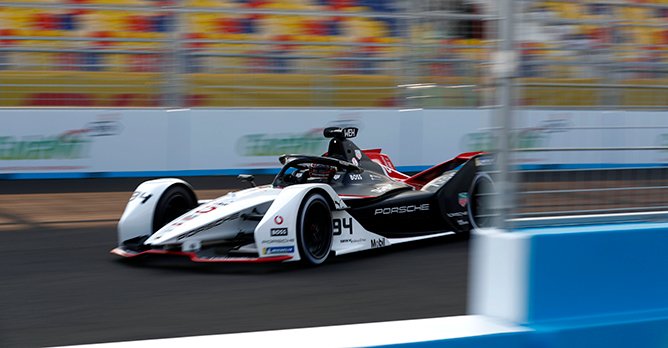
 Beyond an obvious marketing exercise, Formula E is also a valuable arena to develop EV technologies So why Formula E, then?
Obviously, it is an exercise in branding and marketing. Porsche entered Formula E in the same year it launched the Taycan, its first all-electric model. But let's not be naïve - every race series is an exercise in branding and marketing. Just look at all the brand names plastered across race cars.
But beyond that, Formula E is a sport, and competition breeds development. Obviously, if you want to win, you need to improve and develop the car (within the limited parameters established by Formula E).
And while you're not going to necessarily get a direct transplant of the Formula E powertrain into a road car, Formula E is arguably the race series where there is the most relevant and transferable takeaways for road going cars. Managing software, energy recuperation and battery temperature is crucial not just for a Formula E car, but any road-going EV as well. This is especially more so for a brand like Porsche that makes performance EVs, but the relevance to any EV is clear enough.
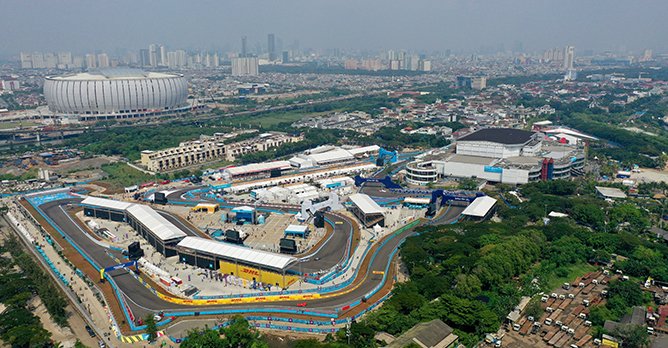 A blazing hot setting like the Jakarta International E-Prix Circuit pushes the race cars to their limits What Formula E offers is a chance to stress test these mechanical components and software in the most extreme of conditions. Jakarta, for example, is a case of extreme temperature management, with ambient temperature in the high 30s.
The ability to ensure optimal battery operation in such conditions is obviously crucial to racing success, but any Singaporean can appreciate what that will mean for EVs in general as well. These are the sort of temperatures we experience every day, and the fact that manufacturers have access to such data (as a function of going racing) bodes well for future road-going EVs.
Racing ambition
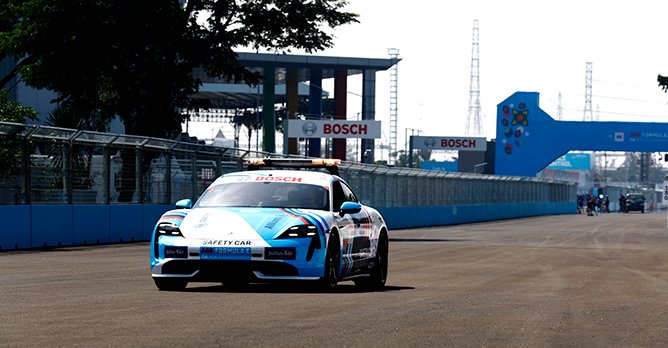 Besides racing, Porsche's involvement in Formula E also extends to the safety car - Taycan Turbo S Formula E also isn't the be all and end all of Porsche's electric racing ambitions. As the automotive industry as a whole moves steadily away from internal combustion, motor racing will likely chart the same course.
It's not something Porsche is shying away from. The Mission R, unveiled last year, is a conceptual look at what a full-blown electric race car could be. And, just a couple of weeks ago, Porsche also revealed the Cayman GT4 ePerformance, an all electric racer based on the chassis of the 718 Cayman GT4 Clubsport.
Some lines from the press release stand out: In simulated racing, a steady 450 kW (612 PS) is available for 30 minutes, i.e. the duration of a Carrera Cup race. In terms of lap times and top speed, the 718 Cayman GT4 ePerformance is on par with the performance of the current 992-generation 911 GT3 Cup.
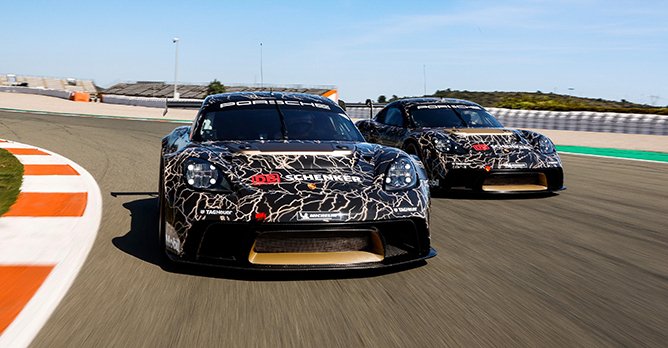 The recently unveiled Cayman T4 ePerformance points at the future of Porsche's electric racing ambitions While not explicitly stated, any betting man would hedge on the fact that the Cayman GT4 ePerformance will likely spawn the next iteration of Porsche's one-make GT3 racer and form the basis of the Carrera Cup moving forward.
Porsche's direct factory involvement in Formula E definitely ties into these future developments. The data and learnings from a top-tier race series like Formula E will trickle down across the rest of its motorsport programme. And, perhaps more so than any other brand, those motorsport developments also tend to find their way into the road cars as well.
So what does that mean for us? Well, the future is electric, that's for sure. The future of performance, too, is increasingly electric. The continued progress and growing ambition of Formula E, together with the various manufacturers involved in the race series, will help breed the necessary innovation to facilitate and even accelerate the development of future EVs. And whether for the rack or the road, it can only mean better cars for all of us.
This dedication to motorsport should come as no surprise for a brand that has sports cars as the very essence of its DNA. Porsche may be the newest team in Formula E, but motorsport has been an integral part of the brand’s heritage. And on one hand, Formula E is a new ballgame - different tracks, different rules, a different approach to the race cars and etc. But on the other hand, its very much the same. It's just racing.
Racing development
Obviously, it is an exercise in branding and marketing. Porsche entered Formula E in the same year it launched the Taycan, its first all-electric model. But let's not be naïve - every race series is an exercise in branding and marketing. Just look at all the brand names plastered across race cars.
But beyond that, Formula E is a sport, and competition breeds development. Obviously, if you want to win, you need to improve and develop the car (within the limited parameters established by Formula E).
And while you're not going to necessarily get a direct transplant of the Formula E powertrain into a road car, Formula E is arguably the race series where there is the most relevant and transferable takeaways for road going cars. Managing software, energy recuperation and battery temperature is crucial not just for a Formula E car, but any road-going EV as well. This is especially more so for a brand like Porsche that makes performance EVs, but the relevance to any EV is clear enough.
The ability to ensure optimal battery operation in such conditions is obviously crucial to racing success, but any Singaporean can appreciate what that will mean for EVs in general as well. These are the sort of temperatures we experience every day, and the fact that manufacturers have access to such data (as a function of going racing) bodes well for future road-going EVs.
Racing ambition
It's not something Porsche is shying away from. The Mission R, unveiled last year, is a conceptual look at what a full-blown electric race car could be. And, just a couple of weeks ago, Porsche also revealed the Cayman GT4 ePerformance, an all electric racer based on the chassis of the 718 Cayman GT4 Clubsport.
Some lines from the press release stand out: In simulated racing, a steady 450 kW (612 PS) is available for 30 minutes, i.e. the duration of a Carrera Cup race. In terms of lap times and top speed, the 718 Cayman GT4 ePerformance is on par with the performance of the current 992-generation 911 GT3 Cup.
Porsche's direct factory involvement in Formula E definitely ties into these future developments. The data and learnings from a top-tier race series like Formula E will trickle down across the rest of its motorsport programme. And, perhaps more so than any other brand, those motorsport developments also tend to find their way into the road cars as well.
So what does that mean for us? Well, the future is electric, that's for sure. The future of performance, too, is increasingly electric. The continued progress and growing ambition of Formula E, together with the various manufacturers involved in the race series, will help breed the necessary innovation to facilitate and even accelerate the development of future EVs. And whether for the rack or the road, it can only mean better cars for all of us.