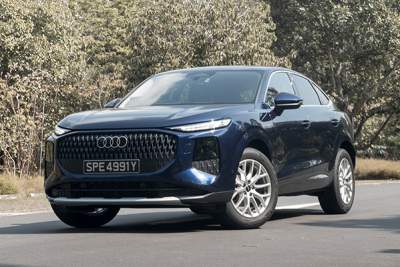
The marque with four rings is introducing new, lightweight suspension springs made of Glass Fibre-Reinforced Polymer (GFRP) in an upper mid-size model before the end of the year.
The GFRP spring, which Audi developed in collaboration with an Italian supplier, looks different from a steel spring. It is light green, the fibre strand is thicker than the wire of a steel spring, and it has a slightly larger overall diameter with a lower number of coils.
More importantly, however, it is almost 40 percent lighter. Whereas a steel spring for an upper mid-size model weighs nearly 2.7kg, a GFRP spring with the same properties weighs just approximately 1.6kg.
Together, the four GFRP springs thus reduce the weight by roughly 4.4kg, half of which pertains to the unsprung mass.
The core of the springs consists of long glass fibres twisted together and impregnated with epoxy resin. A machine wraps additional fibre around this core - which is only a few millimetres in diameter - at alternating angles of plus and minus 45 degrees to the longitudinal axis. These tension and compression plies mutually support one another to optimally absorb the stresses acting on the component.
In the last production step, the blank is cured in an oven at temperatures of over 100 degrees Celsius.
The GFRP springs can be precisely tuned to their respective task, and the material exhibits outstanding properties. Audi claims the GFRP springs do not corrode, even after stone chipping, and is impervious to chemicals such as wheel cleaners. More importantly, production of the GFRP springs requires far less energy than the production of steel springs.
The GFRP spring, which Audi developed in collaboration with an Italian supplier, looks different from a steel spring. It is light green, the fibre strand is thicker than the wire of a steel spring, and it has a slightly larger overall diameter with a lower number of coils.
More importantly, however, it is almost 40 percent lighter. Whereas a steel spring for an upper mid-size model weighs nearly 2.7kg, a GFRP spring with the same properties weighs just approximately 1.6kg.
Together, the four GFRP springs thus reduce the weight by roughly 4.4kg, half of which pertains to the unsprung mass.
The core of the springs consists of long glass fibres twisted together and impregnated with epoxy resin. A machine wraps additional fibre around this core - which is only a few millimetres in diameter - at alternating angles of plus and minus 45 degrees to the longitudinal axis. These tension and compression plies mutually support one another to optimally absorb the stresses acting on the component.
In the last production step, the blank is cured in an oven at temperatures of over 100 degrees Celsius.
The GFRP springs can be precisely tuned to their respective task, and the material exhibits outstanding properties. Audi claims the GFRP springs do not corrode, even after stone chipping, and is impervious to chemicals such as wheel cleaners. More importantly, production of the GFRP springs requires far less energy than the production of steel springs.