Debut of Goodyear Self-Inflating Technology for commercial tyres
25 Sep 2012|3,267 views


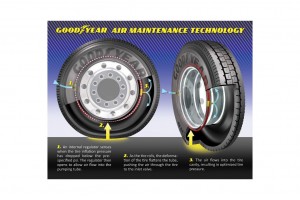
Over the past year, researchers at The Goodyear Tire & Rubber Company have been working on a new Air Maintenance Technology application that can aid in fuel savings and CO2 reductions while potentially improving performance and eliminating need for external inflation pressure intervention. The commercial application of Goodyear's Air Maintenance Technology will make its debut at the 2012 Internationale Automobil-Ausstellung (IAA) Commercial Vehicle Show in Hanover, Germany.
Goodyear's Air Maintenance Technology mechanism allows tyres to maintain constant, optimum pressure without the use of external pumps, electronics and driver intervention. Proper tyre inflation can result in improved fuel economy, prolonged tread life and optimised tyre performance. Customers should receive the following key benefits from Air Maintenance Technology-enabled tires:
 Improved Fuel Economy
 Optimum tyre pressure is key in the commercial market. It is estimated that for every 10 psi lost in tyre inflation, there is a one percent loss in miles per gallon.
While one percent may seem insignificant, it could cost a truck owner over $627 in fuel, based on a vehicle that has a fuel consumption of 6.6 miles per gallon, runs 100,000 miles a year with a diesel fuel price of $4.10/gallon.
Prolonged Tread Life
AMT is expected to play a major role in optimising tread life in the commercial tyre market. Tyres which are under inflated by ten percent decrease tread life by 9-16 percent. By utilising Goodyear's Air Maintenance Technology, commercial vehicle fleet operators will be able to realise the full mileage potential of their tyres, thus saving money by prolonging the use of their tyres.
Optimised Performance
Properly inflated tyres are also necessary to keep a vehicle's handling performance at optimal levels. Under-inflation means less evenly distributed pressure on the road. It also reduces the tread area that is in direct contact with the road and can impact the integrity of the tire casing, which is key to the retreading process.
Commercial trucks pose a different challenge for AMT than that of consumer vehicles as their tyres are larger, have higher inflation pressures, drive longer distances and carry much heavier loads. Commercial tyres operate at a higher air pressure, typically 105 psi for commercial tyres vs. 32 psi for consumer tyres.
"We believe the Air Maintenance Technology application for commercial vehicle tyres will not only enhance the performance of the tyre, but will also provide cost savings to fleet owners and operators through the extension of tyre tread life and increased fuel economy," stated Goodyear's Chief Technical Officer, Jean-Claude Kihn. "The progress we continue to make with this technology is very encouraging. We look forward to further testing of this concept."
Over the past year, researchers at The Goodyear Tire & Rubber Company have been working on a new Air Maintenance Technology application that can aid in fuel savings and CO2 reductions while potentially improving performance and eliminating need for external inflation pressure intervention. The commercial application of Goodyear's Air Maintenance Technology will make its debut at the 2012 Internationale Automobil-Ausstellung (IAA) Commercial Vehicle Show in Hanover, Germany.
Goodyear's Air Maintenance Technology mechanism allows tyres to maintain constant, optimum pressure without the use of external pumps, electronics and driver intervention. Proper tyre inflation can result in improved fuel economy, prolonged tread life and optimised tyre performance. Customers should receive the following key benefits from Air Maintenance Technology-enabled tires:
Improved Fuel Economy
Optimum tyre pressure is key in the commercial market. It is estimated that for every 10 psi lost in tyre inflation, there is a one percent loss in miles per gallon.
While one percent may seem insignificant, it could cost a truck owner over $627 in fuel, based on a vehicle that has a fuel consumption of 6.6 miles per gallon, runs 100,000 miles a year with a diesel fuel price of $4.10/gallon.
Prolonged Tread Life
AMT is expected to play a major role in optimising tread life in the commercial tyre market. Tyres which are under inflated by ten percent decrease tread life by 9-16 percent. By utilising Goodyear's Air Maintenance Technology, commercial vehicle fleet operators will be able to realise the full mileage potential of their tyres, thus saving money by prolonging the use of their tyres.
Optimised Performance
Properly inflated tyres are also necessary to keep a vehicle's handling performance at optimal levels. Under-inflation means less evenly distributed pressure on the road. It also reduces the tread area that is in direct contact with the road and can impact the integrity of the tire casing, which is key to the retreading process.
Commercial trucks pose a different challenge for AMT than that of consumer vehicles as their tyres are larger, have higherinflation pressures, drive longer distances and carry much heavier loads. Commercial tyres operate at a higher air pressure, typically 105 psi for commercial tyres vs. 32 psi for consumer tyres.
"We believe the Air Maintenance Technology application for commercial vehicle tyres will not only enhance the performance of the tyre, but will also provide cost savings to fleet owners and operators through the extension of tyre tread life and increased fuel economy," stated Goodyear's Chief Technical Officer, Jean-Claude Kihn. "The progress we continue to make with this technology is very encouraging. We look forward to further testing of this concept."


Latest COE Prices
June 2026 | 2nd BIDDING
NEXT TENDER: 08 Jul 2026
CAT A$123,847
CAT B$123,502
CAT C$93,001
CAT E$129,002
View Full Results 
Thank You For Your Subscription.










Tags
Products & Services

For Owners
Quick Links
About Sgcarmart