Virtual reality projections bring Ford prototypes to life
18 May 2013|1,846 views


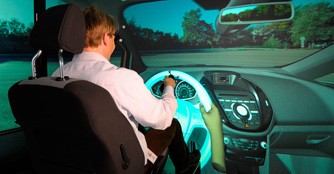
The 3D CAVE - the room where Ford cars of tomorrow are fine tuned - appears slightly incongruous at first glance. Large white walls form a three-sided box with projectors throwing images on to each wall and the ceiling. Mounted in the middle is a dummy car interior.
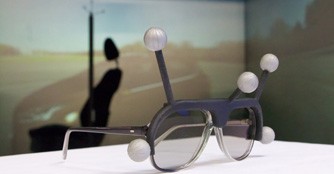

Engineers using the 3D CAVE in Cologne, Germany, sit in a dummy car interior as vehicle 3D simulations are projected onto the ceiling and three surrounding walls. Wearing special polarising glasses and monitored by a motion detecting infrared system, they interact with the virtual vehicle by, for example, determining the reach to rear view mirrors or to place bottles into door pockets.
The CAVE uses an animated external environment with pedestrians and cyclists to help engineers assess visibility of the outside world from inside the car. It also enables engineers to access and compare at the push of a button multiple designs - including vehicle interiors produced by other manufacturers. Ford's CAVE in Cologne is supported by an identical setup in Dearborn, U.S.A, and further single-wall facilities make it much easier to move prototypes around the world.
Ford is now investigating incorporating controls that operate the in-car entertainment system, open and close windows, and provide advanced driving simulations. Real time global illumination scenarios could allow engineers to analyse how interior lighting and reflections change through the course of the day and according to changing weather conditions.
"The CAVE makes it so much quicker and easier to analyse designs," said Michael Wolf, Virtual Reality Supervisor, Ford of Europe. "For example, to manufacture three different front pillar design examples and fit them to a prototype vehicle could take 10 days. The same project could be completed in just one or two days using our virtual reality simulator - and also saves physical resources."
Ford is now researching potentially producing large volume car parts using the technology.
The 3D CAVE - the room where Ford cars of tomorrow are fine tuned - appears slightly incongruous at first glance. Large white walls form a three-sided box with projectors throwing images on to each wall and the ceiling. Mounted in the middle is a dummy car interior.
Rather than building multiple real world vehicle prototypes - a time consuming and resource intensive process - Ford uses the 3D CAVE to test and refine thousands of details of new car designs from the size and position of a cup holder to rear window visibility.
Engineers using the 3D CAVE in Cologne, Germany, sit in a dummy car interior as vehicle 3D simulations are projected onto the ceiling and three surrounding walls. Wearing special polarising glasses and monitored by a motion detecting infrared system, they interact with the virtual vehicle by, for example, determining the reach to rear view mirrors or to place bottles into door pockets.
The CAVE uses an animated external environment with pedestrians and cyclists to help engineers assess visibility of the outside world from inside the car. It also enables engineers to access and compare at the push of a button multiple designs - including vehicle interiors produced by other manufacturers. Ford's CAVE in Cologne is supported by an identical setup in Dearborn, U.S.A, and further single-wall facilities make it much easier to move prototypes around the world.
For the Focus, Ford used the CAVE to optimise windscreen wiper effectiveness; to maximise roominess for rear passengers by testing designs for the front seats and headrests; to evaluate door frame design impact on visibility; and to minimise reflections that can affect the view through windows and of information displays.
Ford is now investigating incorporating controls that operate the in-car entertainment system, open and close windows, and provide advanced driving simulations. Real time global illumination scenarios could allow engineers to analyse how interior lighting and reflections change through the course of the day and according to changing weather conditions.
"The CAVE makes it so much quicker and easier to analyse designs," said Michael Wolf, Virtual Reality Supervisor, Ford of Europe. "For example, to manufacture three different front pillar design examples and fit them to a prototype vehicle could take 10 days. The same project could be completed in just one or two days using our virtual reality simulator - and also saves physical resources."
Ford is now researching potentially producing large volume car parts using the technology.


Latest COE Prices
June 2026 | 2nd BIDDING
NEXT TENDER: 08 Jul 2026
CAT A$123,847
CAT B$123,502
CAT C$93,001
CAT E$129,002
View Full Results 
Thank You For Your Subscription.








Tags
Products & Services

For Owners
Quick Links
About Sgcarmart