Volvo V50 2.0 (A) Review
19 Mar 2010|18,284 views


It’s called the Ford C1 platform and Ford has classified it as their global compact car automobile platform.
Closer to the Swede though, the C1 platforms finds its place in the bottom of V50 estate, the S40 sedan which the V50 is based on, the beautiful C30 hatchback and the more elegant C70 coupe/cabriolet.
Apart from saving Volvo some major costs by sharing these parts, the C1 platform has also imparted its sure handling characteristics in Volvo’s line-up.
Volvo explains that the ‘V’ in the V50’s nomenclature stands for versatility. A very apt title for the estate, being able to take the form of a daily runaround to the transport for the annual family road trip.
So being the baby of the wagons and in base trim, how does this 2.0-litre Volvo match up? Well, let’s start with the car looks.
Exterior
Over the years, Volvo has managed to get itself out of its boxy, mundane and predictable design rut, somewhat transforming itself into something more of a desirable product than just being plain safe and practical. Plus securing the placement of their products in all the Twilight installments, and keeping their new C30 in full view of screaming teenage girls and their parents hasn’t hurt the brand one bit.
Closer to the Swede though, the C1 platforms finds its place in the bottom of V50 estate, the S40 sedan which the V50 is based on, the beautiful C30 hatchback and the more elegant C70 coupe/cabriolet.
Apart from saving Volvo some major costs by sharing these parts, the C1 platform has also imparted its sure handling characteristics in Volvo’s line-up.
Volvo explains that the ‘V’ in the V50’s nomenclature stands for versatility. A very apt title for the estate, being able to take the form of a daily runaround to the transport for the annual family road trip.
So being the baby of the wagons and in base trim, how does this 2.0-litre Volvo match up? Well, let’s start with the car looks.
Exterior
Over the years, Volvo has managed to get itself out of its boxy, mundane and predictable design rut, somewhat transforming itself into something more of a desirable product than just being plain safe and practical. Plus securing the placement of their products in all the Twilight installments, and keeping their new C30 in full view of screaming teenage girls and their parents hasn’t hurt the brand one bit.
 |
It’s with companies like Volvo that I find wagon’s very appealing, and it’s not hard to see with the V50.
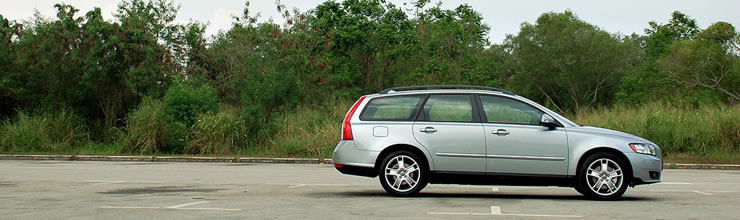
The short overhang at the front features the front end of the S40 mid-sized sedan in all its handsome glory. The front grill sits on a raised middle portion which continues further back towards the windshield, leaving the headlamps to form its own recessed shoulder line – giving the V50 its definitive muscular and sporty stance.
Those shoulder lines continue below the side-mirrors, above both door handles and cutting a wedge out of the rear to give the rear proportions we’ve become sort of familiar with from the XC90.
The short overhangs, the subtly sloping roof, the rising rear bumper and the 17 inch multi-spoke rims round off the car’s sporty stance that the V50 captures perfectly viewed from any angle.
 |
Interior
From the sporty exterior we open the door to reveal the uncluttered and simplistic interior.
Black leather upholstered seats are matched by the hard black plastics around the dash and door areas, broken up at times by the inclusion of grey plastic insets for the centre stack and the surrounding plastics for the door panel buttons.
The floating centre stack that Volvo introduced some years back is featured here as well but does little to add some trace of luxury or depth in design (and character) alongside the rest of the almost minimalist interior. Thankfully though, as it should be in up market brands like Volvo, the plastics used in and around the V50 feels solid and tactile.
That’s especially the case with the dashboard, being covered in soft and grippy rubber.
The leather upholstered seats are comfortable enough for you to find ‘that spot’ in but the lowest position seating position it offered still seemed high in my opinion. But unlike me, then market for such a product has long been analysed and targeted while considering such things like handling, suspension and seating positions. Helping you along in finding that sweet spot, the driver benefits from a six-way electronic adjustment system which he can store up to three positions in memory.
The Volvo V50 boasts seating for five full length adults (up to 178 cm) is very realistic with the front seats set for someone of a similar stature.
Rear boot space comes in at a disappointing 417 litres but can be easily extended to 1,307 litres with the rear two seats folded down flat.
Overall the V50 feels like a near-premium car on the inside with the comfortable leather seats and good quality and solid trim.
From the sporty exterior we open the door to reveal the uncluttered and simplistic interior.
Black leather upholstered seats are matched by the hard black plastics around the dash and door areas, broken up at times by the inclusion of grey plastic insets for the centre stack and the surrounding plastics for the door panel buttons.
The floating centre stack that Volvo introduced some years back is featured here as well but does little to add some trace of luxury or depth in design (and character) alongside the rest of the almost minimalist interior. Thankfully though, as it should be in up market brands like Volvo, the plastics used in and around the V50 feels solid and tactile.
That’s especially the case with the dashboard, being covered in soft and grippy rubber.
The leather upholstered seats are comfortable enough for you to find ‘that spot’ in but the lowest position seating position it offered still seemed high in my opinion. But unlike me, then market for such a product has long been analysed and targeted while considering such things like handling, suspension and seating positions. Helping you along in finding that sweet spot, the driver benefits from a six-way electronic adjustment system which he can store up to three positions in memory.
The Volvo V50 boasts seating for five full length adults (up to 178 cm) is very realistic with the front seats set for someone of a similar stature.
Rear boot space comes in at a disappointing 417 litres but can be easily extended to 1,307 litres with the rear two seats folded down flat.
Overall the V50 feels like a near-premium car on the inside with the comfortable leather seats and good quality and solid trim.
Driving impressions
And this is where things get a little boring.
The 2.0-litre, 145 bhp producing engine prides itself on being the economical choice for buyers but provides the driver with some lackluster performance. With power topping off high up the rev range at 6,000 rpm and 185 Nm of torque hitting its peak at 4,500 rpm, the six speed autobox does provide you with some variation in your driving style but ends when you floor the throttle.
Now, some might think that there’s no need for anyone to be flooring any form of metal to the floor but it becomes relevant when you’re driving at 90 km/h on the expressway and find yourself having to swerve out of your lane and into the next one when another moving bulk of metal decides to blindly cut into your lane at a highly rated speed.
To cleanly get out of trouble though you’d have to floor the throttle and muster up the entire engine’s worth to match your speed with the traffic on the next lane.
On the Volvo, the six-speed box seems to take a second at times to decide which gear it should be slotting itself in. After accomplishing that feat though, you’re met with the incessant wailings of the engine being pushed way past its tolerable and useful range.
The only two saving graces the V50 has going for it though are its handling characteristics and comfort level while driving.
Steering is inherently relaxed but firm enough to be confident when taking the car through bends. Recently when I took the Chery A3 out, even after hours with the car, I still wasn’t able to really put the car through its paces due to my lack of confidence in the cars steering and soft suspension that could easily see me sliding from severe understeer into something I’d rather be driving parallel along.
Suspension has been setup nicely, leaning towards the softer side but still maintaining the firm dampening you need over slow speed bumps and uneven surfaces.
And this is where things get a little boring.
The 2.0-litre, 145 bhp producing engine prides itself on being the economical choice for buyers but provides the driver with some lackluster performance. With power topping off high up the rev range at 6,000 rpm and 185 Nm of torque hitting its peak at 4,500 rpm, the six speed autobox does provide you with some variation in your driving style but ends when you floor the throttle.
Now, some might think that there’s no need for anyone to be flooring any form of metal to the floor but it becomes relevant when you’re driving at 90 km/h on the expressway and find yourself having to swerve out of your lane and into the next one when another moving bulk of metal decides to blindly cut into your lane at a highly rated speed.
To cleanly get out of trouble though you’d have to floor the throttle and muster up the entire engine’s worth to match your speed with the traffic on the next lane.
On the Volvo, the six-speed box seems to take a second at times to decide which gear it should be slotting itself in. After accomplishing that feat though, you’re met with the incessant wailings of the engine being pushed way past its tolerable and useful range.
The only two saving graces the V50 has going for it though are its handling characteristics and comfort level while driving.
Steering is inherently relaxed but firm enough to be confident when taking the car through bends. Recently when I took the Chery A3 out, even after hours with the car, I still wasn’t able to really put the car through its paces due to my lack of confidence in the cars steering and soft suspension that could easily see me sliding from severe understeer into something I’d rather be driving parallel along.
Suspension has been setup nicely, leaning towards the softer side but still maintaining the firm dampening you need over slow speed bumps and uneven surfaces.
 |
Should you even consider this?
From the number of them on our roads, it’s evident that some have found some sense in buying the Swede.
It is given that the Volvo V50 has its moments of worth, but in my own personal and humble opinion, I think anyone considering this have about two other better alternatives to choose from – namely the Alfa Romeo 159 Sportwagon 2.2 Selespeed ($125,800 as at 11/03/10) and the Skoda Octavia Combi VRS ($117,800 as at 11/03/10).
The Alfa, while being marginally more expensive than the Volvo, has a larger capacity engine with a larger boot and has looks that could make up for any short comings of the brand.
From the number of them on our roads, it’s evident that some have found some sense in buying the Swede.
It is given that the Volvo V50 has its moments of worth, but in my own personal and humble opinion, I think anyone considering this have about two other better alternatives to choose from – namely the Alfa Romeo 159 Sportwagon 2.2 Selespeed ($125,800 as at 11/03/10) and the Skoda Octavia Combi VRS ($117,800 as at 11/03/10).
The Alfa, while being marginally more expensive than the Volvo, has a larger capacity engine with a larger boot and has looks that could make up for any short comings of the brand.
The Octavia Combi VRS on the other hand is plain much more sensible a buy than the Volvo if you want a car that drives and sounds like a VW Golf GTI.
So with both the above alternatives, the Volvo V50, at $124,199 as at 11/03/10, isn’t looking as attractive as it first was. But if you’re bent on getting a Volvo, I’d strongly suggest you shelling out more for the higher spec T5 version with R-design kit on.
Not only does it enhances the sporty personality of the car but the turbo 2.5-litre unit churns out 85 bhp more and has 320 Nm of torque spreading out evenly throughout the rev band, from as low as 1,500 rpm.
It’s your decision to make though, so be wise with how you spend your hard earned dollars.
So with both the above alternatives, the Volvo V50, at $124,199 as at 11/03/10, isn’t looking as attractive as it first was. But if you’re bent on getting a Volvo, I’d strongly suggest you shelling out more for the higher spec T5 version with R-design kit on.
Not only does it enhances the sporty personality of the car but the turbo 2.5-litre unit churns out 85 bhp more and has 320 Nm of torque spreading out evenly throughout the rev band, from as low as 1,500 rpm.
It’s your decision to make though, so be wise with how you spend your hard earned dollars.
It’s called the Ford C1 platform and Ford has classified it as their global compact car automobile platform.
Closer to the Swede though, the C1 platforms finds its place in the bottom of V50 estate, the S40 sedan which the V50 is based on, the beautiful C30 hatchback and the more elegant C70 coupe/cabriolet.
Apart from saving Volvo some major costs by sharing these parts, the C1 platform has also imparted its sure handling characteristics in Volvo’s line-up.
Volvo explains that the ‘V’ in the V50’s nomenclature stands for versatility. A very apt title for the estate, being able to take the form of a daily runaround to the transport for the annual family road trip.
So being the baby of the wagons and in base trim, how does this 2.0-litre Volvo match up? Well, let’s start with the car looks.
Exterior
Over the years, Volvo has managed to get itself out of its boxy, mundane and predictable design rut, somewhat transforming itself into something more of a desirable product than just being plain safe and practical. Plus securing the placement of their products in all the Twilight installments, and keeping their new C30 in full view of screaming teenage girls and their parents hasn’t hurt the brand one bit.
Closer to the Swede though, the C1 platforms finds its place in the bottom of V50 estate, the S40 sedan which the V50 is based on, the beautiful C30 hatchback and the more elegant C70 coupe/cabriolet.
Apart from saving Volvo some major costs by sharing these parts, the C1 platform has also imparted its sure handling characteristics in Volvo’s line-up.
Volvo explains that the ‘V’ in the V50’s nomenclature stands for versatility. A very apt title for the estate, being able to take the form of a daily runaround to the transport for the annual family road trip.
So being the baby of the wagons and in base trim, how does this 2.0-litre Volvo match up? Well, let’s start with the car looks.
Exterior
Over the years, Volvo has managed to get itself out of its boxy, mundane and predictable design rut, somewhat transforming itself into something more of a desirable product than just being plain safe and practical. Plus securing the placement of their products in all the Twilight installments, and keeping their new C30 in full view of screaming teenage girls and their parents hasn’t hurt the brand one bit.
|
It’s with companies like Volvo that I find wagon’s very appealing, and it’s not hard to see with the V50.
The short overhang at the front features the front end of the S40 mid-sized sedan in all its handsome glory. The front grill sits on a raised middle portion which continues further back towards the windshield, leaving the headlamps to form its own recessed shoulder line – giving the V50 its definitive muscular and sporty stance.
Those shoulder lines continue below the side-mirrors, above both door handles and cutting a wedge out of the rear to give the rear proportions we’ve become sort of familiar with from the XC90.
The short overhangs, the subtly sloping roof, the rising rear bumper and the 17 inch multi-spoke rims round off the car’s sporty stance that the V50 captures perfectly viewed from any angle.
|
Interior
From the sporty exterior we open the door to reveal the uncluttered and simplistic interior.
Black leather upholstered seats are matched by the hard black plastics around the dash and door areas, broken up at times by the inclusion of grey plastic insets for the centre stack and the surrounding plastics for the door panel buttons.
The floating centre stack that Volvo introduced some years back is featured here as well but does little to add some trace of luxury or depth in design (and character) alongside the rest of the almost minimalist interior. Thankfully though, as it should be in up market brands like Volvo, the plastics used in and around the V50 feels solid and tactile.
That’s especially the case with the dashboard, being covered in soft and grippy rubber.
The leather upholstered seats are comfortable enough for you to find ‘that spot’ in but the lowest position seating position it offered still seemed high in my opinion. But unlike me, then market for such a product has long been analysed and targeted while considering such things like handling, suspension and seating positions. Helping you along in finding that sweet spot, the driver benefits from a six-way electronic adjustment system which he can store up to three positions in memory.
The Volvo V50 boasts seating for five full length adults (up to 178 cm) is very realistic with the front seats set for someone of a similar stature.
Rear boot space comes in at a disappointing 417 litres but can be easily extended to 1,307 litres with the rear two seats folded down flat.
Overall the V50 feels like a near-premium car on the inside with the comfortable leather seats and good quality and solid trim.
From the sporty exterior we open the door to reveal the uncluttered and simplistic interior.
Black leather upholstered seats are matched by the hard black plastics around the dash and door areas, broken up at times by the inclusion of grey plastic insets for the centre stack and the surrounding plastics for the door panel buttons.
The floating centre stack that Volvo introduced some years back is featured here as well but does little to add some trace of luxury or depth in design (and character) alongside the rest of the almost minimalist interior. Thankfully though, as it should be in up market brands like Volvo, the plastics used in and around the V50 feels solid and tactile.
That’s especially the case with the dashboard, being covered in soft and grippy rubber.
The leather upholstered seats are comfortable enough for you to find ‘that spot’ in but the lowest position seating position it offered still seemed high in my opinion. But unlike me, then market for such a product has long been analysed and targeted while considering such things like handling, suspension and seating positions. Helping you along in finding that sweet spot, the driver benefits from a six-way electronic adjustment system which he can store up to three positions in memory.
The Volvo V50 boasts seating for five full length adults (up to 178 cm) is very realistic with the front seats set for someone of a similar stature.
Rear boot space comes in at a disappointing 417 litres but can be easily extended to 1,307 litres with the rear two seats folded down flat.
Overall the V50 feels like a near-premium car on the inside with the comfortable leather seats and good quality and solid trim.
Driving impressions
And this is where things get a little boring.
The 2.0-litre, 145 bhp producing engine prides itself on being the economical choice for buyers but provides the driver with some lackluster performance. With power topping off high up the rev range at 6,000 rpm and 185 Nm of torque hitting its peak at 4,500 rpm, the six speed autobox does provide you with some variation in your driving style but ends when you floor the throttle.
Now, some might think that there’s no need for anyone to be flooring any form of metal to the floor but it becomes relevant when you’re driving at 90 km/h on the expressway and find yourself having to swerve out of your lane and into the next one when another moving bulk of metal decides to blindly cut into your lane at a highly rated speed.
To cleanly get out of trouble though you’d have to floor the throttle and muster up the entire engine’s worth to match your speed with the traffic on the next lane.
On the Volvo, the six-speed box seems to take a second at times to decide which gear it should be slotting itself in. After accomplishing that feat though, you’re met with the incessant wailings of the engine being pushed way past its tolerable and useful range.
The only two saving graces the V50 has going for it though are its handling characteristics and comfort level while driving.
Steering is inherently relaxed but firm enough to be confident when taking the car through bends. Recently when I took the Chery A3 out, even after hours with the car, I still wasn’t able to really put the car through its paces due to my lack of confidence in the cars steering and soft suspension that could easily see me sliding from severe understeer into something I’d rather be driving parallel along.
Suspension has been setup nicely, leaning towards the softer side but still maintaining the firm dampening you need over slow speed bumps and uneven surfaces.
And this is where things get a little boring.
The 2.0-litre, 145 bhp producing engine prides itself on being the economical choice for buyers but provides the driver with some lackluster performance. With power topping off high up the rev range at 6,000 rpm and 185 Nm of torque hitting its peak at 4,500 rpm, the six speed autobox does provide you with some variation in your driving style but ends when you floor the throttle.
Now, some might think that there’s no need for anyone to be flooring any form of metal to the floor but it becomes relevant when you’re driving at 90 km/h on the expressway and find yourself having to swerve out of your lane and into the next one when another moving bulk of metal decides to blindly cut into your lane at a highly rated speed.
To cleanly get out of trouble though you’d have to floor the throttle and muster up the entire engine’s worth to match your speed with the traffic on the next lane.
On the Volvo, the six-speed box seems to take a second at times to decide which gear it should be slotting itself in. After accomplishing that feat though, you’re met with the incessant wailings of the engine being pushed way past its tolerable and useful range.
The only two saving graces the V50 has going for it though are its handling characteristics and comfort level while driving.
Steering is inherently relaxed but firm enough to be confident when taking the car through bends. Recently when I took the Chery A3 out, even after hours with the car, I still wasn’t able to really put the car through its paces due to my lack of confidence in the cars steering and soft suspension that could easily see me sliding from severe understeer into something I’d rather be driving parallel along.
Suspension has been setup nicely, leaning towards the softer side but still maintaining the firm dampening you need over slow speed bumps and uneven surfaces.
|
Should you even consider this?
From the number of them on our roads, it’s evident that some have found some sense in buying the Swede.
It is given that the Volvo V50 has its moments of worth, but in my own personal and humble opinion, I think anyone considering this have about two other better alternatives to choose from – namely the Alfa Romeo 159 Sportwagon 2.2 Selespeed ($125,800 as at 11/03/10) and the Skoda Octavia Combi VRS ($117,800 as at 11/03/10).
The Alfa, while being marginally more expensive than the Volvo, has a larger capacity engine with a larger boot and has looks that could make up for any short comings of the brand.
From the number of them on our roads, it’s evident that some have found some sense in buying the Swede.
It is given that the Volvo V50 has its moments of worth, but in my own personal and humble opinion, I think anyone considering this have about two other better alternatives to choose from – namely the Alfa Romeo 159 Sportwagon 2.2 Selespeed ($125,800 as at 11/03/10) and the Skoda Octavia Combi VRS ($117,800 as at 11/03/10).
The Alfa, while being marginally more expensive than the Volvo, has a larger capacity engine with a larger boot and has looks that could make up for any short comings of the brand.
The Octavia Combi VRS on the other hand is plain much more sensible a buy than the Volvo if you want a car that drives and sounds like a VW Golf GTI.
So with both the above alternatives, the Volvo V50, at $124,199 as at 11/03/10, isn’t looking as attractive as it first was. But if you’re bent on getting a Volvo, I’d strongly suggest you shelling out more for the higher spec T5 version with R-design kit on.
Not only does it enhances the sporty personality of the car but the turbo 2.5-litre unit churns out 85 bhp more and has 320 Nm of torque spreading out evenly throughout the rev band, from as low as 1,500 rpm.
It’s your decision to make though, so be wise with how you spend your hard earned dollars.
So with both the above alternatives, the Volvo V50, at $124,199 as at 11/03/10, isn’t looking as attractive as it first was. But if you’re bent on getting a Volvo, I’d strongly suggest you shelling out more for the higher spec T5 version with R-design kit on.
Not only does it enhances the sporty personality of the car but the turbo 2.5-litre unit churns out 85 bhp more and has 320 Nm of torque spreading out evenly throughout the rev band, from as low as 1,500 rpm.
It’s your decision to make though, so be wise with how you spend your hard earned dollars.



Car Information
Volvo V50 2.0 (A)
CAT B|Petrol|12.6km/L
Horsepower
108kW (145 bhp)
Torque
185 Nm
Acceleration
9.9sec (0-100km /hr)
This model is no longer being sold by local distributor
All Used Volvo V50
Thank You For Your Subscription.


Tags
Products & Services

For Owners
Quick Links
About Sgcarmart