Audi 'eROT' suspension converts bumps into electricity
15 Aug 2016|1,260 views

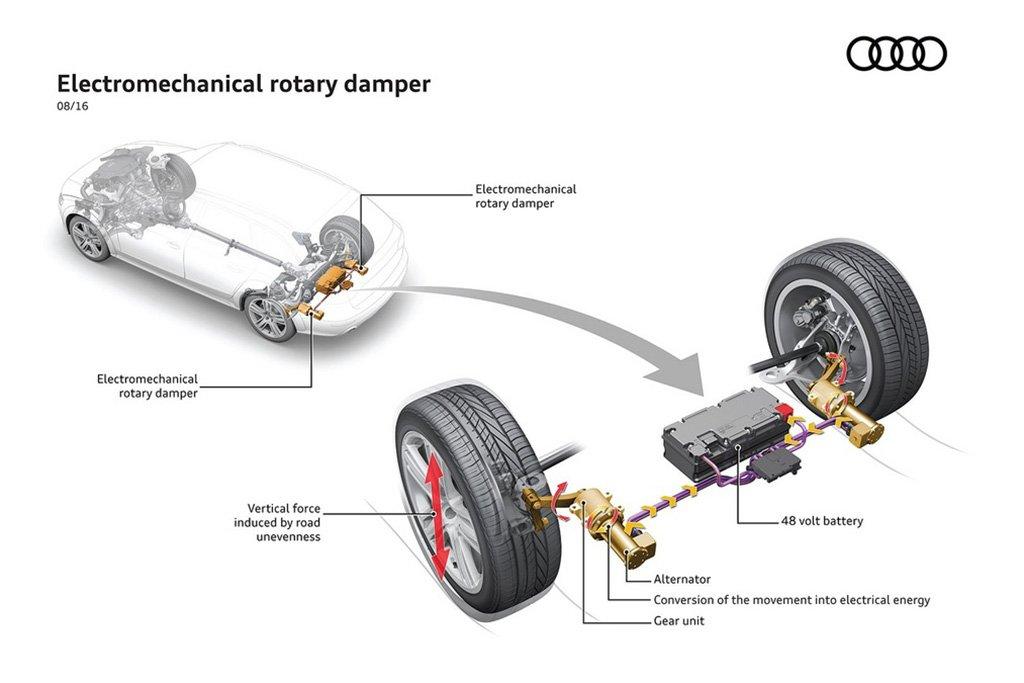
Now known as 'eROT,' the electromechanical rotary dampers transmit the wheel's vertical force into a gear unit that drives an alternator. The approach does not waste kinetic energy that is lost as heat in traditional hydraulic shocks. Perhaps more importantly for Audi, the technology presents new possibilities for increasing ride comfort.

"As an actively controlled suspension, it adapts ideally to irregularities in the road surface and the driver's driving style," the company said in a statement. "A damper characteristic that is virtually freely definable via software increases the functional scope. It eliminates the mutual dependence of the rebound and compression strokes that limits conventional hydraulic dampers."
The electrical recuperation output is said to average 100-150 watts on an average German roads, as little as three watts on a freshly paved highway and as high as 613 watts on a rough side road.
Audi suggests initial tests are promising and the technology is 'certainly plausible' for use in future production cars outfitted with 48-volt electrical systems. The higher-voltage systems are expected to roll out across the company's lineup going forward, providing extra power for electric induction compressors and mild hybrid systems.
Now known as 'eROT,' the electromechanical rotary dampers transmit the wheel's vertical force into a gear unit that drives an alternator. The approach does not waste kinetic energy that is lost as heat in traditional hydraulic shocks. Perhaps more importantly for Audi, the technology presents new possibilities for increasing ride comfort.
As demonstrated by inventor Amar Bose more than 30 years ago, electromagnetic suspension can be used to eliminate body roll and allow a car to drive over a parking block at high speed.
"As an actively controlled suspension, it adapts ideally to irregularities in the road surface and the driver's driving style," the company said in a statement. "A damper characteristic that is virtually freely definable via software increases the functional scope. It eliminates the mutual dependence of the rebound and compression strokes that limits conventional hydraulic dampers."
The electrical recuperation output is said to average 100-150 watts on an average German roads, as little as three watts on a freshly paved highway and as high as 613 watts on a rough side road.
Audi suggests initial tests are promising and the technology is 'certainly plausible' for use in future production cars outfitted with 48-volt electrical systems. The higher-voltage systems are expected to roll out across the company's lineup going forward, providing extra power for electric induction compressors and mild hybrid systems.


Latest COE Prices
March 2026 | 1st BIDDING
NEXT TENDER: 18 Mar 2026
CAT A$108,220
CAT B$114,002
CAT C$76,000
CAT E$114,890
View Full Results 
Thank You For Your Subscription.










Tags
Products & Services

For Owners
Quick Links
About Sgcarmart