View page in desktop
|
Report error
  •   Apple app store icon
  • Google play store icon
Terms of Service
|
Privacy Policy
|
PDPA
|
Site Map
|
Whistleblowing Portal
©2004-2026 Sgcarmart, Singapore. All rights reserved.
  • Home
  • Car Articles
  • advice
  • advice Listings
  • Car Technical Advice

Types of car transmission

01 Sep 2007

|

132,543 views

What are the different types of car transmissions and how do they work?

What is a transmission

The transmission is a device that is connected to the back of the engine. It transmits mechanical power from the engine to the drive wheels. The transmission is used to reduce the revolutions of the crankshaft down to a reasonable value by using interlocking gears to reduce the number of revolutions. By doing so, it makes more effective usage of the engine's torque and helps to keep the engine operating at an appropriate speed.

Common types of Transmission


Manual transmission

Most manual transmissions feature a movable gear selector and clutch. The driver of the vehicle has to manually select and engage the gear ratios. The clutch is a coupling device that is used to separate the engine and transmission. Without it, the engine would stop, causing the vehicle to stop. The clutch allows the engine to continue working when you are waiting at the traffic light. Changing gear without a clutch would be difficult with the crank spinning continuously while the engine is running.

Stages of Manual transmission

Clutch fully depressedThe clutch is fully disengaged when the pedal is fully depressed. There will be no torque being transferred from the engine to the transmission and wheels. Fully depressing the clutch allows the driver to change gears or stop the vehicle.
Clutch slipsThe clutch slips is the point that varys between being fully depressed and released. Torque is transmitted by friction from the engine to the transmission when the clutch slips. The clutch slip is used to start the vehicle from a stand still. It then allows the engine rotation to adjust to the newly selected gear ratio gradually. This reduces jerks during gear change and ensures a smooth gear shift. It is recommended not to slip the clutch for a long time because a lot of heat is generated resulting in energy wastage.
Clutch fully releasedThe clutch is fully engaged when the pedal is fully released. All the engine torque will be transmitted to the transmission. This results in the power being transmitted to the wheels with minimal loss.

What is Automatic transmission

An automatic transmission changes the gear ratios automatically, thus relieving the driver from having to shift gears manually and stepping on the clutch while shifting. The more gears the transmission has, the smoother the acceleration of the vehicle.

Stages of an Automatic transmission

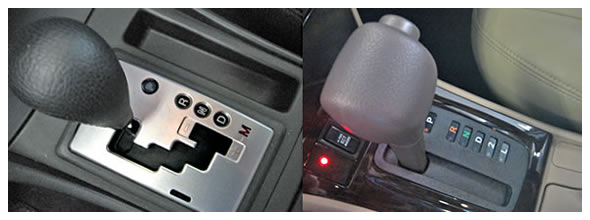
Park(P) Selecting the Park mode locks the transmission, thus restricting the vehicle from moving. It is recommended to use brakes which lock the wheels to prevent the vehicle from moving, because regular usage of the Park mode can damage the transmission. Always make sure that the vehicle comes to a complete stop before shifting into Park.
Reverse (R) Selecting the Reverse mode puts the car into reverse gear, allowing the vehicle to drive backward. Always make sure that the vehicle comes to a complete stop before shifting into Reverse.
Neutral (N) Selecting the Neutral mode disconnects the transmission from the wheel. Some drivers tend to shift to Neutral while waiting for the traffic light to turn green. This is not recommended as changing gears from Drive to Neutral frequently causes wear to the valves and clutch plates.
Drive (D) Selecting the Drive mode allows the vehicle to move and accelerate through a range of gears.
Second gear (2) Selecting the "2" mode restricts the transmission to second gear and cannot go beyond the second gear. The transmission is unable to select any gear higher than the second gear.
First gear (1) Selecting the "1" mode restricts the transmission in first gear and cannot go higher.
Semi automatic transmission is easily recognized by the "+" and "-" signs as shown on the left.

Comparing manual transmission and automatic transmission

Advantages of Manual transmission
•Pricing of vehicle
 Vehicles with manual transmission are usually cheaper than vehicles with automatic transmission.
•Fuel consumption
 Manual transmission has better fuel economy as compared to automatic transmission. This is because manual transmission has better mechanical and gear train efficiency compared to automatic transmission. Manual transmission also has certain fuel-saving modes of operation (eg. Keeping the rpm low by shifting to a higher gear early) .
•Maintenance
 It is cheaper to maintain a vehicle with manual transmission because a vehicle with automatic transmission is more complicated device and requires more maintainence.
•Control
 Manual transmission offers the driver more control of the vehicle compared to automatic transmission. It also offers better driving on steep and winding roads. Drivers of manual cars can also downshift to a lower gear for more power, while an automatic transmission driver can only play with the throttle at the drive mode. That is why the transmission of performance cars are mostly manual and semi-automatic.
•Push start
 Vehicles with manual transmission can often be started using the push start way when the battery goes flat. Vehicles with automatic transmission are unable to utliize the push start method when the battery goes flat.
•Moving a malfunction vehicle
 Vehicles with manual transmission can be moved manually by pushing the vehicle at neutral gear when the engine malfunctions. This is quite useful in situations where the vehicle broke down in the middle of the road, and must be moved to the road shoulder immediately.

Advantages of Automatic Transmission
•Easy to drive
 Driver of vehicles with automatic transmission do not have to shift the gear manually and step on the clutch.

What is Overdrive?

Overdrive is the highest gear for an automatic transmission. It allows the engine to operate at a lower RPM (Revolutions per minute) when the vehicle is cruising at high speed. Overdrive improves the fuel consumption of the vehicle and reduces engine wear. It is not recommended to switch on overdrive when traveling in a mountainous area. This is because the transmission may be shifting back and forth between the overdrive and the second highest gear.

What is CVT?

CVT (Continuous Variable Transmission) provides the driver with more power, better fuel economy and a smoother driving experience when compared to a traditional automatic transmission. No wonder many car manufacturers like Nissan and Honda are replacing their vehicles' automatic transmission with the CVT.

CVT gets the engine to the peak torque and maintains it over a wide range of vehicle speeds by varying the transmission. Unlike conventional transmission where the ratio is changed by shifting the gears, the CVT allows an almost limitless number of engine speeds to vehicle speed ratio. This cannot be achieved by an automatic transmission vehicle because there is no gear to tie a given road speed. The limitless number of gear ratios also means that the nudging motion caused by shifting is no longer present. Since the engine is operating at its optimum power range, excellent fuel economy and less gas emission are also obtained.

Flooring the accelerator pedal of a CVT vehicle gives a smooth and rapid increase to the maximum power unlike a automatic transmission vehicle which brings a sudden burst of power causing the vehicle to lurch forward. The sound from the CVT vehicle's engine also will not change much compared to the automatic transmission vehicle. Many drivers mistook the smooth increase of speed as lack of power due to CVT. In actual fact, the acceleration of the CVT vehicle is much faster compared to the automatic transmission vehicle.

AllReviewsNewsAdviceFeaturesVideos
  • Home
  • Car Articles
  • advice
  • advice Listings
  • Car Technical Advice

Types of car transmission

01 Sep 2007

|

132,543 views

What are the different types of car transmissions and how do they work?

What is a transmission

The transmission is a device that is connected to the back of the engine. It transmits mechanical power from the engine to the drive wheels. The transmission is used to reduce the revolutions of the crankshaft down to a reasonable value by using interlocking gears to reduce the number of revolutions. By doing so, it makes more effective usage of the engine's torque and helps to keep the engine operating at an appropriate speed.

Common types of Transmission


Manual transmission

Most manual transmissions feature a movable gear selector and clutch. The driver of the vehicle has to manually select and engage the gear ratios. The clutch is a coupling device that is used to separate the engine and transmission. Without it, the engine would stop, causing the vehicle to stop. The clutch allows the engine to continue working when you are waiting at the traffic light. Changing gear without a clutch would be difficult with the crank spinning continuously while the engine is running.

Stages of Manual transmission

Clutch fully depressedThe clutch is fully disengaged when the pedal is fully depressed. There will be no torque being transferred from the engine to the transmission and wheels. Fully depressing the clutch allows the driver to change gears or stop the vehicle.
Clutch slipsThe clutch slips is the point that varys between being fully depressed and released. Torque is transmitted by friction from the engine to the transmission when the clutch slips. The clutch slip is used to start the vehicle from a stand still. It then allows the engine rotation to adjust to the newly selected gear ratio gradually. This reduces jerks during gear change and ensures a smooth gear shift. It is recommended not to slip the clutch for a long time because a lot of heat is generated resulting in energy wastage.
Clutch fully releasedThe clutch is fully engaged when the pedal is fully released. All the engine torque will be transmitted to the transmission. This results in the power being transmitted to the wheels with minimal loss.

What is Automatic transmission

An automatic transmission changes the gear ratios automatically, thus relieving the driver from having to shift gears manually and stepping on the clutch while shifting. The more gears the transmission has, the smoother the acceleration of the vehicle.

Stages of an Automatic transmission

Park(P) Selecting the Park mode locks the transmission, thus restricting the vehicle from moving. It is recommended to use brakes which lock the wheels to prevent the vehicle from moving, because regular usage of the Park mode can damage the transmission. Always make sure that the vehicle comes to a complete stop before shifting into Park.
Reverse (R) Selecting the Reverse mode puts the car into reverse gear, allowing the vehicle to drive backward. Always make sure that the vehicle comes to a complete stop before shifting into Reverse.
Neutral (N) Selecting the Neutral mode disconnects the transmission from the wheel. Some drivers tend to shift to Neutral while waiting for the traffic light to turn green. This is not recommended as changing gears from Drive to Neutral frequently causes wear to the valves and clutch plates.
Drive (D) Selecting the Drive mode allows the vehicle to move and accelerate through a range of gears.
Second gear (2) Selecting the "2" mode restricts the transmission to second gear and cannot go beyond the second gear. The transmission is unable to select any gear higher than the second gear.
First gear (1) Selecting the "1" mode restricts the transmission in first gear and cannot go higher.
Semi automatic transmission is easily recognized by the "+" and "-" signs as shown on the left.

Comparing manual transmission and automatic transmission

Advantages of Manual transmission
•Pricing of vehicle
 Vehicles with manual transmission are usually cheaper than vehicles with automatic transmission.
•Fuel consumption
 Manual transmission has better fuel economy as compared to automatic transmission. This is because manual transmission has better mechanical and gear train efficiency compared to automatic transmission. Manual transmission also has certain fuel-saving modes of operation (eg. Keeping the rpm low by shifting to a higher gear early) .
•Maintenance
 It is cheaper to maintain a vehicle with manual transmission because a vehicle with automatic transmission is more complicated device and requires more maintainence.
•Control
 Manual transmission offers the driver more control of the vehicle compared to automatic transmission. It also offers better driving on steep and winding roads. Drivers of manual cars can also downshift to a lower gear for more power, while an automatic transmission driver can only play with the throttle at the drive mode. That is why the transmission of performance cars are mostly manual and semi-automatic.
•Push start
 Vehicles with manual transmission can often be started using the push start way when the battery goes flat. Vehicles with automatic transmission are unable to utliize the push start method when the battery goes flat.
•Moving a malfunction vehicle
 Vehicles with manual transmission can be moved manually by pushing the vehicle at neutral gear when the engine malfunctions. This is quite useful in situations where the vehicle broke down in the middle of the road, and must be moved to the road shoulder immediately.

Advantages of Automatic Transmission
•Easy to drive
 Driver of vehicles with automatic transmission do not have to shift the gear manually and step on the clutch.

What is Overdrive?

Overdrive is the highest gear for an automatic transmission. It allows the engine to operate at a lower RPM (Revolutions per minute) when the vehicle is cruising at high speed. Overdrive improves the fuel consumption of the vehicle and reduces engine wear. It is not recommended to switch on overdrive when traveling in a mountainous area. This is because the transmission may be shifting back and forth between the overdrive and the second highest gear.

What is CVT?

CVT (Continuous Variable Transmission) provides the driver with more power, better fuel economy and a smoother driving experience when compared to a traditional automatic transmission. No wonder many car manufacturers like Nissan and Honda are replacing their vehicles' automatic transmission with the CVT.

CVT gets the engine to the peak torque and maintains it over a wide range of vehicle speeds by varying the transmission. Unlike conventional transmission where the ratio is changed by shifting the gears, the CVT allows an almost limitless number of engine speeds to vehicle speed ratio. This cannot be achieved by an automatic transmission vehicle because there is no gear to tie a given road speed. The limitless number of gear ratios also means that the nudging motion caused by shifting is no longer present. Since the engine is operating at its optimum power range, excellent fuel economy and less gas emission are also obtained.

Flooring the accelerator pedal of a CVT vehicle gives a smooth and rapid increase to the maximum power unlike a automatic transmission vehicle which brings a sudden burst of power causing the vehicle to lurch forward. The sound from the CVT vehicle's engine also will not change much compared to the automatic transmission vehicle. Many drivers mistook the smooth increase of speed as lack of power due to CVT. In actual fact, the acceleration of the CVT vehicle is much faster compared to the automatic transmission vehicle.
Jegan Das Haridas
Text and photos by Jegan Das Haridas
Writing may be my thing, but cars, well, that's just pure passion that I simply cannot get rid off.
24.4k

Tags

car transmission types of car transmission transmission types of transmission

Jegan Das Haridas
Text and photos by Jegan Das Haridas
Writing may be my thing, but cars, well, that's just pure passion that I simply cannot get rid off.
24.4k

Tags

car transmission types of car transmission transmission types of transmission

All Advice Categories

Car BuyingCar SellingCar OwnershipCar TechnicalCar MaintenanceMiscellaneous

All Advice Categories

Car BuyingCar SellingCar OwnershipCar TechnicalCar MaintenanceMiscellaneous

Related Motor Directory Categories

    Power EnhancementBodykits & PartsRacing & Motorsports EquipmentAccident Repair & ClaimsHandling & Safety

Related Motor Directory Categories

    Power EnhancementBodykits & PartsRacing & Motorsports EquipmentAccident Repair & ClaimsHandling & Safety

You May Also Like

Sgcarmart Explores: Bras Basah!

Sgcarmart Explores: Bras Basah!

New cars are safer: Opt for one when you can

New cars are safer: Opt for one when you can

Leapmotor B10: The electric SUV focused on what matters

Leapmotor B10: The electric SUV focused on what matters

LTA sets up poll to decide the least-ugliest EV plate

LTA sets up poll to decide the least-ugliest EV plate

Multi-Pathway approach: Toyota was always right

Multi-Pathway approach: Toyota was always right

Cars of 2026

Cars of 2026

Inside Foton's commercial vehicle range in Singapore

Inside Foton's commercial vehicle range in Singapore

Don't get yourself trapped in your high-tech EV

Don't get yourself trapped in your high-tech EV

iCaur V23 100kW Review

iCaur V23 100kW Review

The all new XPENG Mona L03 is one smart coupe SUV

The all new XPENG Mona L03 is one smart coupe SUV

The rise of PHEVs: A closer look at the numbers

The rise of PHEVs: A closer look at the numbers

Is parallel import hesitancy growing among car buyers?

Is parallel import hesitancy growing among car buyers?

Big Test: Which brand makes the best hybrid?

Big Test: Which brand makes the best hybrid?

Opinion: Why do we even need green number plates?

Opinion: Why do we even need green number plates?

Sgcarmart Explores: East Coast Park!

Sgcarmart Explores: East Coast Park!

Must-Have Car Accessories Every EV Driver Should Own

Must-Have Car Accessories Every EV Driver Should Own

You May Also Like

Sgcarmart Explores: Bras Basah!

Sgcarmart Explores: Bras Basah!

New cars are safer: Opt for one when you can

New cars are safer: Opt for one when you can

Leapmotor B10: The electric SUV focused on what matters

Leapmotor B10: The electric SUV focused on what matters

LTA sets up poll to decide the least-ugliest EV plate

LTA sets up poll to decide the least-ugliest EV plate

Multi-Pathway approach: Toyota was always right

Multi-Pathway approach: Toyota was always right

Cars of 2026

Cars of 2026

Inside Foton's commercial vehicle range in Singapore

Inside Foton's commercial vehicle range in Singapore

Don't get yourself trapped in your high-tech EV

Don't get yourself trapped in your high-tech EV

iCaur V23 100kW Review

iCaur V23 100kW Review

The all new XPENG Mona L03 is one smart coupe SUV

The all new XPENG Mona L03 is one smart coupe SUV

The rise of PHEVs: A closer look at the numbers

The rise of PHEVs: A closer look at the numbers

Is parallel import hesitancy growing among car buyers?

Is parallel import hesitancy growing among car buyers?

Big Test: Which brand makes the best hybrid?

Big Test: Which brand makes the best hybrid?

Opinion: Why do we even need green number plates?

Opinion: Why do we even need green number plates?

Sgcarmart Explores: East Coast Park!

Sgcarmart Explores: East Coast Park!

Must-Have Car Accessories Every EV Driver Should Own

Must-Have Car Accessories Every EV Driver Should Own

Related Articles

The 5 main things you must know about the XPENG L03

The 5 main things you must know about the XPENG L03

Sgcarmart Explores: Bras Basah!

Sgcarmart Explores: Bras Basah!

Maxus MIFA 7 Elite Review

Maxus MIFA 7 Elite Review

Toyota RAV4 Hybrid vs Subaru Forester e-Boxer

Toyota RAV4 Hybrid vs Subaru Forester e-Boxer

PARF rebates cut by 45%: Six quick takeaways and thoughts

PARF rebates cut by 45%: Six quick takeaways and thoughts

We try out roadside parking with the new OBU!

We try out roadside parking with the new OBU!

Potential fixes to our COE system

Potential fixes to our COE system

Multi-Pathway approach: Toyota was always right

Multi-Pathway approach: Toyota was always right

Related Articles

The 5 main things you must know about the XPENG L03

The 5 main things you must know about the XPENG L03

Sgcarmart Explores: Bras Basah!

Sgcarmart Explores: Bras Basah!

Maxus MIFA 7 Elite Review

Maxus MIFA 7 Elite Review

Toyota RAV4 Hybrid vs Subaru Forester e-Boxer

Toyota RAV4 Hybrid vs Subaru Forester e-Boxer

PARF rebates cut by 45%: Six quick takeaways and thoughts

PARF rebates cut by 45%: Six quick takeaways and thoughts

We try out roadside parking with the new OBU!

We try out roadside parking with the new OBU!

Potential fixes to our COE system

Potential fixes to our COE system

Multi-Pathway approach: Toyota was always right

Multi-Pathway approach: Toyota was always right