Teaser Test - Porsches
21 Apr 2009|11,563 views
Standing under the scorching sun, our eyes were fixated on the vast expanse littered with orange specks. Anticipating something to burst dramatically into view, the faint growl of a V8 started to tease our aural senses.
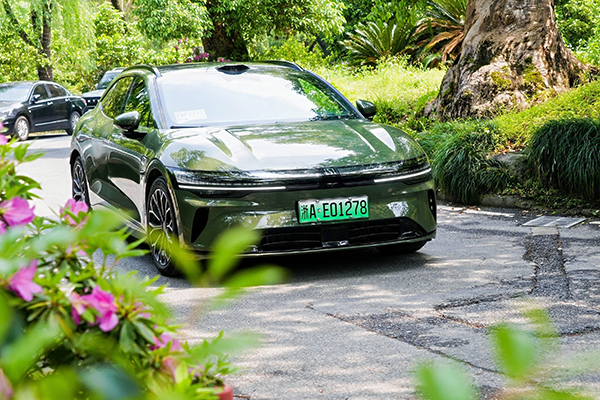
thing we know, a massive olive green SUV begins to slide gracefully across our view, like a seasoned figure skater making a grand entrance.
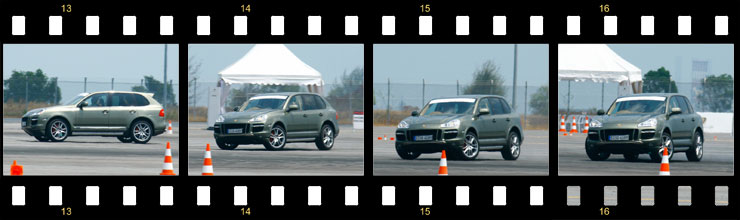
All in a day's work at the Porsche World Roadshow.
Here, the famous sports cars from Germany aren't just garage queens. They're a fleet of Germany's finest and will travel the world to let some very lucky people try to drive the wheels off them. Fresh from the factory, this group of cars serves only one main purpose during their early years - to be driven as like no other Porsche on the road.
The Brake Test
We started off with a Porsche 911 Carrera S Cabriolet (the 997). The route was simple: full acceleration down a straight section, then hard on the brakes while steering to stay within the width of the course. The objective - to show how much control the car has in difficult situations.
It's a very important test, this. If drivers encounter a sudden obstacle, or are trying to avoid hitting something, chances are they'd stomp hard on the brakes and turn the wheel. And in a car with a relatively short wheelbase, engine sitting in the back, that could easily translate into a huge heartache and a very painful write-off.
But since we were in a controlled environment, we were assured by the German instructors.
"Drive hard and enjoy yourselves! Don't worry!" they told us, "You scratch, you buy!"
Very comforting.
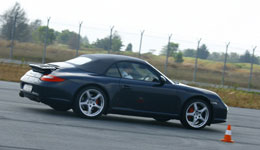
I aimed the Carrera towards a set of cones and gave it full throttle. With a bassy growl from its six-cylinder boxer engine and a chirp from its tyres, the Carrera lurched ahead.
With much of its weight sitting on the rear axle, flicking the steering wheel while stomping on the brakes would send most cars spinning (which we experienced later with the "Moose Test"). But the Porsche's electronics management system proved its worth and kept things in check, and the car's nose pointing exactly where I wanted it to.
Amidst all the noise from the 911, we could hear the irresistible wail of the Cayman S fitted with a sports exhaust.The High Speed Course
Our next stage was a bit more daunting. Four cars sat in line awaiting our arrival - a Cayenne Turbo, a Cayenne GTS, a sexy red Targa 4S and a sleek black Cayman S. The course, along Aviation Park Road, was punctuated with a chicane and U-turn, followed by a few other fast bends - a straightforward that would cheekily unveil the tip of the iceberg of the car's performance, leaving you wanting for more.
Blasting down the straight stretch, the Cayman S made it clear why Porsche's addition to the line-up has been successful, despite not being a nine-eleven.
With 295 hp and 340 Nm of torque fed to its rear wheels, the Cayman S was the least powerful among the four, but its handling more than made up for the "power shortage".
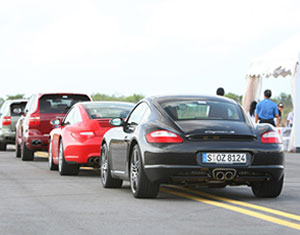
It weighs about 220 kg less than the 385 hp Targa 4S, showing clearly its advantage under braking and turning. The Cayman S was definitely the more agile of the two, also thanks to its better weight distribution. Despite Porsche insisting that the engine's weight over its rear wheels provides better traction, the fact is that the 911 loses out in front-end sensation to its more well-balanced sister.
Speeding towards the chicane at well over 100 km/h, I braked hard and prepared to turn. The Cayman dived a tiny bit before regaining poise to tackle the quick left-right-left.
In the Targa 4S, I felt like I had to be more careful, especially when exiting the series of turns. An over-zealous right foot would have easily made the "You scratch, you buy" piece of "advice" come true. There was less information coming through about its front end, and knowing the rear's load didn't help with my confidence.
Most surprising, though, were the Cayennes. A transition for my bum from being a few inches of the ground into the SUV's seats was comfortable, though not the most comforting sensation, knowing that in a few moments I had to complete a high-speed course normally tackled by low, sleek sports cars. Hearing stories and testimonies about its superb handling is one thing, but actually sitting in one to drive it this way is different.
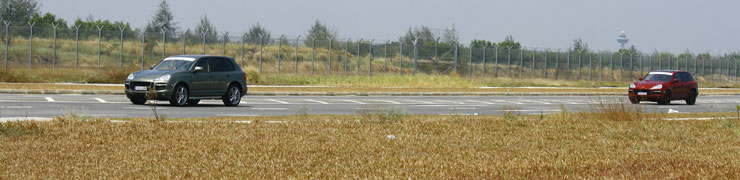
Turning out on to the straights, the 500 hp Cayenne Turbo showed its might and in just slightly over five seconds, we were past a hundred. I held on to the throttle, right to the last second before hitting the left pedal at the braking point. The 2.3-tonne giant bowed gently while the seat belts squeezed the air out of my chest, and along with it, all the doubt I ever had about its stopping power.
I pointed the wheel towards the turns, hoping it wouldn't understeer and collect a few cones. And it didn't. Instead, it quickly turned into a different animal. I had anticipated plenty of body roll. But instead of leaning frighteningly over on its side, the Cayenne stuck well to its flat stance, tilting just slightly but remaining confident. When it comes to sporty driving, though, the Cayennes are more for having fun and a laugh than for setting lap times.
By this time, the loud echoes from a nearby yellow Cayman S were distracting us, so we were shooed away to the next stage where there were even more cones.
The Slalom Test
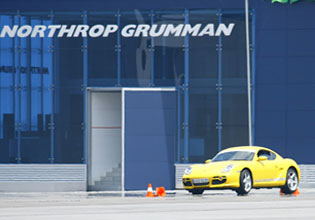
A German in the bright yellow mid-engined coupe greeted us, demonstrated his elite driving skills and swerved gracefully around the lines of cones, then told us to do the same.
And this was where the Cayman S really stood out from the rest of the cars we had driven. Through the cones, shifting its weight from side to side, the car handled predictably and consistently, and any slides were easily corrected with a quick flick of counter-steer.
Everything from its acceleration to braking, to mid-corner grip and rapid changes in direction was impressive. It may not have give a 911 a hard time on circuits like Sepang, but a spirited B-road drive could see the Cayman S trouncing its more expensive sister.
The Moose Test
The next and final test was equally challenging. To simulate a stray moose in the middle of your path, Very useful, too, as the set of skills from this stage would be valuable when driving along places like Serangoon Road. And while we don't have any such creatures in Singapore, we do have an urban equivalent - taxis.
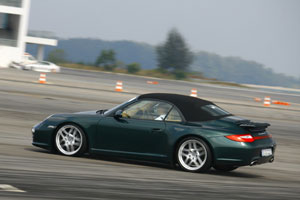
The objective was first to brake hard and avoid "the moose", in the form of an orange cone, swerve to avoid it, and then back again to pass through a "gate". A very relevant test of any car's capability of avoiding unexpected obstacles. Essentially, the steering action is similar to a Scandinavian flick (and we're not talking about porn flicks). And in a rear-engined coupe like the 911, that could easily result in a spin.
As expected, when tested with the traction control systems activated, the Carrera managed to avoid the taxi™er, moose, and continue accurately through the cones. When we tried it again without any electronic traction aid, unsurprisingly, the Porsche's tail stepped out after avoiding the moose. But more importantly, a quick turn of the wheel put the slide under control and, once again, the Carrera demonstrated impressive agility, sailing cleanly through the cones and concluding our day's worth of driving.
But before the day ended, our German instructors treated us to a ballet demonstration - with the Porsches.
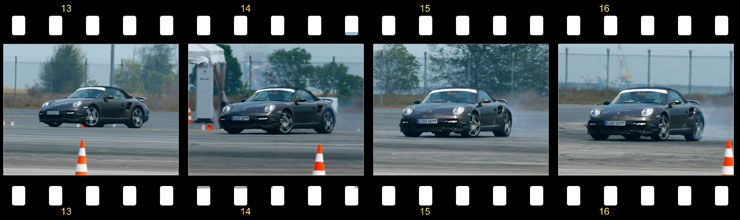
Setting off with a 997 Turbo, a Cayman S and the huge Cayenne Turbo, the Germans had no qualms about pushing the cars to the limit, sliding them again and again gracefully across the length of the Changi Airshow grounds.
Again, the Cayenne reminded us of Porsche's capabilities when it comes to vehicular dynamics, and repeatedly maintained beautiful drifts around the circuit.
Overall, the best handling Porsche of the day was the Cayman S. With its ability to remain composed despite quick, successive changes in direction and brilliant feedback through the steering, it has some very exciting potential.
The 911 Carrera, on the other hand, feels more like a grand tourer when compared to the Cayman. Definitely better when it comes to comfort, but it probably would get left behind by its younger sibling when going round a series of tight corners.
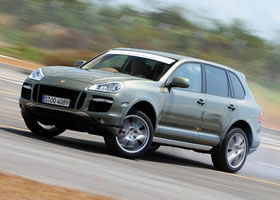
Of course, the one that still drew the biggest wows was the Cayenne. Seeing a 2.3-tonne SUV sliding around in the manner it did sent shivers down our spine and left our mouths gaping. It's like seeing an elephant breakdance; your mind tells you it's impossible, but you're stunned when you see it.
More importantly, the fact that Porsche has sent out this little platoon of cars to go travel the world and do nothing but get driven till their tyres need replacing says plenty about how confident they are of their product, and lots about their the quality of their engineering.
After smoking enough rubber for the day, we chatted with one of the instructors, Gunther Ofenmacher, to find out what he thinks about Porsche's cars and the company. Read on for the interview.
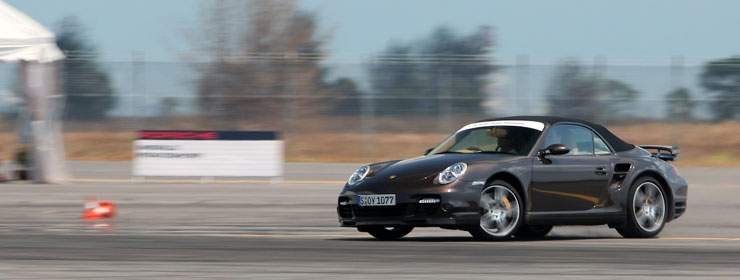
Interview with Gunther Ofenmacher, instructor, Porsche World Road Show
sgCarMart: What can participants expect to learn and apply from the PWRS course?
GO: First of all, I have to say, we're not here for teaching. We're not teachers. We're here to present our cars to bring the Porsche virus to the whole world and we want to give a pleasant and comfortable day to the people. 'By the way', we show them some things about how to handle a car with more than 300 horsepower. For example, doing an emergency brake, braking during cornering, avoiding obstacles and to drive consciously.
sgCarMart: How much of the car's potential did the participants get to experience, or did it depend on the individual?
GO: It depends on the individual. But this is one of the fascinating aspects of a Porsche, where the limit is in a very high region. So if you really want to reach the limit, you should have some experiences. A normal driver maybe will use 70 to 80 percent of the car's performance, but this is also good for the safety.
sgCarMart: People say that Porsches can be taken straight out of the box and onto a track. How true do you think that is?
GO: That's definitely true. And this is one of our main targets - to create cars for normal public roads, for daily life, driving and cruising to the inner city, but also to be ready for the race track.
sgCarMart: What is it about the engineering of Porsches that allows them to handle the way they do, even with the engine in the back?
GO: I think Porsche is the manufacturer with the most experience to have an engine in the rear. We have a long history of such cars; if you look at the 911, since more than 30 years. It's definitely no disadvantage. You also can look at motorsports. Every year, we beat and win other cars with their engines in the middle. It's nearly a perfect car. First of all, a safe car, a stable car and so it's no disadvantage to have the engine in the rear.
sgCarMart: Not even the slightest bit?
GO: You have a lot of electronic systems in the car. First of all, Porsche Stability Management. But the suspension of the car is created in the way when you are in an emergency situation and you are braking hard, the car normally begins to understeer. This is the way the car is built and we've spent a lot of time for developing the car in this direction and to avoid oversteering.
sgCarMart: What can Porsches do that other cars can't?
GO: Good question. Haha. I think when you have a closer look at the history, you will see that Porsche always is best in its class. Porsche sets the benchmark and this is, of course, one outstanding aspect of all Porsche cars. Whether it's a Cayenne, for the SUVs, or the classic 911 as a sports car. One other thing is that there is a really great family feeling. It's a small company and we are one big family. Everything you see, you can touch, you can talk to the people, to instructors, to engineers. It's really family-like. And I think also for the customers, for the Porsche owners, we are one big family.
sgCarMart: With that sort of company culture, do a lot of things get done easier?
GO: Yeah, you know nearly everyone. From the top management to the cleaners, you know everyone and it's really a good atmosphere to work. And I'm glad to work for Porsche and I'm proud. It's really a great company.
sgCarMart: Why choose Porsche over other brands?
Because another aspect is that the cars keep their value. Haha. For a very, very long time. I think that's true. And you have a really outstanding overall performance. For example, the new PDK system, you can drive it very, very comfortably. Very smooth shifting without interruption and, on the other side, you have a race track feature with the PDK, shifting up and down in only four-tenths of a second. You can't do it faster in a manual, it's absolutely brilliant and unbeatable. So this shows you the outstanding overall performance of the cars.

thing we know, a massive olive green SUV begins to slide gracefully across our view, like a seasoned figure skater making a grand entrance.
![]() |
All in a day's work at the Porsche World Roadshow.
Here, the famous sports cars from Germany aren't just garage queens. They're a fleet of Germany's finest and will travel the world to let some very lucky people try to drive the wheels off them. Fresh from the factory, this group of cars serves only one main purpose during their early years - to be driven as like no other Porsche on the road.
The Brake Test
We started off with a Porsche 911 Carrera S Cabriolet (the 997). The route was simple: full acceleration down a straight section, then hard on the brakes while steering to stay within the width of the course. The objective - to show how much control the car has in difficult situations.
It's a very important test, this. If drivers encounter a sudden obstacle, or are trying to avoid hitting something, chances are they'd stomp hard on the brakes and turn the wheel. And in a car with a relatively short wheelbase, engine sitting in the back, that could easily translate into a huge heartache and a very painful write-off.
But since we were in a controlled environment, we were assured by the German instructors.
"Drive hard and enjoy yourselves! Don't worry!" they told us, "You scratch, you buy!"
Very comforting.
![]() |
With much of its weight sitting on the rear axle, flicking the steering wheel while stomping on the brakes would send most cars spinning (which we experienced later with the "Moose Test"). But the Porsche's electronics management system proved its worth and kept things in check, and the car's nose pointing exactly where I wanted it to.
Amidst all the noise from the 911, we could hear the irresistible wail of the Cayman S fitted with a sports exhaust.The High Speed Course
Our next stage was a bit more daunting. Four cars sat in line awaiting our arrival - a Cayenne Turbo, a Cayenne GTS, a sexy red Targa 4S and a sleek black Cayman S. The course, along Aviation Park Road, was punctuated with a chicane and U-turn, followed by a few other fast bends - a straightforward that would cheekily unveil the tip of the iceberg of the car's performance, leaving you wanting for more.
Blasting down the straight stretch, the Cayman S made it clear why Porsche's addition to the line-up has been successful, despite not being a nine-eleven.
With 295 hp and 340 Nm of torque fed to its rear wheels, the Cayman S was the least powerful among the four, but its handling more than made up for the "power shortage".
![]() |
Speeding towards the chicane at well over 100 km/h, I braked hard and prepared to turn. The Cayman dived a tiny bit before regaining poise to tackle the quick left-right-left.
In the Targa 4S, I felt like I had to be more careful, especially when exiting the series of turns. An over-zealous right foot would have easily made the "You scratch, you buy" piece of "advice" come true. There was less information coming through about its front end, and knowing the rear's load didn't help with my confidence.
Most surprising, though, were the Cayennes. A transition for my bum from being a few inches of the ground into the SUV's seats was comfortable, though not the most comforting sensation, knowing that in a few moments I had to complete a high-speed course normally tackled by low, sleek sports cars. Hearing stories and testimonies about its superb handling is one thing, but actually sitting in one to drive it this way is different.
![]() |
Turning out on to the straights, the 500 hp Cayenne Turbo showed its might and in just slightly over five seconds, we were past a hundred. I held on to the throttle, right to the last second before hitting the left pedal at the braking point. The 2.3-tonne giant bowed gently while the seat belts squeezed the air out of my chest, and along with it, all the doubt I ever had about its stopping power.
I pointed the wheel towards the turns, hoping it wouldn't understeer and collect a few cones. And it didn't. Instead, it quickly turned into a different animal. I had anticipated plenty of body roll. But instead of leaning frighteningly over on its side, the Cayenne stuck well to its flat stance, tilting just slightly but remaining confident. When it comes to sporty driving, though, the Cayennes are more for having fun and a laugh than for setting lap times.
By this time, the loud echoes from a nearby yellow Cayman S were distracting us, so we were shooed away to the next stage where there were even more cones.
![]() |
A German in the bright yellow mid-engined coupe greeted us, demonstrated his elite driving skills and swerved gracefully around the lines of cones, then told us to do the same.
And this was where the Cayman S really stood out from the rest of the cars we had driven. Through the cones, shifting its weight from side to side, the car handled predictably and consistently, and any slides were easily corrected with a quick flick of counter-steer.
Everything from its acceleration to braking, to mid-corner grip and rapid changes in direction was impressive. It may not have give a 911 a hard time on circuits like Sepang, but a spirited B-road drive could see the Cayman S trouncing its more expensive sister.
The Moose Test
The next and final test was equally challenging. To simulate a stray moose in the middle of your path, Very useful, too, as the set of skills from this stage would be valuable when driving along places like Serangoon Road. And while we don't have any such creatures in Singapore, we do have an urban equivalent - taxis.
![]() |
As expected, when tested with the traction control systems activated, the Carrera managed to avoid the taxi™er, moose, and continue accurately through the cones. When we tried it again without any electronic traction aid, unsurprisingly, the Porsche's tail stepped out after avoiding the moose. But more importantly, a quick turn of the wheel put the slide under control and, once again, the Carrera demonstrated impressive agility, sailing cleanly through the cones and concluding our day's worth of driving.
But before the day ended, our German instructors treated us to a ballet demonstration - with the Porsches.
![]() |
Setting off with a 997 Turbo, a Cayman S and the huge Cayenne Turbo, the Germans had no qualms about pushing the cars to the limit, sliding them again and again gracefully across the length of the Changi Airshow grounds.
Again, the Cayenne reminded us of Porsche's capabilities when it comes to vehicular dynamics, and repeatedly maintained beautiful drifts around the circuit.
Overall, the best handling Porsche of the day was the Cayman S. With its ability to remain composed despite quick, successive changes in direction and brilliant feedback through the steering, it has some very exciting potential.
The 911 Carrera, on the other hand, feels more like a grand tourer when compared to the Cayman. Definitely better when it comes to comfort, but it probably would get left behind by its younger sibling when going round a series of tight corners.
![]() |
More importantly, the fact that Porsche has sent out this little platoon of cars to go travel the world and do nothing but get driven till their tyres need replacing says plenty about how confident they are of their product, and lots about their the quality of their engineering.
After smoking enough rubber for the day, we chatted with one of the instructors, Gunther Ofenmacher, to find out what he thinks about Porsche's cars and the company. Read on for the interview.
![]() |
Interview with Gunther Ofenmacher, instructor, Porsche World Road Show
sgCarMart: What can participants expect to learn and apply from the PWRS course?
GO: First of all, I have to say, we're not here for teaching. We're not teachers. We're here to present our cars to bring the Porsche virus to the whole world and we want to give a pleasant and comfortable day to the people. 'By the way', we show them some things about how to handle a car with more than 300 horsepower. For example, doing an emergency brake, braking during cornering, avoiding obstacles and to drive consciously.
sgCarMart: How much of the car's potential did the participants get to experience, or did it depend on the individual?
GO: It depends on the individual. But this is one of the fascinating aspects of a Porsche, where the limit is in a very high region. So if you really want to reach the limit, you should have some experiences. A normal driver maybe will use 70 to 80 percent of the car's performance, but this is also good for the safety.
sgCarMart: People say that Porsches can be taken straight out of the box and onto a track. How true do you think that is?
GO: That's definitely true. And this is one of our main targets - to create cars for normal public roads, for daily life, driving and cruising to the inner city, but also to be ready for the race track.
sgCarMart: What is it about the engineering of Porsches that allows them to handle the way they do, even with the engine in the back?
GO: I think Porsche is the manufacturer with the most experience to have an engine in the rear. We have a long history of such cars; if you look at the 911, since more than 30 years. It's definitely no disadvantage. You also can look at motorsports. Every year, we beat and win other cars with their engines in the middle. It's nearly a perfect car. First of all, a safe car, a stable car and so it's no disadvantage to have the engine in the rear.
sgCarMart: Not even the slightest bit?
GO: You have a lot of electronic systems in the car. First of all, Porsche Stability Management. But the suspension of the car is created in the way when you are in an emergency situation and you are braking hard, the car normally begins to understeer. This is the way the car is built and we've spent a lot of time for developing the car in this direction and to avoid oversteering.
sgCarMart: What can Porsches do that other cars can't?
GO: Good question. Haha. I think when you have a closer look at the history, you will see that Porsche always is best in its class. Porsche sets the benchmark and this is, of course, one outstanding aspect of all Porsche cars. Whether it's a Cayenne, for the SUVs, or the classic 911 as a sports car. One other thing is that there is a really great family feeling. It's a small company and we are one big family. Everything you see, you can touch, you can talk to the people, to instructors, to engineers. It's really family-like. And I think also for the customers, for the Porsche owners, we are one big family.
sgCarMart: With that sort of company culture, do a lot of things get done easier?
GO: Yeah, you know nearly everyone. From the top management to the cleaners, you know everyone and it's really a good atmosphere to work. And I'm glad to work for Porsche and I'm proud. It's really a great company.
sgCarMart: Why choose Porsche over other brands?
Because another aspect is that the cars keep their value. Haha. For a very, very long time. I think that's true. And you have a really outstanding overall performance. For example, the new PDK system, you can drive it very, very comfortably. Very smooth shifting without interruption and, on the other side, you have a race track feature with the PDK, shifting up and down in only four-tenths of a second. You can't do it faster in a manual, it's absolutely brilliant and unbeatable. So this shows you the outstanding overall performance of the cars.

Standing under the scorching sun, our eyes were fixated on the vast expanse littered with orange specks. Anticipating something to burst dramatically into view, the faint growl of a V8 started to tease our aural senses.
thing we know, a massive olive green SUV begins to slide gracefully across our view, like a seasoned figure skater making a grand entrance.
All in a day's work at the Porsche World Roadshow.
Here, the famous sports cars from Germany aren't just garage queens. They're a fleet of Germany's finest and will travel the world to let some very lucky people try to drive the wheels off them. Fresh from the factory, this group of cars serves only one main purpose during their early years - to be driven as like no other Porsche on the road.
The Brake Test
We started off with a Porsche 911 Carrera S Cabriolet (the 997). The route was simple: full acceleration down a straight section, then hard on the brakes while steering to stay within the width of the course. The objective - to show how much control the car has in difficult situations.
It's a very important test, this. If drivers encounter a sudden obstacle, or are trying to avoid hitting something, chances are they'd stomp hard on the brakes and turn the wheel. And in a car with a relatively short wheelbase, engine sitting in the back, that could easily translate into a huge heartache and a very painful write-off.
But since we were in a controlled environment, we were assured by the German instructors.
"Drive hard and enjoy yourselves! Don't worry!" they told us, "You scratch, you buy!"
Very comforting.
I aimed the Carrera towards a set of cones and gave it full throttle. With a bassy growl from its six-cylinder boxer engine and a chirp from its tyres, the Carrera lurched ahead.
With much of its weight sitting on the rear axle, flicking the steering wheel while stomping on the brakes would send most cars spinning (which we experienced later with the "Moose Test"). But the Porsche's electronics management system proved its worth and kept things in check, and the car's nose pointing exactly where I wanted it to.
Amidst all the noise from the 911, we could hear the irresistible wail of the Cayman S fitted with a sports exhaust.The High Speed Course
Our next stage was a bit more daunting. Four cars sat in line awaiting our arrival - a Cayenne Turbo, a Cayenne GTS, a sexy red Targa 4S and a sleek black Cayman S. The course, along Aviation Park Road, was punctuated with a chicane and U-turn, followed by a few other fast bends - a straightforward that would cheekily unveil the tip of the iceberg of the car's performance, leaving you wanting for more.
Blasting down the straight stretch, the Cayman S made it clear why Porsche's addition to the line-up has been successful, despite not being a nine-eleven.
With 295 hp and 340 Nm of torque fed to its rear wheels, the Cayman S was the least powerful among the four, but its handling more than made up for the "power shortage".
It weighs about 220 kg less than the 385 hp Targa 4S, showing clearly its advantage under braking and turning. The Cayman S was definitely the more agile of the two, also thanks to its better weight distribution. Despite Porsche insisting that the engine's weight over its rear wheels provides better traction, the fact is that the 911 loses out in front-end sensation to its more well-balanced sister.
Speeding towards the chicane at well over 100 km/h, I braked hard and prepared to turn. The Cayman dived a tiny bit before regaining poise to tackle the quick left-right-left.
In the Targa 4S, I felt like I had to be more careful, especially when exiting the series of turns. An over-zealous right foot would have easily made the "You scratch, you buy" piece of "advice" come true. There was less information coming through about its front end, and knowing the rear's load didn't help with my confidence.
Most surprising, though, were the Cayennes. A transition for my bum from being a few inches of the ground into the SUV's seats was comfortable, though not the most comforting sensation, knowing that in a few moments I had to complete a high-speed course normally tackled by low, sleek sports cars. Hearing stories and testimonies about its superb handling is one thing, but actually sitting in one to drive it this way is different.
Turning out on to the straights, the 500 hp Cayenne Turbo showed its might and in just slightly over five seconds, we were past a hundred. I held on to the throttle, right to the last second before hitting the left pedal at the braking point. The 2.3-tonne giant bowed gently while the seat belts squeezed the air out of my chest, and along with it, all the doubt I ever had about its stopping power.
I pointed the wheel towards the turns, hoping it wouldn't understeer and collect a few cones. And it didn't. Instead, it quickly turned into a different animal. I had anticipated plenty of body roll. But instead of leaning frighteningly over on its side, the Cayenne stuck well to its flat stance, tilting just slightly but remaining confident. When it comes to sporty driving, though, the Cayennes are more for having fun and a laugh than for setting lap times.
By this time, the loud echoes from a nearby yellow Cayman S were distracting us, so we were shooed away to the next stage where there were even more cones.
The Slalom Test
A German in the bright yellow mid-engined coupe greeted us, demonstrated his elite driving skills and swerved gracefully around the lines of cones, then told us to do the same.
And this was where the Cayman S really stood out from the rest of the cars we had driven. Through the cones, shifting its weight from side to side, the car handled predictably and consistently, and any slides were easily corrected with a quick flick of counter-steer.
Everything from its acceleration to braking, to mid-corner grip and rapid changes in direction was impressive. It may not have give a 911 a hard time on circuits like Sepang, but a spirited B-road drive could see the Cayman S trouncing its more expensive sister.
The Moose Test
The next and final test was equally challenging. To simulate a stray moose in the middle of your path, Very useful, too, as the set of skills from this stage would be valuable when driving along places like Serangoon Road. And while we don't have any such creatures in Singapore, we do have an urban equivalent - taxis.
The objective was first to brake hard and avoid "the moose", in the form of an orange cone, swerve to avoid it, and then back again to pass through a "gate". A very relevant test of any car's capability of avoiding unexpected obstacles. Essentially, the steering action is similar to a Scandinavian flick (and we're not talking about porn flicks). And in a rear-engined coupe like the 911, that could easily result in a spin.
As expected, when tested with the traction control systems activated, the Carrera managed to avoid the taxi™er, moose, and continue accurately through the cones. When we tried it again without any electronic traction aid, unsurprisingly, the Porsche's tail stepped out after avoiding the moose. But more importantly, a quick turn of the wheel put the slide under control and, once again, the Carrera demonstrated impressive agility, sailing cleanly through the cones and concluding our day's worth of driving.
But before the day ended, our German instructors treated us to a ballet demonstration - with the Porsches.
Setting off with a 997 Turbo, a Cayman S and the huge Cayenne Turbo, the Germans had no qualms about pushing the cars to the limit, sliding them again and again gracefully across the length of the Changi Airshow grounds.
Again, the Cayenne reminded us of Porsche's capabilities when it comes to vehicular dynamics, and repeatedly maintained beautiful drifts around the circuit.
Overall, the best handling Porsche of the day was the Cayman S. With its ability to remain composed despite quick, successive changes in direction and brilliant feedback through the steering, it has some very exciting potential.
The 911 Carrera, on the other hand, feels more like a grand tourer when compared to the Cayman. Definitely better when it comes to comfort, but it probably would get left behind by its younger sibling when going round a series of tight corners.
Of course, the one that still drew the biggest wows was the Cayenne. Seeing a 2.3-tonne SUV sliding around in the manner it did sent shivers down our spine and left our mouths gaping. It's like seeing an elephant breakdance; your mind tells you it's impossible, but you're stunned when you see it.
More importantly, the fact that Porsche has sent out this little platoon of cars to go travel the world and do nothing but get driven till their tyres need replacing says plenty about how confident they are of their product, and lots about their the quality of their engineering.
After smoking enough rubber for the day, we chatted with one of the instructors, Gunther Ofenmacher, to find out what he thinks about Porsche's cars and the company. Read on for the interview.
Interview with Gunther Ofenmacher, instructor, Porsche World Road Show
sgCarMart: What can participants expect to learn and apply from the PWRS course?
GO: First of all, I have to say, we're not here for teaching. We're not teachers. We're here to present our cars to bring the Porsche virus to the whole world and we want to give a pleasant and comfortable day to the people. 'By the way', we show them some things about how to handle a car with more than 300 horsepower. For example, doing an emergency brake, braking during cornering, avoiding obstacles and to drive consciously.
sgCarMart: How much of the car's potential did the participants get to experience, or did it depend on the individual?
GO: It depends on the individual. But this is one of the fascinating aspects of a Porsche, where the limit is in a very high region. So if you really want to reach the limit, you should have some experiences. A normal driver maybe will use 70 to 80 percent of the car's performance, but this is also good for the safety.
sgCarMart: People say that Porsches can be taken straight out of the box and onto a track. How true do you think that is?
GO: That's definitely true. And this is one of our main targets - to create cars for normal public roads, for daily life, driving and cruising to the inner city, but also to be ready for the race track.
sgCarMart: What is it about the engineering of Porsches that allows them to handle the way they do, even with the engine in the back?
GO: I think Porsche is the manufacturer with the most experience to have an engine in the rear. We have a long history of such cars; if you look at the 911, since more than 30 years. It's definitely no disadvantage. You also can look at motorsports. Every year, we beat and win other cars with their engines in the middle. It's nearly a perfect car. First of all, a safe car, a stable car and so it's no disadvantage to have the engine in the rear.
sgCarMart: Not even the slightest bit?
GO: You have a lot of electronic systems in the car. First of all, Porsche Stability Management. But the suspension of the car is created in the way when you are in an emergency situation and you are braking hard, the car normally begins to understeer. This is the way the car is built and we've spent a lot of time for developing the car in this direction and to avoid oversteering.
sgCarMart: What can Porsches do that other cars can't?
GO: Good question. Haha. I think when you have a closer look at the history, you will see that Porsche always is best in its class. Porsche sets the benchmark and this is, of course, one outstanding aspect of all Porsche cars. Whether it's a Cayenne, for the SUVs, or the classic 911 as a sports car. One other thing is that there is a really great family feeling. It's a small company and we are one big family. Everything you see, you can touch, you can talk to the people, to instructors, to engineers. It's really family-like. And I think also for the customers, for the Porsche owners, we are one big family.
sgCarMart: With that sort of company culture, do a lot of things get done easier?
GO: Yeah, you know nearly everyone. From the top management to the cleaners, you know everyone and it's really a good atmosphere to work. And I'm glad to work for Porsche and I'm proud. It's really a great company.
sgCarMart: Why choose Porsche over other brands?
Because another aspect is that the cars keep their value. Haha. For a very, very long time. I think that's true. And you have a really outstanding overall performance. For example, the new PDK system, you can drive it very, very comfortably. Very smooth shifting without interruption and, on the other side, you have a race track feature with the PDK, shifting up and down in only four-tenths of a second. You can't do it faster in a manual, it's absolutely brilliant and unbeatable. So this shows you the outstanding overall performance of the cars.
thing we know, a massive olive green SUV begins to slide gracefully across our view, like a seasoned figure skater making a grand entrance.
![]() |
All in a day's work at the Porsche World Roadshow.
Here, the famous sports cars from Germany aren't just garage queens. They're a fleet of Germany's finest and will travel the world to let some very lucky people try to drive the wheels off them. Fresh from the factory, this group of cars serves only one main purpose during their early years - to be driven as like no other Porsche on the road.
The Brake Test
We started off with a Porsche 911 Carrera S Cabriolet (the 997). The route was simple: full acceleration down a straight section, then hard on the brakes while steering to stay within the width of the course. The objective - to show how much control the car has in difficult situations.
It's a very important test, this. If drivers encounter a sudden obstacle, or are trying to avoid hitting something, chances are they'd stomp hard on the brakes and turn the wheel. And in a car with a relatively short wheelbase, engine sitting in the back, that could easily translate into a huge heartache and a very painful write-off.
But since we were in a controlled environment, we were assured by the German instructors.
"Drive hard and enjoy yourselves! Don't worry!" they told us, "You scratch, you buy!"
Very comforting.
![]() |
With much of its weight sitting on the rear axle, flicking the steering wheel while stomping on the brakes would send most cars spinning (which we experienced later with the "Moose Test"). But the Porsche's electronics management system proved its worth and kept things in check, and the car's nose pointing exactly where I wanted it to.
Amidst all the noise from the 911, we could hear the irresistible wail of the Cayman S fitted with a sports exhaust.The High Speed Course
Our next stage was a bit more daunting. Four cars sat in line awaiting our arrival - a Cayenne Turbo, a Cayenne GTS, a sexy red Targa 4S and a sleek black Cayman S. The course, along Aviation Park Road, was punctuated with a chicane and U-turn, followed by a few other fast bends - a straightforward that would cheekily unveil the tip of the iceberg of the car's performance, leaving you wanting for more.
Blasting down the straight stretch, the Cayman S made it clear why Porsche's addition to the line-up has been successful, despite not being a nine-eleven.
With 295 hp and 340 Nm of torque fed to its rear wheels, the Cayman S was the least powerful among the four, but its handling more than made up for the "power shortage".
![]() |
Speeding towards the chicane at well over 100 km/h, I braked hard and prepared to turn. The Cayman dived a tiny bit before regaining poise to tackle the quick left-right-left.
In the Targa 4S, I felt like I had to be more careful, especially when exiting the series of turns. An over-zealous right foot would have easily made the "You scratch, you buy" piece of "advice" come true. There was less information coming through about its front end, and knowing the rear's load didn't help with my confidence.
Most surprising, though, were the Cayennes. A transition for my bum from being a few inches of the ground into the SUV's seats was comfortable, though not the most comforting sensation, knowing that in a few moments I had to complete a high-speed course normally tackled by low, sleek sports cars. Hearing stories and testimonies about its superb handling is one thing, but actually sitting in one to drive it this way is different.
![]() |
Turning out on to the straights, the 500 hp Cayenne Turbo showed its might and in just slightly over five seconds, we were past a hundred. I held on to the throttle, right to the last second before hitting the left pedal at the braking point. The 2.3-tonne giant bowed gently while the seat belts squeezed the air out of my chest, and along with it, all the doubt I ever had about its stopping power.
I pointed the wheel towards the turns, hoping it wouldn't understeer and collect a few cones. And it didn't. Instead, it quickly turned into a different animal. I had anticipated plenty of body roll. But instead of leaning frighteningly over on its side, the Cayenne stuck well to its flat stance, tilting just slightly but remaining confident. When it comes to sporty driving, though, the Cayennes are more for having fun and a laugh than for setting lap times.
By this time, the loud echoes from a nearby yellow Cayman S were distracting us, so we were shooed away to the next stage where there were even more cones.
![]() |
A German in the bright yellow mid-engined coupe greeted us, demonstrated his elite driving skills and swerved gracefully around the lines of cones, then told us to do the same.
And this was where the Cayman S really stood out from the rest of the cars we had driven. Through the cones, shifting its weight from side to side, the car handled predictably and consistently, and any slides were easily corrected with a quick flick of counter-steer.
Everything from its acceleration to braking, to mid-corner grip and rapid changes in direction was impressive. It may not have give a 911 a hard time on circuits like Sepang, but a spirited B-road drive could see the Cayman S trouncing its more expensive sister.
The Moose Test
The next and final test was equally challenging. To simulate a stray moose in the middle of your path, Very useful, too, as the set of skills from this stage would be valuable when driving along places like Serangoon Road. And while we don't have any such creatures in Singapore, we do have an urban equivalent - taxis.
![]() |
As expected, when tested with the traction control systems activated, the Carrera managed to avoid the taxi™er, moose, and continue accurately through the cones. When we tried it again without any electronic traction aid, unsurprisingly, the Porsche's tail stepped out after avoiding the moose. But more importantly, a quick turn of the wheel put the slide under control and, once again, the Carrera demonstrated impressive agility, sailing cleanly through the cones and concluding our day's worth of driving.
But before the day ended, our German instructors treated us to a ballet demonstration - with the Porsches.
![]() |
Setting off with a 997 Turbo, a Cayman S and the huge Cayenne Turbo, the Germans had no qualms about pushing the cars to the limit, sliding them again and again gracefully across the length of the Changi Airshow grounds.
Again, the Cayenne reminded us of Porsche's capabilities when it comes to vehicular dynamics, and repeatedly maintained beautiful drifts around the circuit.
Overall, the best handling Porsche of the day was the Cayman S. With its ability to remain composed despite quick, successive changes in direction and brilliant feedback through the steering, it has some very exciting potential.
The 911 Carrera, on the other hand, feels more like a grand tourer when compared to the Cayman. Definitely better when it comes to comfort, but it probably would get left behind by its younger sibling when going round a series of tight corners.
![]() |
More importantly, the fact that Porsche has sent out this little platoon of cars to go travel the world and do nothing but get driven till their tyres need replacing says plenty about how confident they are of their product, and lots about their the quality of their engineering.
After smoking enough rubber for the day, we chatted with one of the instructors, Gunther Ofenmacher, to find out what he thinks about Porsche's cars and the company. Read on for the interview.
![]() |
Interview with Gunther Ofenmacher, instructor, Porsche World Road Show
sgCarMart: What can participants expect to learn and apply from the PWRS course?
GO: First of all, I have to say, we're not here for teaching. We're not teachers. We're here to present our cars to bring the Porsche virus to the whole world and we want to give a pleasant and comfortable day to the people. 'By the way', we show them some things about how to handle a car with more than 300 horsepower. For example, doing an emergency brake, braking during cornering, avoiding obstacles and to drive consciously.
sgCarMart: How much of the car's potential did the participants get to experience, or did it depend on the individual?
GO: It depends on the individual. But this is one of the fascinating aspects of a Porsche, where the limit is in a very high region. So if you really want to reach the limit, you should have some experiences. A normal driver maybe will use 70 to 80 percent of the car's performance, but this is also good for the safety.
sgCarMart: People say that Porsches can be taken straight out of the box and onto a track. How true do you think that is?
GO: That's definitely true. And this is one of our main targets - to create cars for normal public roads, for daily life, driving and cruising to the inner city, but also to be ready for the race track.
sgCarMart: What is it about the engineering of Porsches that allows them to handle the way they do, even with the engine in the back?
GO: I think Porsche is the manufacturer with the most experience to have an engine in the rear. We have a long history of such cars; if you look at the 911, since more than 30 years. It's definitely no disadvantage. You also can look at motorsports. Every year, we beat and win other cars with their engines in the middle. It's nearly a perfect car. First of all, a safe car, a stable car and so it's no disadvantage to have the engine in the rear.
sgCarMart: Not even the slightest bit?
GO: You have a lot of electronic systems in the car. First of all, Porsche Stability Management. But the suspension of the car is created in the way when you are in an emergency situation and you are braking hard, the car normally begins to understeer. This is the way the car is built and we've spent a lot of time for developing the car in this direction and to avoid oversteering.
sgCarMart: What can Porsches do that other cars can't?
GO: Good question. Haha. I think when you have a closer look at the history, you will see that Porsche always is best in its class. Porsche sets the benchmark and this is, of course, one outstanding aspect of all Porsche cars. Whether it's a Cayenne, for the SUVs, or the classic 911 as a sports car. One other thing is that there is a really great family feeling. It's a small company and we are one big family. Everything you see, you can touch, you can talk to the people, to instructors, to engineers. It's really family-like. And I think also for the customers, for the Porsche owners, we are one big family.
sgCarMart: With that sort of company culture, do a lot of things get done easier?
GO: Yeah, you know nearly everyone. From the top management to the cleaners, you know everyone and it's really a good atmosphere to work. And I'm glad to work for Porsche and I'm proud. It's really a great company.
sgCarMart: Why choose Porsche over other brands?
Because another aspect is that the cars keep their value. Haha. For a very, very long time. I think that's true. And you have a really outstanding overall performance. For example, the new PDK system, you can drive it very, very comfortably. Very smooth shifting without interruption and, on the other side, you have a race track feature with the PDK, shifting up and down in only four-tenths of a second. You can't do it faster in a manual, it's absolutely brilliant and unbeatable. So this shows you the outstanding overall performance of the cars.
Thank You For Your Subscription.