A Comprehensive COE Renewal Guide for Singaporean Drivers

24 Dec 2022 | Updated on 31 Dec 2022

Here's everything you need to know about COE Renewal in Singapore. Renew for 5 or 10 years? Taking the best COE renewal loan, when to renew your COE and more.


COE Renewal Guide
What should you know before renewing your COE?
There are three important terms you must familiarise yourself with - Prevailing Quota Premium (PQP), Preferential Additional Registration Fee (PARF) and COE Rebates. These terms will help you make an educated and informed decision when it comes to renewing your COE or deregistering it.
SGCM Connect Banner

Understanding PQP, PARF and COE rebates

Why is COE renewal important?

Certificate of Entitlement (COE) renewal ensures that you can continue driving your trusty old car. Otherwise, once your COE expires, you need to deregister your car.

Why should you opt for COE renewal?

COE renewal is an economical choice that involves a much lower upfront cost. You only need to pay for the Prevailing Quota Premium (PQP) to renew your COE.

What is PQP?

PQP is the moving average of the COE prices in the past 3 months. It varies from month to month. To calculate PQP, simply take the existing COE prices of the most recent three months and find its average.

How do I determine if COE renewal is the better choice?

You can calculate your car’s deregistration value to understand the financial considerations involved if you don’t renew your COE.

How do I calculate my car’s deregistration value?

Your car’s deregistration value = [COE rebate + PARF rebate]

What is my COE rebate?

COE rebate is based off the Quota Premium paid and the remaining COE left.

Your COE rebate = [(Quota Premium Paid x Number of months left)/120 months].

Example: It is 2021. Adam has 12 months of COE left on his car. Assuming that his Quota Premium (QP) paid back in 2012 was $40,000, the COE rebate he will receive is ($40,000 x 12) / 120 = $4,000
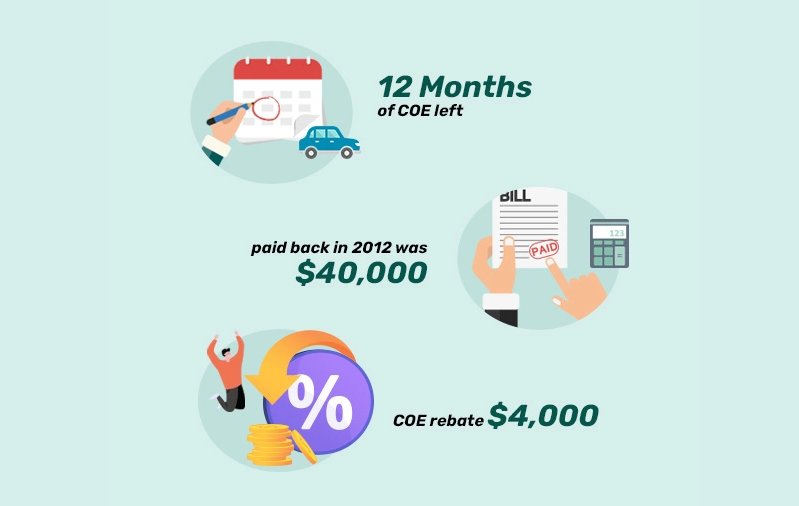
COE rebate diagram

What is my PARF rebate?

Preferential Additional Registration Fee (PARF) rebate is based on the Additional Registration Fee (ARF) value.

Your PARF rebate = [ARF x % based on the age of your car]

ARF is a tax imposed upon the registration of your vehicle, which depends on your car's Open Market Value (OMV). A car's OMV is the original cost of production of the vehicle before surcharges, taxes and the dealer's profit.

Age of vehicle at deregistration
PARF rebate (COE May 2002 onwards)
Not exceeding 5 years
75% of ARF paid
Above 5 years but not exceeding 6 years
70% of ARF paid
Above 6 years but not exceeding 7 years
65% of ARF paid
Above 7 years but not exceeding 8 years
60% of ARF paid
Above 8 years but not exceeding 9 years
55% of ARF paid
Above 9 years but not exceeding 10 years
50% of ARF paid
Above 10 years
N.A

What happens after I renew my COE?

Your PARF car becomes a COE car. PARF cars have both PARF and COE rebates, while COE cars only have COE rebates. That's because all PARF rebates are forfeited upon COE renewal.

Thus, bear in mind that when you deregister your COE car in the future, you will only receive COE rebates.

High and low COE prices, what does that mean for COE renewal?

Rising COE prices means that you need to pay a higher PQP for COE renewal, vice versa. It's best to plan ahead for COE renewal, so you can make a financially informed choice after weighing the pros and cons of keeping your car.

Why is COE renewal important?

Certificate of Entitlement (COE) renewal ensures that you can continue driving your trusty old car. Otherwise, once your COE expires, you need to deregister your car.
Understanding OMV, PARF and COE rebates for your car >
When should you renew your COE and how do you go about doing it?
Renewing your COE means you forfeit any unused portion of your current COE. Keep a look out
for low PQPs and renew your COE online.

COE Renewal: When and How

When do I need to renew my COE?

You are given up till one month after your expiry date to renew your COE. Until your COE is renewed, you will not be able to drive your vehicle.
Vehicle Type
Late Payment Fee
Motorcycle
$50
Private motor car (1,000cc and below)
$50
Private motor car (1,001cc to 1,600cc)
$100
Private motor car (1,601cc to 2,000cc
$150
Private motor car (2,001cc to 3,000cc)
$200
Private motor car (more than 3,000cc)
$250
Business service passenger vehicle
(company car)
$250
Goods vehicle and public service vehicle
$250
Others
$250

How do I renew my COE?

Online via the One Motoring website:
• You will need to have an internet banking account with either DBS/POSB, UOB, Citibank, Standard Chartered, OCBC.

• Ensure that you increase your daily limit and have sufficient funds in your bank account
A simple guide to COE renewal: How & when should you renew >
COE Renewal: How much does it cost?
There are five factors to consider when you renew your COE - PQP, forfeiting PARF and COE rebates, road tax, insurance, vehicle maintenance . If your vehicle is in good condition, it’s definitely more cost effective than buying a brand new car.

What costs to expect when you renew your COE

1. Prevailing Quota Premium (PQP)

To renew your COE, you will need to pay the PQP to extend the ‘life’ of your car. The cost of the premium varies according to the COE prices of the previous three months .

The cost of your PQP also depends on how long you intend to renew your COE for. Premiums for 5 year renewals will be half of 10 year renewals, resulting in lower costs. Consider these questions when you decide on the length of your COE renewal period.

2. Forfeiting PARF and COE rebates

Car owners will receive PARF and COE rebates when a car younger than 10 years old is deregistered. Choosing to keep your car and renewing it’s COE would mean that you forfeit this rebate.

3. Increase on road tax

Your annual road tax will increase yearly by 10% of the car’s regular road tax rate (capped at a maximum of 50%)

4. Limited comprehensive insurance options

Older cars are deemed more problematic by insurers and are mostly offered third party insurance. Comprehensive cover is offered on a case-by-case basis by only a handful of insurers.

5. Vehicle maintenance

A vehicle over 10 years will be increasingly costly to maintain and repair. Send your car for an inspection of your car’s condition to get a gauge on your expected cost of maintaining your vehicle.
COE renewal: What costs can you expect? >
Renewing your COE might come with hidden costs
When you renew your COE, you must be mentally prepared to face mechanical and/or electrical issues every now and then. These issues inadvertently come with age so it’s important to send your car for regular maintenance.

Factors to consider before renewing COE

1. Mileage – A car with lower mileage is likely to have a longer life ahead of it, as compared to a car with higher mileage. The average annual mileage of a passenger car in Singapore is in the region of 17,000km to 18,000km.
2. Drivetrain integrity – Your drivetrain includes highly complex mechanical components like engine and transmission. If your drivetrain is not showing any unusual symptoms, such as abnormal noises being emitted when you are driving, difficulty in starting the car, or even loss of engine power when driving, then your car is in good condition for COE renewal.
3. Pre-existing electrical faults – If your electrical systems are faulty, it will cost more to service it more often than usual. Obvious tell tale signs include charging malfunctions, dimming lights and low system voltage. Etc.
4. Age of Car – Older cars tend to face problems over time, but that’s no surprise. Precautionary measures can be taken to mitigate this.
5. Frequency of maintenance – Cars that have been regularly and properly maintained are in better overall condition. Consider sending your car for regular maintenance so you don’t need to worry about it’s lifespan.
6. Availability of spare/replacement parts – Renewing COE of a common car model means you won’t to worry about the availability of spare and replacement parts if your car needs it in the future.
7. Desirability – Some drivers renew COE with the intention to sell their cars in the long-run. If your car is a desirable model, chances are you can sell it off relatively easy next time as compared to the lesser popular models.
COE renewal: 5 key things to take note of >
Should you opt for a 5 or 10 year COE renewal?
You have to ask yourself a series of questions before you make that financial commitment. Keep it mind that if you renew your COE for 5 years, you will not be able to renew it again once those 5 years are up.

Renew your COE for 5 or 10 years?

When applying for COE renewal, you will have to decide between a 5 or 10 year COE renewal period. Ask yourself these questions to determine which is more suitable for you and your car:

Am I prepared financially

5 year COE premiums are cheaper than 10 year COE premiums by half. Review the financial commitments that you have in your life to make a sound decision.

Your COE renewal repayment period also differs. Ten-year COE renewals can be repaid over seven years, while five-year COE renewals can be repaid across five years.

Do also take into consideration that the road tax surcharge for COE cars with larger engines are more significant.

How long do I intend to drive my car?

If you opt to renew for 5 years, your car MUST be deregistered after 5 years. Its COE cannot be renewed any further.

If you opt to renew for 10 years, you are eligible for unlimited COE renewals thereafter.

Bank COE renewal car loans

Banks offer transparency, decent interest rates and do not charge pricey administrative fees. Bank loans are also tedious to secure because loan eligibility is based on your credit score. Additionally, the process for approval takes a few working days.

Do note that banks don’t do direct COE renewal loan applications. You will need to go through an agent.
Renew your COE for five or ten years? >
COE Renewal loans: Bank or in-house loans?
Paying a lump sum for the PQP upfront isn’t always financially prudent. There are loan options available to you but, which one do you choose?

Taking a loan for COE Renewal

Bank COE renewal car loans

Banks offer transparency, decent interest rates and do not charge pricey administrative fees. Bank loans are also tedious to secure because loan eligibility is based on your credit score. Additionally, the process for approval takes a few working days.

Do note that banks don’t do direct COE renewal loan applications. You will need to go through an agent.

In-house COE renewal car loans

In-house COE renewal loans offer a higher interest rate when compared to banks. It starts at 3% and can go up to 4%, depending on the loan amount and tenure. However, some exceptions include promotional interest rates (as low at 1.88%) and higher administrative fees.

In-house loans are approved faster than bank loans because credit checks are not done. Should credit assessments be done, and you have a poor credit rating, it rarely affects chances of securing your COE renewal loan.
COE renewal - should you choose a bank loan or in-house loan? >

ctaimage

Sgcarmart

Get COE Renewal Advice, Loans & Paperwork

We help you renew your COE and find the best loan rates in Singapore.
  • Complimentary pre-COE inspection
  • Settlement of entire COE renewal paperwork
Get started

COE Renewal Advice

FAQ

What are the main financial considerations?
Can I renew my COE early?
Can I renew my COE myself?
Are there additional fees I should know about when I renew my COE?

Renew your COE with Sgcarmart Connect now and get up to $780 worth of perks! T&Cs apply*