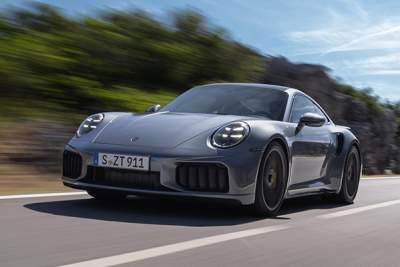
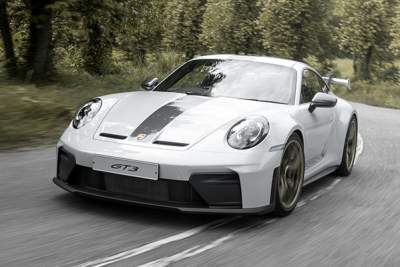
Porsche will be running three prototypes of the Boxster E, which are being used as part of the government-funded “Model Region Electro-Mobility Stuttgart” large-scale trial to study the everyday practicality of all-electric vehicles, and the company released details about the cars at the Michelin Challenge Bibendum event in Germany last weekend. Of the three cars, two are rear-wheel drive and one is all-wheel drive.
The four-wheel-drive model is powered by two independent electric motors that act on the front and rear axles, producing a combined output of 241bhp and a maximum total torque of 540Nm at approximately 12,000 rpm. The rear drive unit includes the motor and transmission, together with the power electronics and is located where the manual gearbox and exhaust system are accommodated in the conventional Boxster, while the front electric motor takes up the space freed up by the gasoline model’s 64-litre fuel tank. An electric unit synchronizes the two electric motors and controls the drive torque distribution to the front and rear axle. Porsche claims that the Boxster E four-wheel-drive is able to go from 0-100km/h in 5.5 seconds and reach a limited top speed of 200km/h.
The two rear-wheel-drive prototypes meanwhile, does away with the electric motor located on the front axle and make do with the rear unit that delivers 121bhp and 270Nm of torque. The RWD Boxster E can dash from a standing start to 100 km/h in 9.8 seconds, and has a top speed of 150km/h.
All of the Boxster E prototypes are equipped with a 29 kWh lithium-iron-phosphate based battery, which takes up the space of the combustion engine and offers a driving range of around 107 kilometres .The battery weighs in at 341kg with the Boxster E tipping the scales at 1,600kg. The battery can be fully recharged through a conventional socket in approximately 9 hours; however, the charging time can be reduced with a rapid charging function.
According to Porsche, despite the electronic components, there’s enough space left for a luggage in the front storage compartment while the rear luggage area of the Boxster E remains unchanged. In addition, both the rear- and four-wheel drive Boxster Es are equipped with an Active Sound Design system to provide drivers with acoustic feedback as well as to alert pedestrians and other road users of the car.
Source: Porsche
The four-wheel-drive model is powered by two independent electric motors that act on the front and rear axles, producing a combined output of 241bhp and a maximum total torque of 540Nm at approximately 12,000 rpm. The rear drive unit includes the motor and transmission, together with the power electronics and is located where the manual gearbox and exhaust system are accommodated in the conventional Boxster, while the front electric motor takes up the space freed up by the gasoline model’s 64-litre fuel tank. An electric unit synchronizes the two electric motors and controls the drive torque distribution to the front and rear axle. Porsche claims that the Boxster E four-wheel-drive is able to go from 0-100km/h in 5.5 seconds and reach a limited top speed of 200km/h.
The two rear-wheel-drive prototypes meanwhile, does away with the electric motor located on the front axle and make do with the rear unit that delivers 121bhp and 270Nm of torque. The RWD Boxster E can dash from a standing start to 100 km/h in 9.8 seconds, and has a top speed of 150km/h.
All of the Boxster E prototypes are equipped with a 29 kWh lithium-iron-phosphate based battery, which takes up the space of the combustion engine and offers a driving range of around 107 kilometres .The battery weighs in at 341kg with the Boxster E tipping the scales at 1,600kg. The battery can be fully recharged through a conventional socket in approximately 9 hours; however, the charging time can be reduced with a rapid charging function.
According to Porsche, despite the electronic components, there’s enough space left for a luggage in the front storage compartment while the rear luggage area of the Boxster E remains unchanged. In addition, both the rear- and four-wheel drive Boxster Es are equipped with an Active Sound Design system to provide drivers with acoustic feedback as well as to alert pedestrians and other road users of the car.
Source: Porsche