Short for 'Maserati Corse', the 'MC' prefix is associated with Maserati's sporting models. Long-time fans might recall the GranSport MC Victory, which was produced in a limited run of 180 units to celebrate the occasion of Maserati winning the 2005 FIA GT Manufacturers' Cup (with the MC12 racecar). Most notable for its blue livery both inside and out, the driving feel and aerodynamics were improved over the standard GranSport roadcar, even though the engine remained largely untouched.
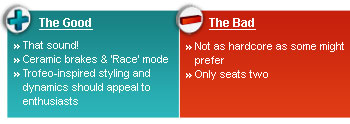
Today's MC Stradale may not be limited in the same sense as the MC Victory's 180 units, but it offers the enthusiast a more comprehensive repertoire over the GranTurismo S than the previous GranSport's 'Rhapsody in Blue' (versus the standard GranSport). With this iteration of a 'MC' car, the list is pretty long: apart from losing the rear seats, slapping-on sexy carbon ceramic brakes, improvements to power, transmission, aerodynamics and the subtle racecar-derived styling, the MC Stradale also adds a quick-access 'Race' button to the centre fascia.
Exterior
1770kg still seems rather hefty, but the benefits of the weight-loss regime from GranTurismo S to MC Stradale are not to be sniffed at and we found the effects of the diet noticeably tangible in terms of outright acceleration and dynamics - this transformation sees 110kg shed from the GranTurismo S' near-1.9-tonnes.
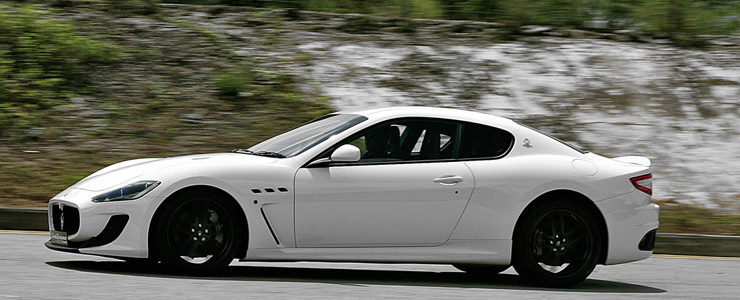
Personally, we love the colour combination on the testcar: a virginal white body with only the most discreet styling matched to a gorgeous blue cabin. Without any external emblems, you need to pick-up on the little details that clue you in to its performance credentials.
Today's MC Stradale may not be limited in the same sense as the MC Victory's 180 units, but it offers the enthusiast a more comprehensive repertoire over the GranTurismo S than the previous GranSport's 'Rhapsody in Blue' (versus the standard GranSport). With this iteration of a 'MC' car, the list is pretty long: apart from losing the rear seats, slapping-on sexy carbon ceramic brakes, improvements to power, transmission, aerodynamics and the subtle racecar-derived styling, the MC Stradale also adds a quick-access 'Race' button to the centre fascia.
Exterior
1770kg still seems rather hefty, but the benefits of the weight-loss regime from GranTurismo S to MC Stradale are not to be sniffed at and we found the effects of the diet noticeably tangible in terms of outright acceleration and dynamics - this transformation sees 110kg shed from the GranTurismo S' near-1.9-tonnes.
Personally, we love the colour combination on the testcar: a virginal white body with only the most discreet styling matched to a gorgeous blue cabin. Without any external emblems, you need to pick-up on the little details that clue you in to its performance credentials.
 |
One of the more distinctive new bits is the 20-inch lightweight wheels, with stylised trident spokes that demonstrate how the devil is in the details - this is the most obvious item we can see owners of the regular GranTurismo variants adopting.
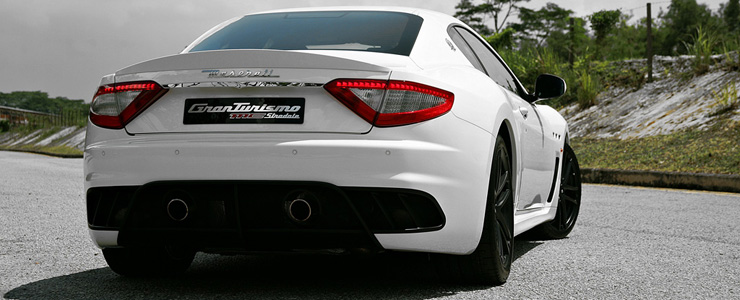
The Pininfarina-penned MC Stradale is derived from the Trofeo racecars and inherits the latter's aero-styling to optimise air-flow, downforce and engine/brake cooling. Although the bonnet-scoop has been left out, the MC Stradale features two nondescript bonnet outlets, which help expel hot air from the engine. Behind, a new lower diffuser positions the tailpipes closer to the middle of the car, while a ducktail spoiler on the bootlid helps generate high-speed downforce.
 |
Interior
Although we didn't miss the rear seats on the MC Stradale, we're pretty sure some will, since the car's long 2900mm wheelbase makes the GranTurismo a convincing and comfortable 2+2 in its class. The cabin of the test car is resplendent in soft blue Alcantara and leather, while the half rollcage is finished in a less conspicuous black.
Elsewhere inside, you get the token carbonfibre panels and sports pedals to complete the experience. Engage 'Race' mode and the display also lights up with an illuminated 'MC-R' icon - just in case you weren't sure!
Some people quickly assume that sports-seats have to be uncomfortable, but the carbonfibre reclining seats (blue with contrasting white stitching) in the MC Stradale are a treat to sit in, even for this author's amply padded figure. Covering almost 100km during our time with the car, the seats held us snugly in place (with help from the four-point racing harness) during lateral cornering loads, yet provided strong support on the highways.
Instead of the snazzy starter button that so many brands now employ, the MC Stradale is awoken by a simple turn of the key (blue again, of course!).
Although we didn't miss the rear seats on the MC Stradale, we're pretty sure some will, since the car's long 2900mm wheelbase makes the GranTurismo a convincing and comfortable 2+2 in its class. The cabin of the test car is resplendent in soft blue Alcantara and leather, while the half rollcage is finished in a less conspicuous black.
Elsewhere inside, you get the token carbonfibre panels and sports pedals to complete the experience. Engage 'Race' mode and the display also lights up with an illuminated 'MC-R' icon - just in case you weren't sure!
Some people quickly assume that sports-seats have to be uncomfortable, but the carbonfibre reclining seats (blue with contrasting white stitching) in the MC Stradale are a treat to sit in, even for this author's amply padded figure. Covering almost 100km during our time with the car, the seats held us snugly in place (with help from the four-point racing harness) during lateral cornering loads, yet provided strong support on the highways.
Instead of the snazzy starter button that so many brands now employ, the MC Stradale is awoken by a simple turn of the key (blue again, of course!).
The Drive
The V8 starts to life with a hearty, off-beat burble before settling into a sedate idle. The engine in the GranTurismo S has always had a charismatic note, with excellent sound-tuning from idle to redline, but this iteration sounds even meaner. With the bypass valve disengaged throughout the rev-band in 'Race' (like the regular car, in 'Sport', the exhaust valve only opens above 4000rpm), the idle note deepens and takes on an ominous rumble.
Revving it at idle provokes an angry bark from the lightened rear silencers that snorts and snuffles like a grumpy bull terrier on the overruns. On the fly, the car even drops a gear when switching to 'Race' from 'Sport', complete with an accompanying throttle 'blip' to warn other motorists it's planning on going bananas - this was pretty addictive fun in the various tunnels around Singapore.
'Race' mode also sharpens throttle response, adopts a higher threshold for the stability programme and most importantly, quickens shift-speeds to 0.06 seconds (versus 0.1 seconds in 'Sport' and 0.24 seconds in 'Auto'). Instead of going down the route of double-clutch transmissions, the cambiocorsa (electro-actuated automated manual, like the R8's R tronic) still sees active duty in the MC Stradale.
The V8 starts to life with a hearty, off-beat burble before settling into a sedate idle. The engine in the GranTurismo S has always had a charismatic note, with excellent sound-tuning from idle to redline, but this iteration sounds even meaner. With the bypass valve disengaged throughout the rev-band in 'Race' (like the regular car, in 'Sport', the exhaust valve only opens above 4000rpm), the idle note deepens and takes on an ominous rumble.
Revving it at idle provokes an angry bark from the lightened rear silencers that snorts and snuffles like a grumpy bull terrier on the overruns. On the fly, the car even drops a gear when switching to 'Race' from 'Sport', complete with an accompanying throttle 'blip' to warn other motorists it's planning on going bananas - this was pretty addictive fun in the various tunnels around Singapore.
'Race' mode also sharpens throttle response, adopts a higher threshold for the stability programme and most importantly, quickens shift-speeds to 0.06 seconds (versus 0.1 seconds in 'Sport' and 0.24 seconds in 'Auto'). Instead of going down the route of double-clutch transmissions, the cambiocorsa (electro-actuated automated manual, like the R8's R tronic) still sees active duty in the MC Stradale.
 |
To put its shift-speed into perspective, the MC Stradale's shift-speed in 'Race' is identical to the shift-speed of the Ferrari F430 Scuderia, not that the F430 Scuderia should be regarded as a benchmark for the MC Stradale, since the two cars are fundamentally different on so many levels. Unlike double-clutched systems that don't really require the driver to ease-off the throttle, we found that timed properly, light lifts resulted in smoother progress, which gives you a nice rush of satisfaction when you get it right, as opposed to letting a computer do everything.
An additional element to the gearbox is its ability to downshift sequentially: as you approach a low-speed corner, pull on the '-/down' gear paddle and hold it towards you (instead of manually flapping it to downshift) while you're hard on the brakes to have the transmission sequentially drop-down the desired number of gears, e.g. from 6th to 3rd gear. In 3rd, release the paddle, get off the brakes, back on the gas and away you go.
The 4.7-litre V8 has been further tweaked to deliver 450bhp and 510Nm, up 10bhp and 20Nm from the GranTurismo S. With their race experience, Maserati engineers have also redesigned the oil sump's fluid dynamics and applied DLC (Diamond-Like Coating) to the tappets and camshaft lobes to reduce friction for better engine efficiency.
Pedal-to-metal, the MC Stradale is fast but ultimately not as quick as it sounds, due largely to the weight it carries. The MC Stradale proceeds at a pace that is deliberate rather than frantic and frenetic. The standing 100km/h dash is now dispatched in 4.6 seconds with top speed rated at 301km/h.
Apart from when we were cruising the highways in 'Sport', the car was left in 'Race' for the most part. 'Auto' is fine if you're really feeling lazy, but the slow 0.24 seconds shift-speeds (full automatic mode in automated manuals never seem to offer smooth and fast shifts), coupled to the compulsive urge to work the engine just to hear the epic exhaust note meant the gearbox saw more service in the two dynamic modes.
An additional element to the gearbox is its ability to downshift sequentially: as you approach a low-speed corner, pull on the '-/down' gear paddle and hold it towards you (instead of manually flapping it to downshift) while you're hard on the brakes to have the transmission sequentially drop-down the desired number of gears, e.g. from 6th to 3rd gear. In 3rd, release the paddle, get off the brakes, back on the gas and away you go.
The 4.7-litre V8 has been further tweaked to deliver 450bhp and 510Nm, up 10bhp and 20Nm from the GranTurismo S. With their race experience, Maserati engineers have also redesigned the oil sump's fluid dynamics and applied DLC (Diamond-Like Coating) to the tappets and camshaft lobes to reduce friction for better engine efficiency.
Pedal-to-metal, the MC Stradale is fast but ultimately not as quick as it sounds, due largely to the weight it carries. The MC Stradale proceeds at a pace that is deliberate rather than frantic and frenetic. The standing 100km/h dash is now dispatched in 4.6 seconds with top speed rated at 301km/h.
Apart from when we were cruising the highways in 'Sport', the car was left in 'Race' for the most part. 'Auto' is fine if you're really feeling lazy, but the slow 0.24 seconds shift-speeds (full automatic mode in automated manuals never seem to offer smooth and fast shifts), coupled to the compulsive urge to work the engine just to hear the epic exhaust note meant the gearbox saw more service in the two dynamic modes.
The ride is hard but never harsh nor jiggly, even on the 20-inch low profile Pirelli rubber. During our time with the car in the dry, the grip offered by the near-new tyres proved to be phenomenal. Breaking traction in 'Race' even with the stability programme off requires conviction, but the car's inherently long wheelbase always means that any sideways action is progressive and can easily be reined-in without any "OMG OMG OMG!" dramatics. At 110kilos down, the MC Stradale feels more agile and light-on-its-feet than the regular car; however, the steering doesn't quite have that keen-edged scalpel-incisiveness we'd prefer, but is nevertheless perfectly suited for its purpose.
The mere mention of 'CCB' (get your mind out of the gutter, we're talking about carbon ceramic brakes) tends to get a lot of people hot under the collar, but not all systems are created equal. Sure, they offer fade-free braking and are lighter than their cast iron counterparts, but the pedal-feel can vary a great deal, even for models under the same brand-fold. After sufficient warm-up, we found that the 'stop' pedal on the MC Stradale offered sufficient feel for modulation during hard runs and abrupt decelerations.
Conclusion
A lot more weight could have been shed by removing the plush carpeting at the back and the other concessions to comfort, but that isn't really the point of the car. We reckon that the MC Stradale will appeal to the owner who enjoys the emotional kick of having the visual trappings of motorsports in an exotic shape, yet doesn't want to put up with the discomfort typically associated with such machines.
There might be faster cars out there, but sometimes, it's less about how quickly you get somewhere, but more about how you get there. If the term 'gentleman racecar' wasn't such an oxymoron, we'd gladly use it on the MC Stradale.
What do you think? Jot down your opinions at the comment box below.
The mere mention of 'CCB' (get your mind out of the gutter, we're talking about carbon ceramic brakes) tends to get a lot of people hot under the collar, but not all systems are created equal. Sure, they offer fade-free braking and are lighter than their cast iron counterparts, but the pedal-feel can vary a great deal, even for models under the same brand-fold. After sufficient warm-up, we found that the 'stop' pedal on the MC Stradale offered sufficient feel for modulation during hard runs and abrupt decelerations.
Conclusion
A lot more weight could have been shed by removing the plush carpeting at the back and the other concessions to comfort, but that isn't really the point of the car. We reckon that the MC Stradale will appeal to the owner who enjoys the emotional kick of having the visual trappings of motorsports in an exotic shape, yet doesn't want to put up with the discomfort typically associated with such machines.
There might be faster cars out there, but sometimes, it's less about how quickly you get somewhere, but more about how you get there. If the term 'gentleman racecar' wasn't such an oxymoron, we'd gladly use it on the MC Stradale.
What do you think? Jot down your opinions at the comment box below.