View page in desktop
|
Report error
  •   Apple app store icon
  • Google play store icon
Terms of Service
|
Privacy Policy
|
PDPA
|
Site Map
©2004-2026 Sgcarmart, Singapore. All rights reserved.
  • Home
  • Car Articles
  • news
  • news Listings
  • Audi News
  • Audi Q7 gets facelifted

    16 Apr 2009

    |

    4,513 views

    Audi's new Q7 features better fuel economy and updated aesthetics, and continues to target sporty, business individuals.


    Three years ago, the Audi Q7 achieved the position of a sporty, comfortable, and high-performance recreational and business vehicle on a grand scale.

    Now Audi is making it even better - more elegant and more efficient, with lower emissions: the Q7 3.0 TDI consumes only 9.1 litres per 100 kilometers (10.98 km/l). And now it's also available in a new version as a TDI clean diesel, with the world's cleanest diesel technology and even lower fuel consumption of only 8.9 litres/100 km (11.23 km/l).

    With the new Q7, Audi continues to target sporty individualists, or more specifically, people who are seeking a vehicle that will take them anywhere they want to go for sports, recreation, and business.
    The design: The language of dynamics

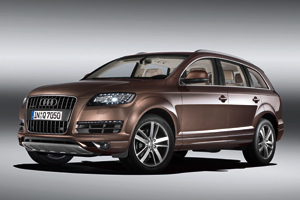
    At the front end, the large single-frame radiator grille has been redesigned. Vertical chrome bars contrast with its black high-gloss finish. The bumpers have also been restyled. Their lower section is now painted in a contrasting black or gray, depending on the body color. The newly integrated underbody protection in the center section of the bumper has a distinctive ribbed design.

    As alternatives to the standard halogen headlights, Audi offers a xenon plus variant and a new adaptive-light system that integrates not only low-beam, high-beam and a special superhighway beam but also turning and cornering lights.

    In conjunction with the xenon headlights, light-emitting diodes assembled to form U-shaped bands provide the daytime running lights. The front blinkers are also composed of LEDs as straight-line arrays, located at the upper edge of the air intakes.

    The side view too, with its coupe-like roofline, low window area and tautly curved body surfaces, reinforces the dynamic look of the Q7.The lightweight alloy wheels are sized 7.5 J x 18-inch 235/60. The V6 vehicles feature seven-spoke rims while the V8 versions have six.

    At the rear end, the bumper has also been given two-tone paintwork; the tailgate, which includes a portion of the rear pillars in an S-shaped contour, has been given a new and distinctively 3D shape in the vicinity of the license plate bracket. To reduce the weight of the Q7, the tailgate has been made of aluminium, as have the engine hood and the fenders. Standard LEDs in the tail lights create a distinctive lighting pattern.
    The interior: Room to spare

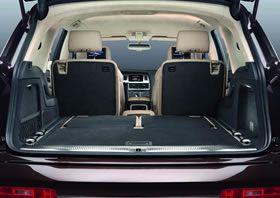
    Thanks to its luxurious 300-centimetre wheelbase within an overall length of 5.09 metres, the Audi Q7 has interior room to spare, and the interior flexibility is unrivalled. The seatbacks in the second row are divided into three fold-down sections to provide a level cargo floor, increasing the luggage space from a volume of 775 litres to 2,035 litres.

    Two very useful features are optionally available: a longitudinally displaceable second seat row or individual comfort seats that are separately displaceable. Another available option is a third row for passengers no taller than 1.60 metres, combined with an improved easy entry function.

    The power train: Performance and efficiency

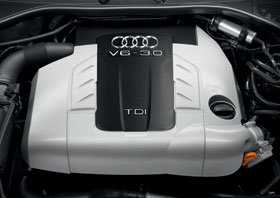
    The Audi Q7 is available with six powerful and highly efficient direct injection engines - two petrol-powered and four diesel engines, including the world's most powerful diesel SUV, the Audi Q7 V12 TDI.

    Their power is transmitted via a convenient and fast-shifting six-speed Tiptronic to the quattro permanent all-wheel drive, which distributes it between the axles with slightly more than half to the rear.

    The 3.0 TDI puts out 240 bhp and now delivers 550 Nm between 2,000 and 2,250 rpm, yet on the EU cycle it consumes only 9.1 litres / 100 km. The optionally available 3.0 TDI clean diesel consumes 0.2 litres less.

    The technology of the TDI clean diesel is highly complex. An advanced version of the common rail injection system with 2,000 bars of pressure, new combustion chamber sensors and a high-performance exhaust recirculating system ensure a highly efficient combustion process.

    An innovative DeNOx catalytic converter reduces the remaining nitrogen oxides. Just upstream of it, a pump injects an additive named AdBlue into the hot exhaust flow, where this solution decomposes into ammonia, which splits the nitrogen oxides into harmless nitrogen and water. Audi partners replenish the additive during regular maintenance servicing.

    In the Q7 4.2 TDI, power remains the same but the fuel consumption has been drastically reduced - from 11.1 to 9.9 litres per 100 km. The 4.2-litre diesel still produces 340 bhp and a torque of 760 Nm is available in the range from 1,750 to 3,000 rpm.

    The 3.6 FSI, a V6 with a small cylinder angle, has a power output of 280 bhp and delivers 360 Nm between 2,500 and 5,000 rpm, consuming an average of 12.1 litres per 100 km. The 4.2 FSI, a V8, delivers 350 bhp and 440 Nm at 3,500 rpm, and consumes 12.7 litres/100 km.

    A novel technology from the Modular Efficiency Platform further improves fuel efficiency in all the engines: the recovery system, which during braking and coasting phases converts mechanical energy into electric energy and buffer-stores it in the battery, reducing CO2 emissions by up to 5 g/km (8.05 g/mile).

    The chassis: Safe and sporty

    As a customer option, Audi equips the Q7 with adaptive air suspension - a pneumatic suspension system that operates in conjunction with an electronic shock absorber control, varies the ground clearance at five different levels, and lets the driver select three driving modes: comfort, automatic and dynamic.

    The choice of wheels ranges from 18 inches to the top-of-the-line 10 J x 21 with 295/35 tyres. Ten different designs are available, including two very elegant, high-luster, bi-colour versions.

    Optionally available in the eight-cylinder models are carbon-fiber ceramic disc brakes which further enhance the dynamic character of this performance SUV: they are lighter than their steel equivalents, extremely abrasion-resistant and virtually fading-free.

    They achieve high driving performance and ensure short braking distances. The diameters of the ceramic discs are 420 millimeters in front and 370 millimeters at the rear. The calipers are black and adorned with the wording "Audi ceramic". A total of 24 pistons are used.
    The equipment: Luxury and high-tech

    The Q7 comes with a splendid range of standard equipment. The speed-dependent servotronic steering system is standard, as is a double floor in the cargo area complete with a storage compartment and a dirt tray; there is also a roof rack, an automatic air conditioning system, and an MMI radio operating system complete with a CD audio player and eight loudspeakers.

    The option program includes luxury features such as the remote key and four-zone automatic air conditioning. Another high-end option is the climate-controlled comfort seat, which can keep the body warm or cool it by means of small fans.

    Particularly dynamic Q7 drivers may wish to consider one of two other quality option packages. The S line exterior package enhances the styling with details such as distinctive bumpers and a solid paint finish.

    The S line sports package includes a black interior, sport seats with Alcantara leather or Verano leather upholstery, aluminium trim (optionally in piano lacquer finish or birch grain wood), special exterior colors, 20-inch wheels, and a firmer setup for the steel spring suspension or the adaptive air suspension.

    In the infotainment field, Audi provides a carefully differentiated selection of modules. The three optional systems are part of the new generation of Audi devices. The top-of-the-line version integrates a hard drive for navigation, music and telephone data, a high-resolution color monitor and 3D map graphics, a DVD player as well as voice control.

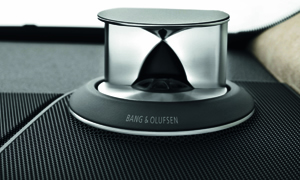
    It can be expanded into a luxury media centre with features such as a Bluetooth telephone, a TV tuner, a digital radio tuner, plus rear seat entertainment. A very special highlight is the advanced sound system from Bang & Olufsen with its ten channels, 505 watts of power and 14 loudspeakers.

    The range of optional equipment is rounded off by technologies from the luxury class. The radar-supported adaptive cruise control regulates the speed and the distance to the preceding vehicle in a range from 30 to 200 km/h by acceleration and deceleration. If a threat is detected, the integrated Audi braking guard warns the driver at two levels.

    From a speed of 60 km/h, Audi lane assist helps the driver stay in lane by means of a camera that recognizes the lane lines. Audi side assist ensures safe lane changes above 30 km/h with the aid of a radar system that monitors the traffic pattern within 70 metres behind the vehicle. Finally, the Audi parking system advanced assists parking by means of a rearview camera and reference lines on the onboard monitor.

    24.4k

    Tags

    audi audi q7 audi ag suv high performance suv audi q7 v12 tdi q7 v12 tdi new q7 new audi german cars

    AllReviewsNewsAdviceFeaturesVideos
    • Home
    • Car Articles
    • news
    • news Listings
    • Audi News

    Audi Q7 gets facelifted

    16 Apr 2009

    |

    4,513 views

    Audi's new Q7 features better fuel economy and updated aesthetics, and continues to target sporty, business individuals.


    Three years ago, the Audi Q7 achieved the position of a sporty, comfortable, and high-performance recreational and business vehicle on a grand scale.

    Now Audi is making it even better - more elegant and more efficient, with lower emissions: the Q7 3.0 TDI consumes only 9.1 litres per 100 kilometers (10.98 km/l). And now it's also available in a new version as a TDI clean diesel, with the world's cleanest diesel technology and even lower fuel consumption of only 8.9 litres/100 km (11.23 km/l).

    With the new Q7, Audi continues to target sporty individualists, or more specifically, people who are seeking a vehicle that will take them anywhere they want to go for sports, recreation, and business.

    The design: The language of dynamics

    At the front end, the large single-frame radiator grille has been redesigned. Vertical chrome bars contrast with its black high-gloss finish. The bumpers have also been restyled. Their lower section is now painted in a contrasting black or gray, depending on the body color. The newly integrated underbody protection in the center section of the bumper has a distinctive ribbed design.

    As alternatives to the standard halogen headlights, Audi offers a xenon plus variant and a new adaptive-light system that integrates not only low-beam, high-beam and a special superhighway beam but also turning and cornering lights.

    In conjunction with the xenon headlights, light-emitting diodes assembled to form U-shaped bands provide the daytime running lights. The front blinkers are also composed of LEDs as straight-line arrays, located at the upper edge of the air intakes.

    The side view too, with its coupe-like roofline, low window area and tautly curved body surfaces, reinforces the dynamic look of the Q7.The lightweight alloy wheels are sized 7.5 J x 18-inch 235/60. The V6 vehicles feature seven-spoke rims while the V8 versions have six.

    At the rear end, the bumper has also been given two-tone paintwork; the tailgate, which includes a portion of the rear pillars in an S-shaped contour, has been given a new and distinctively 3D shape in the vicinity of the license plate bracket. To reduce the weight of the Q7, the tailgate has been made of aluminium, as have the engine hood and the fenders. Standard LEDs in the tail lights create a distinctive lighting pattern.

    The interior: Room to spare

    Thanks to its luxurious 300-centimetre wheelbase within an overall length of 5.09 metres, the Audi Q7 has interior room to spare, and the interior flexibility is unrivalled. The seatbacks in the second row are divided into three fold-down sections to provide a level cargo floor, increasing the luggage space from a volume of 775 litres to 2,035 litres.

    Two very useful features are optionally available: a longitudinally displaceable second seat row or individual comfort seats that are separately displaceable. Another available option is a third row for passengers no taller than 1.60 metres, combined with an improved easy entry function.


    The power train: Performance and efficiency

    The Audi Q7 is available with six powerful and highly efficient direct injection engines - two petrol-powered and four diesel engines, including the world's most powerful diesel SUV, the Audi Q7 V12 TDI.

    Their power is transmitted via a convenient and fast-shifting six-speed Tiptronic to the quattro permanent all-wheel drive, which distributes it between the axles with slightly more than half to the rear.

    The 3.0 TDI puts out 240 bhp and now delivers 550 Nm between 2,000 and 2,250 rpm, yet on the EU cycle it consumes only 9.1 litres / 100 km. The optionally available 3.0 TDI clean diesel consumes 0.2 litres less.

    The technology of the TDI clean diesel is highly complex. An advanced version of the common rail injection system with 2,000 bars of pressure, new combustion chamber sensors and a high-performance exhaust recirculating system ensure a highly efficient combustion process.

    An innovative DeNOx catalytic converter reduces the remaining nitrogen oxides. Just upstream of it, a pump injects an additive named AdBlue into the hot exhaust flow, where this solution decomposes into ammonia, which splits the nitrogen oxides into harmless nitrogen and water. Audi partners replenish the additive during regular maintenance servicing.

    In the Q7 4.2 TDI, power remains the same but the fuel consumption has been drastically reduced - from 11.1 to 9.9 litres per 100 km. The 4.2-litre diesel still produces 340 bhp and a torque of 760 Nm is available in the range from 1,750 to 3,000 rpm.

    The 3.6 FSI, a V6 with a small cylinder angle, has a power output of 280 bhp and delivers 360 Nm between 2,500 and 5,000 rpm, consuming an average of 12.1 litres per 100 km. The 4.2 FSI, a V8, delivers 350 bhp and 440 Nm at 3,500 rpm, and consumes 12.7 litres/100 km.

    A novel technology from the Modular Efficiency Platform further improves fuel efficiency in all the engines: the recovery system, which during braking and coasting phases converts mechanical energy into electric energy and buffer-stores it in the battery, reducing CO2 emissions by up to 5 g/km (8.05 g/mile).

    The chassis: Safe and sporty

    As a customer option, Audi equips the Q7 with adaptive air suspension - a pneumatic suspension system that operates in conjunction with an electronic shock absorber control, varies the ground clearance at five different levels, and lets the driver select three driving modes: comfort, automatic and dynamic.

    The choice of wheels ranges from 18 inches to the top-of-the-line 10 J x 21 with 295/35 tyres. Ten different designs are available, including two very elegant, high-luster, bi-colour versions.

    Optionally available in the eight-cylinder models are carbon-fiber ceramic disc brakes which further enhance the dynamic character of this performance SUV: they are lighter than their steel equivalents, extremely abrasion-resistant and virtually fading-free.

    They achieve high driving performance and ensure short braking distances. The diameters of the ceramic discs are 420 millimeters in front and 370 millimeters at the rear. The calipers are black and adorned with the wording "Audi ceramic". A total of 24 pistons are used.

    The equipment: Luxury and high-tech

    The Q7 comes with a splendid range of standard equipment. The speed-dependent servotronic steering system is standard, as is a double floor in the cargo area complete with a storage compartment and a dirt tray; there is also a roof rack, an automatic air conditioning system, and an MMI radio operating system complete with a CD audio player and eight loudspeakers.

    The option program includes luxury features such as the remote key and four-zone automatic air conditioning. Another high-end option is the climate-controlled comfort seat, which can keep the body warm or cool it by means of small fans.

    Particularly dynamic Q7 drivers may wish to consider one of two other quality option packages. The S line exterior package enhances the styling with details such as distinctive bumpers and a solid paint finish.

    The S line sports package includes a black interior, sport seats with Alcantara leather or Verano leather upholstery, aluminium trim (optionally in piano lacquer finish or birch grain wood), special exterior colors, 20-inch wheels, and a firmer setup for the steel spring suspension or the adaptive air suspension.

    In the infotainment field, Audi provides a carefully differentiated selection of modules. The three optional systems are part of the new generation of Audi devices. The top-of-the-line version integrates a hard drive for navigation, music and telephone data, a high-resolution color monitor and 3D map graphics, a DVD player as well as voice control.

    It can be expanded into a luxury media centre with features such as a Bluetooth telephone, a TV tuner, a digital radio tuner, plus rear seat entertainment. A very special highlight is the advanced sound system from Bang & Olufsen with its ten channels, 505 watts of power and 14 loudspeakers.

    The range of optional equipment is rounded off by technologies from the luxury class. The radar-supported adaptive cruise control regulates the speed and the distance to the preceding vehicle in a range from 30 to 200 km/h by acceleration and deceleration. If a threat is detected, the integrated Audi braking guard warns the driver at two levels.

    From a speed of 60 km/h, Audi lane assist helps the driver stay in lane by means of a camera that recognizes the lane lines. Audi side assist ensures safe lane changes above 30 km/h with the aid of a radar system that monitors the traffic pattern within 70 metres behind the vehicle. Finally, the Audi parking system advanced assists parking by means of a rearview camera and reference lines on the onboard monitor.
    24.4k

    Tags

    audi audi q7 audi ag suv high performance suv audi q7 v12 tdi q7 v12 tdi new q7 new audi german cars

    Newsletter

    Be Notified On The Latest News

    Newsletter

    Be Notified On The Latest News

    Latest COE Prices

    September 2026 | 2nd BIDDING
    NEXT TENDER: 07 Oct 2026
    CAT A
    $131,890
    CAT B
    $133,000
    CAT C
    $92,144
    CAT E
    $137,000
    View Full Results

    Latest COE Prices

    September 2026 | 2nd BIDDING
    NEXT TENDER: 07 Oct 2026
    CAT A
    $131,890
    CAT B
    $133,000
    CAT C
    $92,144
    CAT E
    $137,000
    View Full Results

    Related Articles

    Zeekr 9X First Drive Review

    Zeekr 9X First Drive Review

    Ferrari Amalfi First Drive Review

    Ferrari Amalfi First Drive Review

    New cars are safer: Opt for one when you can

    New cars are safer: Opt for one when you can

    EV NEXT: Peace of mind with battery SOH certification

    EV NEXT: Peace of mind with battery SOH certification

    LTA sets up poll to decide the least-ugliest EV plate

    LTA sets up poll to decide the least-ugliest EV plate

    Multi-Pathway approach: Toyota was always right

    Multi-Pathway approach: Toyota was always right

    Is parallel import hesitancy growing among car buyers?

    Is parallel import hesitancy growing among car buyers?

    Don't get yourself trapped in your high-tech EV

    Don't get yourself trapped in your high-tech EV

    Related Articles

    Zeekr 9X First Drive Review

    Zeekr 9X First Drive Review

    Ferrari Amalfi First Drive Review

    Ferrari Amalfi First Drive Review

    New cars are safer: Opt for one when you can

    New cars are safer: Opt for one when you can

    EV NEXT: Peace of mind with battery SOH certification

    EV NEXT: Peace of mind with battery SOH certification

    LTA sets up poll to decide the least-ugliest EV plate

    LTA sets up poll to decide the least-ugliest EV plate

    Multi-Pathway approach: Toyota was always right

    Multi-Pathway approach: Toyota was always right

    Is parallel import hesitancy growing among car buyers?

    Is parallel import hesitancy growing among car buyers?

    Don't get yourself trapped in your high-tech EV

    Don't get yourself trapped in your high-tech EV

    You May Also Like

    LTA sets up poll to decide the least-ugliest EV plate

    LTA sets up poll to decide the least-ugliest EV plate

    New cars are safer: Opt for one when you can

    New cars are safer: Opt for one when you can

    EV NEXT: Peace of mind with battery SOH certification

    EV NEXT: Peace of mind with battery SOH certification

    Multi-Pathway approach: Toyota was always right

    Multi-Pathway approach: Toyota was always right

    Sgcarmart Explores: Bras Basah!

    Sgcarmart Explores: Bras Basah!

    Don't get yourself trapped in your high-tech EV

    Don't get yourself trapped in your high-tech EV

    Big Test: Which brand makes the best hybrid?

    Big Test: Which brand makes the best hybrid?

    Is parallel import hesitancy growing among car buyers?

    Is parallel import hesitancy growing among car buyers?

    The rise of PHEVs: A closer look at the numbers

    The rise of PHEVs: A closer look at the numbers

    iCaur V23 100kW Review

    iCaur V23 100kW Review

    A first look at Chery's iCaur V23 and Jaecoo J8 in Singapore

    A first look at Chery's iCaur V23 and Jaecoo J8 in Singapore

    Hongqi Singapore opens its showroom doors

    Hongqi Singapore opens its showroom doors

    Inside Foton's commercial vehicle range in Singapore

    Inside Foton's commercial vehicle range in Singapore

    The BYD Sealion 8 seven-seater SUV arrives in Singapore

    The BYD Sealion 8 seven-seater SUV arrives in Singapore

    Cars of 2026

    Cars of 2026

    The all new XPENG Mona L03 is one smart coupe SUV

    The all new XPENG Mona L03 is one smart coupe SUV

    You May Also Like

    LTA sets up poll to decide the least-ugliest EV plate

    LTA sets up poll to decide the least-ugliest EV plate

    New cars are safer: Opt for one when you can

    New cars are safer: Opt for one when you can

    EV NEXT: Peace of mind with battery SOH certification

    EV NEXT: Peace of mind with battery SOH certification

    Multi-Pathway approach: Toyota was always right

    Multi-Pathway approach: Toyota was always right

    Sgcarmart Explores: Bras Basah!

    Sgcarmart Explores: Bras Basah!

    Don't get yourself trapped in your high-tech EV

    Don't get yourself trapped in your high-tech EV

    Big Test: Which brand makes the best hybrid?

    Big Test: Which brand makes the best hybrid?

    Is parallel import hesitancy growing among car buyers?

    Is parallel import hesitancy growing among car buyers?

    The rise of PHEVs: A closer look at the numbers

    The rise of PHEVs: A closer look at the numbers

    iCaur V23 100kW Review

    iCaur V23 100kW Review

    A first look at Chery's iCaur V23 and Jaecoo J8 in Singapore

    A first look at Chery's iCaur V23 and Jaecoo J8 in Singapore

    Hongqi Singapore opens its showroom doors

    Hongqi Singapore opens its showroom doors

    Inside Foton's commercial vehicle range in Singapore

    Inside Foton's commercial vehicle range in Singapore

    The BYD Sealion 8 seven-seater SUV arrives in Singapore

    The BYD Sealion 8 seven-seater SUV arrives in Singapore

    Cars of 2026

    Cars of 2026

    The all new XPENG Mona L03 is one smart coupe SUV

    The all new XPENG Mona L03 is one smart coupe SUV