Entering the automotive market now is a tough gig, let alone the hot hatch segment. Continental breeds such as Audi, Volkswagen as well as MINI have placed both their feet in the pie and have dominated it for a long time. While the Japanese have done a good job in swaying choices with the Honda Jazz, Swift Sport and Subaru Impreza Hatchback, the Koreans have just merely started on their journey to the hatch (pun totally intended).
Kia launched its Forte Hatchback in the third-quarter of 2011 and while it was a car worthy of its name and price, it didn't fare well amongst the competition due to high COE prices. Now, fellow Korean carmaker, Hyundai, decides it wants a piece of the hatchback pie with its latest offering - Veloster. It was years ago in 2007 when the concept was unveiled at Seoul Motor Show but it wasn't until early January in 2011 when the final production was showcased at Detroit Auto Show.
Exterior
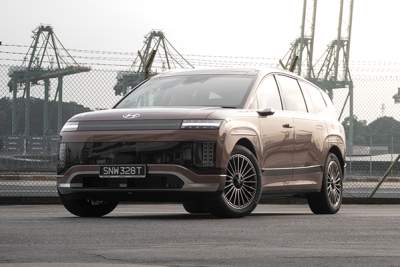
Considering that Hyundai was filling the void left by the Tuscani, the Korean marque did one hell of a job. Its latest attempt to produce a coupe without compromise has proven that the Korean carmaker hasn't lost its design touch yet. Least to say, the Veloster, whether near or far, is a looker.
As it is, the Veloster has a bold-looking fascia that's pulled back tightly with deep sculpted lines and it mimics the rest of the recent models in its stable. Where it doesn't exhibit mimicry is the layout of the rear door. Having similar design as the Nissan Juke where the rear door handle is flushed with its sheet metal, the Veloster sports a single door on the driver's side and a pair of doors on the other to improve access to the back seats. It's probably one of the most innovative designs we've come across in years.
Kia launched its Forte Hatchback in the third-quarter of 2011 and while it was a car worthy of its name and price, it didn't fare well amongst the competition due to high COE prices. Now, fellow Korean carmaker, Hyundai, decides it wants a piece of the hatchback pie with its latest offering - Veloster. It was years ago in 2007 when the concept was unveiled at Seoul Motor Show but it wasn't until early January in 2011 when the final production was showcased at Detroit Auto Show.
Exterior
Considering that Hyundai was filling the void left by the Tuscani, the Korean marque did one hell of a job. Its latest attempt to produce a coupe without compromise has proven that the Korean carmaker hasn't lost its design touch yet. Least to say, the Veloster, whether near or far, is a looker.
As it is, the Veloster has a bold-looking fascia that's pulled back tightly with deep sculpted lines and it mimics the rest of the recent models in its stable. Where it doesn't exhibit mimicry is the layout of the rear door. Having similar design as the Nissan Juke where the rear door handle is flushed with its sheet metal, the Veloster sports a single door on the driver's side and a pair of doors on the other to improve access to the back seats. It's probably one of the most innovative designs we've come across in years.
 |
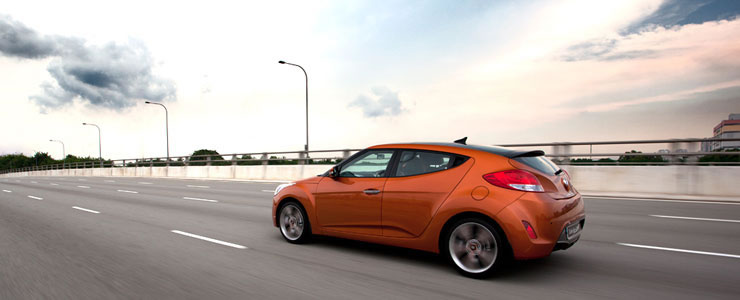
This mutated coupe-hatch also sports a silhouette that could be easily mistaken as the coupe offering from Volkswagen. Where it differentiates itself from its continental competitor is the blacked-out roof and the scalloped portions of the rear fenders which certainly add visual enjoyment to the Korean car.
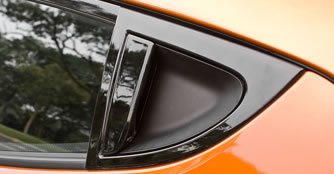 Design of the door handle is similar to Nissan's offering
  |
While this snazzy machine is the ticket for younger generation drivers, the appeal of the car does transcend itself even to the older folks, especially when we had an experience at a car park where five friendly middle-aged folks were intrigued by the design.
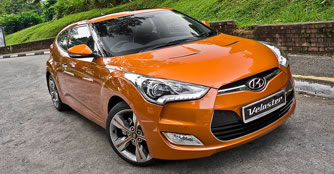 Although targeted at the young, it attracts the old as well
Interior
Not only does the unique three door-layout get the innumerable eyeballs on the road, its form does meet functional needs. Unlike its competitors, the layout makes ingress and egress very easy, especially for rear passengers. The two at the back will enjoy sufficient legroom but taller ones may have trouble with the headroom. Up front, though, the driver and passenger will find themselves having plenty of leg and shoulder room.
Although targeted at the young, it attracts the old as well Interior
Not only does the unique three door-layout get the innumerable eyeballs on the road, its form does meet functional needs. Unlike its competitors, the layout makes ingress and egress very easy, especially for rear passengers. The two at the back will enjoy sufficient legroom but taller ones may have trouble with the headroom. Up front, though, the driver and passenger will find themselves having plenty of leg and shoulder room.
That aside, the Veloster boasts a comfortable cabin. The leather seats are well-bolstered and are capable for offering good support over long hauls. And it certainly doesn't harm with the sunroof that came with the test car. Although it hindered head space for the driver, we couldn't fault the glass roof for an overall airy and fresh ambience.
It's an unfortunate thing, then, when the Korean coupe is filled with plasticky bits that do not feel solid to the touch. Perhaps we expected a tad too much. Given that Hyundai has finally launched something exciting to compete against tough competitors, one would expect better quality materials used. The only consolation for this is that the cabin is well-designed with plenty of useful cubbies and storage.
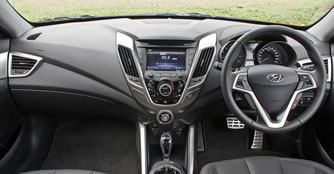 The cabin feels fresh and it is well-designed
It's an unfortunate thing, then, when the Korean coupe is filled with plasticky bits that do not feel solid to the touch. Perhaps we expected a tad too much. Given that Hyundai has finally launched something exciting to compete against tough competitors, one would expect better quality materials used. The only consolation for this is that the cabin is well-designed with plenty of useful cubbies and storage.
The cabin feels fresh and it is well-designed 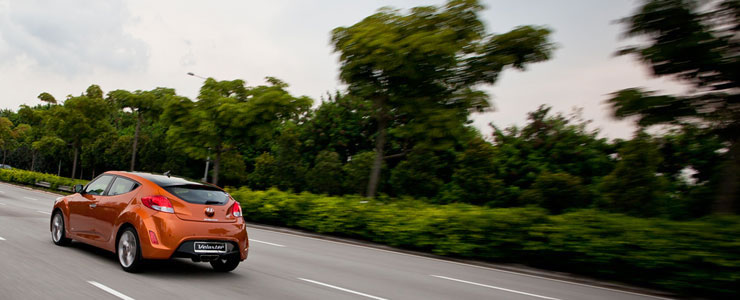 |
The Drive
On the go, the 1.6-litre powerplant shows its enthusiasm around the curves. It has sufficient grip and agility to qualify it as a fun car to throw around. Steering response is relatively accurate but it certainly wouldn't harm with more weight.
It can't, however, be said the same for its overall performance. On the straights, the Veloster will cover the century sprint in a respectable 10.3 seconds but it does feel like the engine has to be worked hard in order to achieve the figure. With a peak output of 140bhp and 167Nm of torque sent to the front wheels, the coupe isn't quite ready to set any lap timings at the moment. What made things worse was the lack of ability to negate the effects of the slightest bumps on the road, sending uncomforted vibrations to the cabin.
On the bright side, gear changes are as smooth as they come, thanks to the fluid dual-clutch gearbox. As a result, the stylish coupe is simple to drive and operate around town. And with its reasonably compact dimensions, zipping in and out of tight spaces is a breeze and a joy to behold.
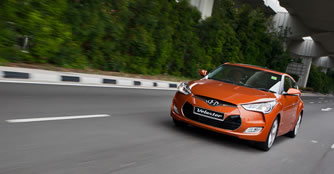 It is around town where the Veloster excels
On the go, the 1.6-litre powerplant shows its enthusiasm around the curves. It has sufficient grip and agility to qualify it as a fun car to throw around. Steering response is relatively accurate but it certainly wouldn't harm with more weight.
It can't, however, be said the same for its overall performance. On the straights, the Veloster will cover the century sprint in a respectable 10.3 seconds but it does feel like the engine has to be worked hard in order to achieve the figure. With a peak output of 140bhp and 167Nm of torque sent to the front wheels, the coupe isn't quite ready to set any lap timings at the moment. What made things worse was the lack of ability to negate the effects of the slightest bumps on the road, sending uncomforted vibrations to the cabin.
On the bright side, gear changes are as smooth as they come, thanks to the fluid dual-clutch gearbox. As a result, the stylish coupe is simple to drive and operate around town. And with its reasonably compact dimensions, zipping in and out of tight spaces is a breeze and a joy to behold.
It is around town where the Veloster excels Conclusion
As the continuing success that Hyundai has experienced over the past few years has been due to its competitive pricing, the Korean marque still needs to work on its performance field.
For the new and young generation of drivers, the Veloster will no doubt fit the bill nicely. But we reckon enthusiasts will want to wait for the turbocharged model to arrive at the end of the year for the extra power.
But for now, the car lacks the oomph that its looks convey.
As the continuing success that Hyundai has experienced over the past few years has been due to its competitive pricing, the Korean marque still needs to work on its performance field.
For the new and young generation of drivers, the Veloster will no doubt fit the bill nicely. But we reckon enthusiasts will want to wait for the turbocharged model to arrive at the end of the year for the extra power.
But for now, the car lacks the oomph that its looks convey.