Root cause behind Downtown Line glitch still unknown
03 Mar 2018|882 views
The root cause of Thursday's full-day glitch on the Downtown Line - Singapore's newest MRT line - remains a mystery. The line was affected by a fault with the signalling system - which determines the safe distance between trains - which lengthened journey times by up to half an hour.
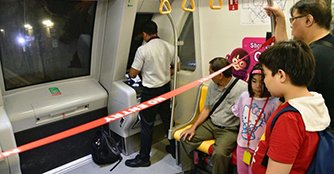
The Land Transport Authority (LTA) and Downtown Line operator SBS Transit said last night 'the fault was traced to a synchronisation issue between two sets of signalling equipment'.
This triggered a speed restriction on trains passing the affected stretch. While the signalling fault has been resolved, LTA was unable to say what caused this glitch in the equipment.
"Siemens will continue its investigations into the root cause of the failed synchronisation of the signalling equipment to prevent a recurrence," they added.
When approached yesterday, German engineering giant Siemens, which supplied the signalling system, said it had already filed its findings to the LTA and added it was for the LTA to release information relating to the incident. Singapore Institute of Technology Assistant Professor Andrew Ng suggested some possibilities for the synchronisation problem.
"Since the signalling fault occurred at Bayfront station - a specific location - the possible causes of the fault might be a wayside communications-based train control equipment failure, a wayside-to-wayside communication failure, or a wayside-to-train communication failure," he said.
Wayside refers to a point along the trackside which a train detects, and determines, among other things, where it should stop at a station platform. Communications-based train control refers to the name of the signalling system. Prof. Ng, however, was also unable to say what the root causes of the failures were.
The root cause of Thursday's full-day glitch on the Downtown Line - Singapore's newest MRT line - remains a mystery. The line was affected by a fault with the signalling system - which determines the safe distance between trains - which lengthened journey times by up to half an hour.
The Land Transport Authority (LTA) and Downtown Line operator SBS Transit said last night 'the fault was traced to a synchronisation issue between two sets of signalling equipment'.
This triggered a speed restriction on trains passing the affected stretch. While the signalling fault has been resolved, LTA was unable to say what caused this glitch in the equipment.
"Siemens will continue its investigations into the root cause of the failed synchronisation of the signalling equipment to prevent a recurrence," they added.
When approached yesterday, German engineering giant Siemens, which supplied the signalling system, said it had already filed its findings to the LTA and added it was for the LTA to release information relating to the incident. Singapore Institute of Technology Assistant Professor Andrew Ng suggested some possibilities for the synchronisation problem.
"Since the signalling fault occurred at Bayfront station - a specific location - the possible causes of the fault might be a wayside communications-based train control equipment failure, a wayside-to-wayside communication failure, or a wayside-to-train communication failure," he said.
Wayside refers to a point along the trackside which a train detects, and determines, among other things, where it should stop at a station platform. Communications-based train control refers to the name of the signalling system. Prof. Ng, however, was also unable to say what the root causes of the failures were.

Latest COE Prices
November 2025 | 2nd BIDDING
NEXT TENDER: 03 Dec 2025
CAT A$109,000
CAT B$129,890
CAT C$76,389
CAT E$125,001
View Full Results Thank You For Your Subscription.